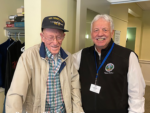
The article “Serving Those Who Served” (BCF Newsletter, November/December 2025) contained a mistaken identity. The gentleman pictured on the left on page 3 (and above) is Mr. Robert Young, a 100-year-old veteran, not Robert Taylor. We apologize for the mistake, and we salute Mr. Young’s service
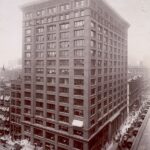
Belmont Farmers Built Chicago Skyscrapers

By Edmund McDevitt In 1831, in the section of Watertown that later became the south part of Belmont, Peter Chardon Brooks was born. The child was to become one of the most important historic figures in the development of the skyscraper. Little is known about his family’s residence in Watertown. Peter Brooks’s grandfather, the original Peter Chardon Brooks (1767–1849), was, at the time of his death, quite possibly the wealthiest man in Boston. His wealth came from a marine insurance business, some of which insured ships involved in the Atlantic slave trade—no surprise, given that the family were slaveholders prior [READ MORE]
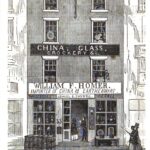
Who Built the Homer House?

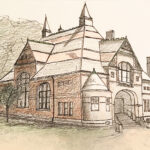
By John Beaty The William Flagg Homer House is a Belmont story with two mysteries. The first mystery is who was the architect who designed and built the Homer House. The second mystery is who William Flagg Homer was and how he provided the resources to acquire the land, hire an architect, and build this magnificent home. The Homer House is listed in the National Register of Historic Places (1979) and has been a focal point in Belmont’s Pleasant Street Historic District. It is especially interesting because the artist Winslow Homer was Flagg Homer’s nephew and often visited during the [READ MORE]
Belmont’s Victory Gardens Remain Vibrant

By Jeffrey North Victory gardening in Belmont has never been more popular (local food production activity during World War II notwithstanding). One of the largest and oldest continuously active community gardens in the Boston area, Belmont’s Rock Meadow Victory Gardens consists of 132 garden plots of varying sizes, typically ranging from 12 by 12 feet to 50 by 50 feet. The gardens cover about three acres of land at the Rock Meadow Conservation Area along Mill Street, between Trapelo Road on the south and Winter Street on the north. After glaciers retreated 10,000 years ago, Native Americans burned the land [READ MORE]
Profile in Belmont: Wendy Murphy

By Elissa Ely “What is that house?” Wendy Murphy thought the first time she saw the mansion at 661 Pleasant Street: elevated, magisterial, remote, uninhabited, yet somehow alive. “Is it haunted?” The William Flagg Homer House is neither inhabited nor haunted, though it is alive with architecture and art. As president of the Belmont Woman’s Club, Wendy became one of its protectors. Her decade-long tenure exceeds term limits, though not for lack of a successor search. “I’m like a general contractor,” she says ruefully, “and the problem with being productive is that no one wants to be that busy.” The [READ MORE]
Native Peoples Lived in Belmont

By Mark Jarzombek It comes as a surprise to people who assume that Boston’s colonization began with the settlement of Boston in 1630 that there was an equally important settlement in Watertown that same year. It was organized by Sir Richard Saltonstall, along with approximately 40 families. Unlike the Bostonians, the group in Watertown consisted of ranchers and farmers living primarily in homesteads spread out over the rapidly deforested landscape. Though Boston takes the glory when it comes to the history of New England, the relationship between a town and its farm and pastureland was critical to the settlers’ success. [READ MORE]
Vision for a Better Belmont: Elizabeth Dionne

This is the first of a new series of interviews with Belmont stakeholders about their vision for Belmont’s future. This interview was conducted by Jeffrey North. It has been edited for length and clarity. – Ed. BCF: Congratulations on your election to the Select Board earlier this year. What have you learned about how Belmont works—either well or not so well? Overall, having served in an official capacity in Belmont for the past seven-and-a-half years (Town Meeting, Warrant Committee, Community Preservation Committee), I am pleasantly surprised that there are not many surprises. While municipal governance can be daunting and sometimes [READ MORE]
Stewards Keep Ogilby Farm Traditions

By Judith Feinleib Henry Ogilby thinks of himself, his siblings, and Mike and Hermik Chase as stewards of the last remaining farmland in Belmont, part of the Richardson Farm Historical District. They are stewards in the classical sense of the term—people whose code of ethics requires them to engage in responsible planning and management of resources. In this case, these resources are the land and houses that have been in the Ogilby family since the 17th century. For the last 11 years, the Chases have cultivated the land of Belmont Acres Farm where they grow and sell vegetables and keep [READ MORE]
Profiles in Belmont: Scott Ferson

By Elissa Ely The start of the pandemic elongated time in lonely and frightening ways. People craved the consolation of community but were prohibited from human contact. Screens were a brilliant technologic substitute, yet just as lonely in their way. Sometime around then, Scott Ferson drew a hopscotch board on the sidewalk in front of his School Street house, and an inspirational message above it. Solitary pedestrians—who were all of us—found it hard to pass without noticing, and maybe without a small involuntary skip between squares. It was a bright bit of humor we could share without knowing one [READ MORE]
Belmont Was a Town of Market Gardens

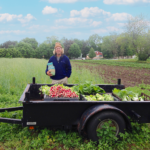
By Jane Sherwin For about a century, areas around Boston that are now suburban housing were in many cases devoted to market gardening. Arlington, Lexington, Belmont, Watertown, Brighton—all grew produce very profitably. A market garden, sometimes known as a truck farm, produces on a small scale a variety of fruits and vegetables for local markets. Around Boston, this intensive form of farming was supported by heated greenhouses. The market gardens were so close to Boston that they had no need to pay railroad charges, using their own trucks and wagons instead. The gardens were profitable, and families could afford the [READ MORE]
Historic Clock Project Seeks Donations

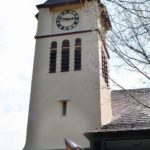
By Michael Flamang The First Church in Belmont Unitarian Universalist is seeking funds and a qualified contractor to restore the historic clock in the church’s tower on the town green to functioning condition. In December, the Community Preservation Committee approved a grant application for the repair funds and included it in the projects to be considered by Town Meeting. (See “CPC Recommends Funds for Seven Projects,” in this issue.) There is a great deal of precedent in our area for cities and towns successfully using Commonwealth-designated Community Preservation Act (CPA) funds to implement this type of project in religious buildings. [READ MORE]
Belmont Once Had a Cooperative Market

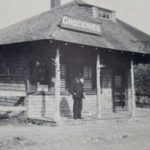
By Jane Sherwin Many people are aware that Belmont was a town of farms until the mid-twentieth century, but fewer may know that we also had a cooperative grocery: the Belmont Cooperative Society Market, which opened in 1911. The Market, the earliest commercial building in Cushing Square, was located on the southwest corner, where the Bradford development now stands. A second store stood in Belmont Center. In his wonderful Footsteps Through Belmont, the late Richard Betts, town historian, wrote that among other things the market sold spring water from a nearby well, and later, gasoline for horseless carriages. A 1905 [READ MORE]
Time to Fix the Town’s Historic Clock

By Michael Flamang Since the invention of mechanical clocks in Renaissance Europe, town governments have installed clocks in prominent buildings in town centers to standardize time in support of commerce. In New England, many of the clocks that we see in historic churches on town greens were purchased and maintained by town select boards. In Belmont, in 1889, Town Meeting voted “that the selectmen be authorized to place a clock in the new Unitarian Church to be erected this year and the sum of $500 be appropriated for the same.” When the church was dedicated in 1890, the clock was [READ MORE]
Jerry’s Pond May Have A Chance to Shine

By Greg Harris Since developers have targeted the Alewife area for rapid development, with housing interests erecting massive apartment complexes and life sciences companies rushing to turn the area into a second Kendall Square, long-time residents have feared the trampling of their history, quality of life, community health, and the remaining natural environment. But these changes present opportunities as well as risks. If a coalition of long-time residents and neighborhood activists get their way, life science developer IQHQ’s $125 million dollar acquisition of land next to the Alewife T Station may result in the resurrection of Jerry’s Pond. This neighborhood [READ MORE]
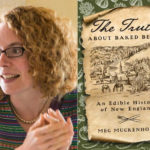
BCF Editor Publishes “The Truth About Baked Beans”

When she isn’t editing the BCF Newsletter, Meg Muckenhoupt writes about land use, the environment, gardening—and food. Her latest book, The Truth About Baked Beans, was released on August 30 by NYU Press. As the NYU Press states, “The Truth about Baked Beans explores New England’s culinary myths and reality through some of the region’s most famous foods: baked beans, brown bread, clams, cod and lobster, maple syrup, pies, and Yankee pot roast. From 1870 to 1920, the idea of New England food was presented in magazines, newspapers, and cookbooks, often through fictitious and sometimes bizarre origin stories touted as [READ MORE]

Belmont’s Last Pandemic: the 1918 Flu

By Vincent Stanton, Jr. Thought you could escape coronavirus news in the pages of the BCF Newsletter? You are safe, but there is a catch. If you can tolerate more grim news, consider taking a trip back to the last global pandemic, the so-called “Spanish Influenza” of 1918. The story of how Belmont responded is replete with both striking similarities to the 2020 coronavirus response and sharp differences. A weekly record of the influenza pandemic as it swept through Belmont in the fall of 1918 can be found in the pages of the Belmont Patriot. However, before diving into the [READ MORE]
Community Path Began Decades Ago

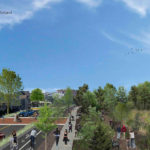
By Vincent Stanton, Jr. It has taken over two decades of stop-and-start development to bring the Belmont Community Path to its current state of planning and formal design, but a timeline for construction of the path is finally in sight. The design and engineering of Phase I of the Belmont Community Path, from Brighton Street to the Clark Street Bridge, started last fall and should take about two years to complete. In the next two years, path plans will progress through three major milestones: 25, 75, and 100 percent design, as part of a Massachusetts Department of Transportation (MassDOT) guided [READ MORE]
Belmont Timeline

Belmont Timeline Featuring events significant to the Belmont’s history and Belmont Citizens Forum issues. 1654 The John Chenery house, 52 Washington Street, is built. The Chenery house is the oldest surviving house in Belmont. 1760 The Thomas Clark House is built on what is now Common Street. “Local tradition maintains that the Clark family witnessed the beginning of America’s War for Independence from the hill behind this house, seeing smoke and hearing the sounds of war breaking out on April 19, 1775.” —Joseph Cornish, BCF Newsletter, January 2011. It was moved in 2012, and finally demolished in 2014. 1805 “Ice [READ MORE]
20 Years of Historic Preservation

By Sharon Vanderslice In the late summer of 1999, a dozen or so Belmont residents met in Town Meeting member Sue Bass’s dining room on Concord Avenue to discuss ways to increase transparency in our local government and protect the small-town atmosphere that had drawn us to Belmont in the first place. We had just lost a battle to keep out a massive development proposed by Partners Healthcare on the campus of McLean Hospital. This forward-thinking psychiatric institution was originally designed to offer patients a calm, nature-based space in which to heal. With the advent of pharmaceutical treatments, McLean’s board [READ MORE]
20 Amazing Years of the Belmont Citizens Forum

By Jim Graves As a founding board member of the Belmont Citizens Forum (BCF), who has been inactive in recent years, I am honored to share these thoughts on why the BCF has been so valuable and to applaud the individuals and supporters who have sustained the BCF for 20 years. Prior to starting the BCF, the founders worked to first improve, then oppose, and nearly defeat the development and zoning changes proposed for 238 acres of open space owned by Partners Healthcare and its subsidiary, McLean Hospital. Legal challenges by the BCF and supporters slowed implementation, and notably, [READ MORE]