
By Vincent Stanton, Jr.
Construction of the Belmont Community Path (Phase I) will encompass significant landscaping work, including planting 354 trees and 478 shrubs along the path. For example, 32 new trees and 11 shrubs will be planted along a 425-foot section of path behind the old BMLD building, the Belmont Police Station and the house at 710 Pleasant Street. Tree and shrub varieties were selected from Belmont’s Preferred Trees List developed by the Shade Tree Committee (see “Belmont Has a New List of Preferred Trees” in the May/June 2024 Newsletter). Tree type (e.g., deciduous vs. coniferous) and placement along the path were determined in close consultation with path abutters by landscape architect Sean Sanger and his team at Copley Wolff Design Group, the landscape design subcontractor to Nitsch Engineering on Phase I of the community path.
Most of the community path will traverse land owned by the MBTA, which, apart from its interest in poisoning plant life along the ballasted railroad right-of-way (as described in the MBTA’s five-year Vegetation Management Plan and annual Yearly Operating Plan) has had little interest in what grows on the rest of its land (or resources to address it). As a consequence, much MBTA land is overgrown with aggressive invasive species, which thrive in disturbed soil. For example the area behind the police station (partially town land) is colonized by Japanese knotweed, tree of heaven, and Norway maple. The community path landscape plan calls for planting eastern white pine, pin oak, and common witch hazel in that area. However, the non-native Norway maple and tree of heaven can outgrow and shade those species, while the knotweed tends to form a dense monoculture shading everything below 10 feet and inhibiting growth of any other plants. Without a plan to control the existing invasive species, the viability of the new plantings will be threatened.
Discussions with the town’s path design consultants had created the impression (at least in the author’s mind) that the state and federal funds that will fund path construction (via the Transportation Improvement Program, or TIP) could not be used for invasive plant control. It turns out that is not the case; indeed, the Federal Highway Administration (FHWA, a source of federal TIP dollars) has a guidance document on controlling invasive plants that states, in part: “The FHWA recommends use of Federal-aid funds for new and expanded invasive species control efforts under each state DOT’s roadside vegetation management program.”
More important, in the recently published Belmont Community Path bid document, MassDOT details the scope of work that contractors must accomplish to meet project requirements, with nine pages of instructions on how to treat invasive plants. Section 102.33 “Invasive Plant Management Strategy” states, in part:
“[Provide] an Invasive Plant Management Strategy (IPMS) for the control of invasive plants currently existing on the project site … the IPMS shall be submitted in the form of the MassDOT Invasive Plant Management Strategy Report Form.”
Further, Section 102.3 of the bid instructions, titled “Herbicide Treatment of Invasive Plants” states, in part:
“Control of invasive plants shall begin immediately with the initiation of construction activities and prior to any clearing or site disturbance. Treatment areas … may, upon approval of the Engineer, extend outside the project limit. Treatment shall be done each consecutive year for the duration of the contract unless specified otherwise …”
There are two encouraging aspects of those instructions: first, because the infestation of knotweed and other invasive plants extends beyond the path right-of-way to adjacent town, private, and MBTA land, the ability to “extend outside the project limit” (with permission, of course) is important, and second, the planned project duration is three years, with treatment to be applied in each year, which is enough time to get most invasive plants under control.
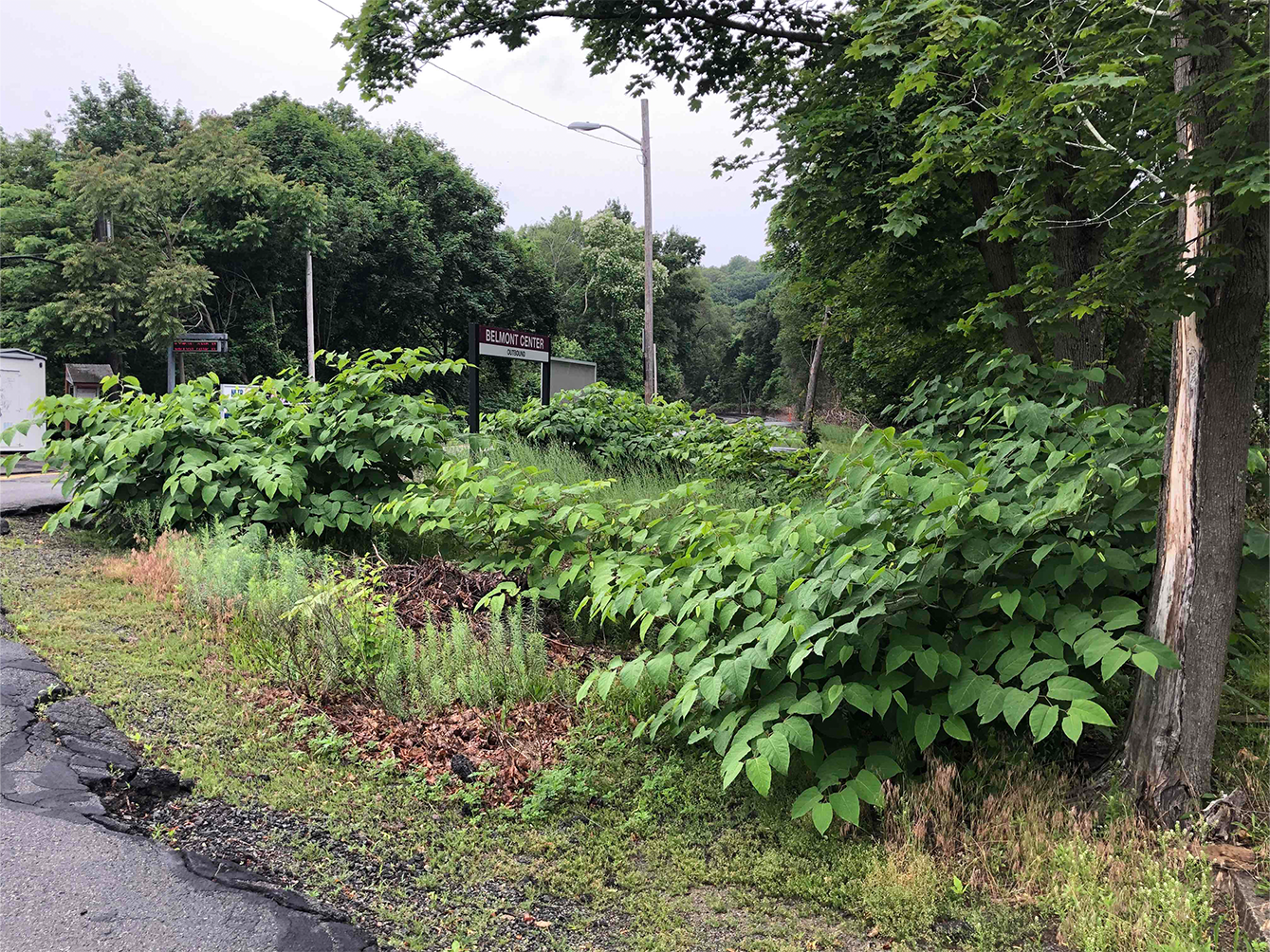
Knotweed on town land north of Belmont Center Station, June 14, 2025, view southwest towards “Belmont Center” sign.
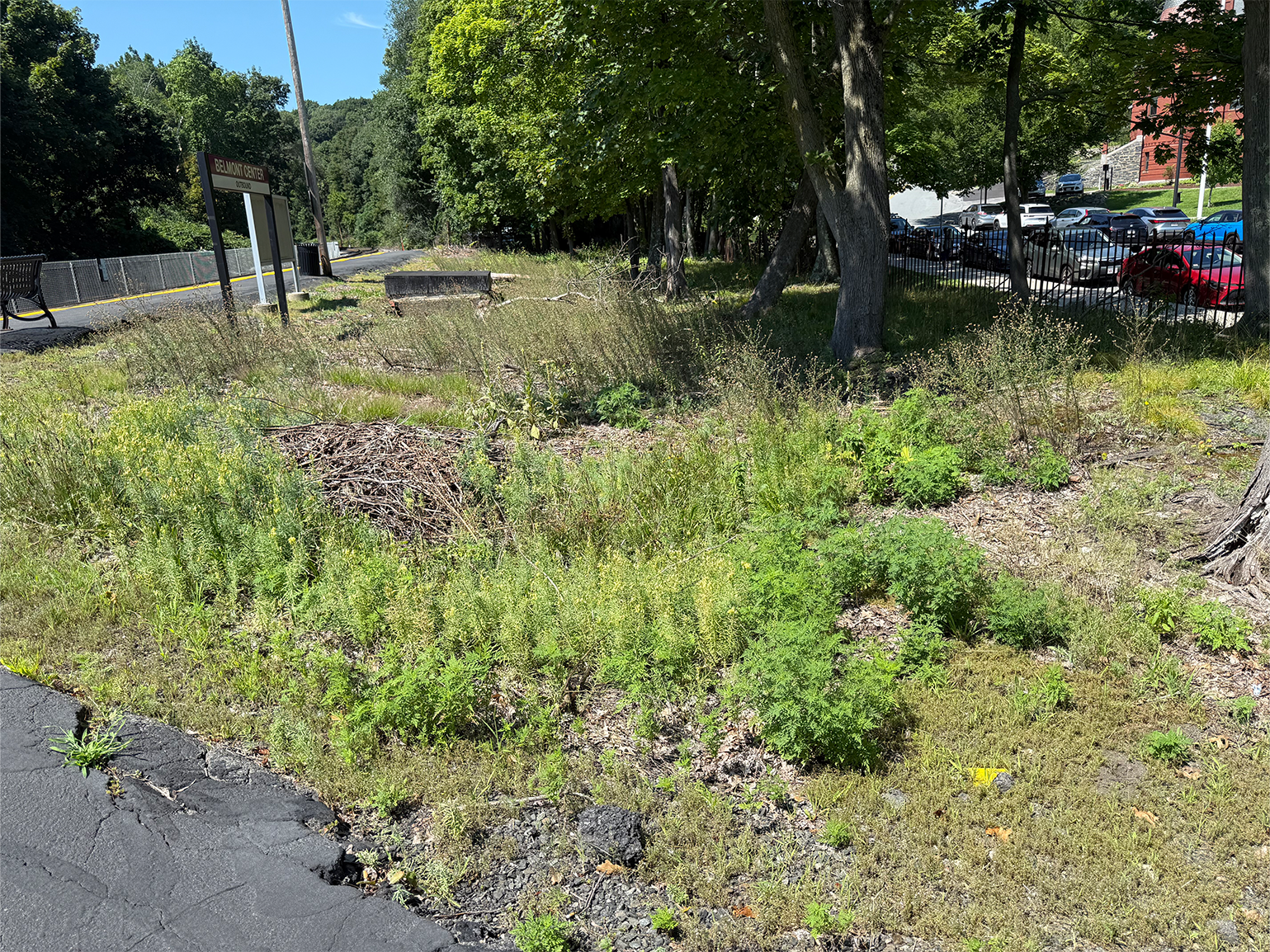
Same view as above 14 months later (August 7, 2026), following glyphosate treatment of knotweed on October 3, 2025.
Only a Comprehensive Approach Can Succeed
The largest and most mature knotweed colony along the path is actually on the south side of the Fitchburg tracks (opposite the path) where a 12-foot-tall stand on MBTA land leans into the right-of-way. Seeds from those plants are likely the source of knotweed on town land north of Belmont Center Station. (The timeline feature of Google Earth shows that knotweed first appeared on town land north of the station around 2015, decades after it was present on the south side of the tracks.)
Ideally, the contractor’s Invasive Plant Management Strategy will address that source, perhaps with some prodding from the town. In concert, the town should consider tackling the contiguous knotweed infestation on its land at the bottom of Royal Road where there are wetlands, a favorite habitat for knotweed. The MBTA land between the Fitchburg tracks and Pleasant Street near the Clark Street Bridge is another area heavily populated by knotweed, tree of heaven, and Norway maple where the town should encourage a comprehensive IPMS.
Getting a Head Start on Town Land North of Belmont Center Station
Last fall, with the approval of the Select Board and a financial contribution from the Belmont Citizens Forum, Parterre Ecological, a local landscaping firm, targeted knotweed and tree of heaven on the town land north of Belmont Center. Concentrated glyphosate foam was applied to knotweed leaves, and triclopyr was painted on tree of heaven bark. This year, the knotweed biomass was down over 95% (see before and after photos,) and all of the large tree of heaven specimens (concentrated near the BMLD building) were dead. Still, some small knotweed and tree of heaven plants remained viable so in September 2026, again with permission from the town and support from the BCF, Parterre re-treated the knotweed and tree of heaven.
Those are not the only invasive plants on that land; there is also Asian bittersweet, black swallow wort, European privet, Japanese honeysuckle, and more. For the last two years (and again on October 12, 2026) those plants—which are not quite as aggressive as knotweed and tree of heaven—have been manually removed by a group of Belmont Serves citizens acting in concert with, and under the direction of the Belmont Conservation Volunteers, a group of trained volunteers who work on controlling Belmont’s invasive plant population every Saturday morning from March to October (see “Belmont Conservation Volunteers Need Help” in the August/September 2025 Newsletter).
In conclusion, the upcoming construction of the community path could serve as a catalyst –with external funding from MassDOT via the TIP– to tackle the serious invasive plant problem on public lands flanking the path close to Belmont Center.
Vincent Stanton, Jr., is a director of the Belmont Citizens Forum.

Sorry, the comment form is closed at this time.