
By Nicole Estvanik Taylor
An intergenerational group of locals gathered on Saturday, October 3, to sing happy birthday to the pocket-sized forest in front of Belmont High School. The party, organized by Miyawaki Forest Action Belmont (MFAB), marked the first anniversary of the lively October 2025 planting day that drew hundreds of participants.
The Miyawaki method aims to give a head start to the formation of a mature forest ecosystem through dense planting, on a prepared site, of a careful selection of native trees and shrubs. Though botanist Akira Miyawaki began developing his approach in the 1970s in Japan, most such projects in the United States are younger than a decade. The method is often used in urban contexts to turn small patches of land into what are popularly termed “miniforests.”
Accounts of how Belmont came to have its own Miyawaki miniforest have appeared in this publication and others, but our young forest is just beginning its story. In honor of its first 12 months, here are a dozen conversation-starters for your next stroll past the high school or around Claypit Pond.
Roughly 97% of the More than 1,100 Trees Planted Last October Have Survived.
Some 30 trees didn’t make it to their first spring. A majority of these were sugar maples and shagbark hickories, which were among the smallest saplings planted. Some have been replaced, but since competition is a tenet of the Miyawaki method, MFAB leaders plan to hold off on further replanting and allow the forest to develop naturally.
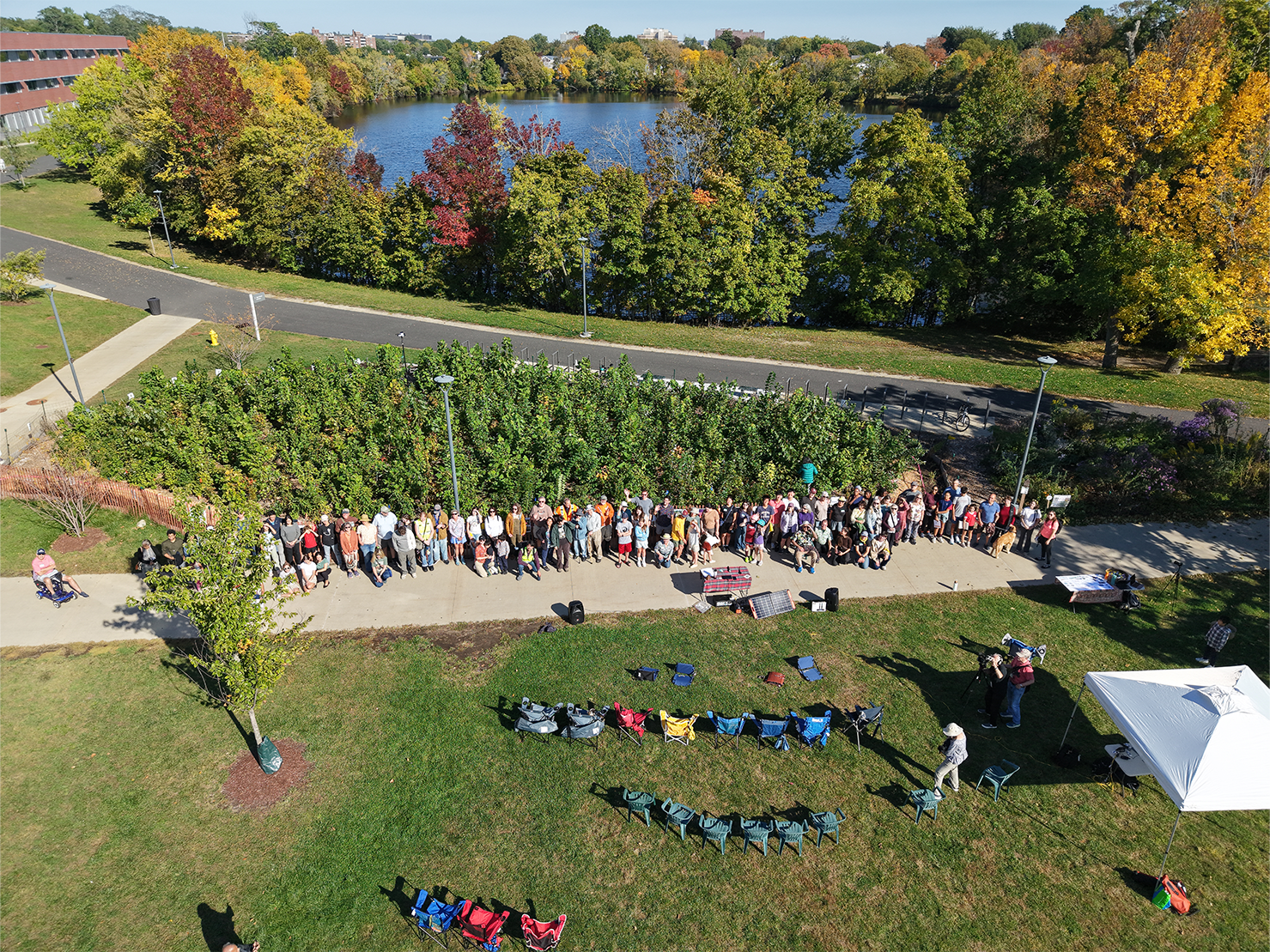
An intergenerational group of locals gathered on Saturday, October 3, to sing happy birthday to the pocket-sized forest in front of Belmont High School.
Every Sapling Is Accounted for on a Massive Spreadsheet.
Each tree and shrub has an identifying number and can be located using coordinates on a grid. Belmont High School student Jason Zhao used this info to create an interactive map for the MFAB website, packed with facts about each species. The plants started out wearing ID bracelets, but to prevent damage to growing branches, volunteers labored this summer to move the metal tags onto chopsticks inserted in the ground.
There’s a Selfie Station and a Really Big Ruler.
A phone stand next to the forest provides an easy way to snapshot yourself on a solo walk, or a fun backdrop for an annual family photo. Mounted on a nearby lamppost is a tall stick marked in footlong increments, useful for tracking the growth of kids and trees alike. On planting day, the average tree height was roughly 3 feet. Most now exceed 4.5 feet, and some high-achievers have shot up past 9.
The Miniforest Has Its Own Irrigation System, Though It Hasn’t Been Needed Much So Far
Throughout a summer with drought conditions across much of Massachusetts, periodic testing of soil moisture levels at the miniforest revealed little need for extra watering. While the site is exposed to drying winds and full sun, an abundance of moisture-retaining clay and organic material lies beneath the surface. Embedded sprinklers come in handy on hot days for cooling off the canopy with five-minute showers.
That Colorful Collar Is an Invitation to Bees and Butterflies.
A strip of native perennial flowers and grasses encircles the forest, with more planting to come. Twenty-five species were selected for site-suitability and their value in supporting at-risk pollinators, bolstering the lure of the adjacent native plant garden tended by the BHS Climate Action Club. The collar is designed to bloom across three seasons; this summer, Rudbeckia ( Black-Eyed Susan) and Partridge Pea stole the show with their cheerful yellow petals.
Pollinators are Welcome—Bunnies, Not So Much.
For rabbits, the miniforest is a too-tempting buffet of berries and tender stems. When other food is scarce, they’ll resort to stripping away bark. The forest’s robust fence, already reinforced multiple times, defends against ruin-by-a-thousand-nibbles. Even so, there are indications that a few furry snackers have found their way in.
The Forest Has a “Lollipop” and a Weather Station.
You may notice a lollipop-shaped path jutting into the center of the site from the pond-facing side. That area was left unplanted to allow the town emergency access to water valves. Using funds from the Belmont Cultural Council, the MFAB team took advantage of the open space by installing a weather station that measures wind, rainfall, temperature, humidity, and other climate indicators at the forest’s interior.
Experts are Examining the Forest From Above and Below.
Landscape designer Jenifer Tidwell and Salem State University professor Nicholas Geron have contributed their expertise in drone imaging to help document and analyze the Belmont forest’s early development. This summer, Geron captured thermal images from overhead as part of his studies on how different surfaces, from concrete to mulch to trees, affect temperature. At ground level, University of Delaware ecology grad student Melory Brandao has collected data from the Belmont site for her research on insect activity and biodiversity in urban green spaces.
Ever Heard of Phenology? It’s Happening Here.
Volunteer citizen scientists are using the Nature’s Notebook app to track designated specimens of 10 of the forest’s plant species. They’re engaged in what’s called phenology: studying the plants’ progress through seasonal milestones like budding, leaf growth, and fruiting. Their observations augment a nationwide dataset, managed by the USA National Phenology Network, that may shed light on how climate change affects ecosystems.
Students Are Learning From the Forest on Their Doorstep.
BHS students, including from the Climate Action Club, have been a key part of the miniforest effort from the start. The most prolific contributors to the phenology project so far are students of biology teacher Bonnie Chen, who brings her classes outside to observe and record the plants’ development. High-schoolers led forest scavenger hunts for younger kids through the Belmont Summer Enrichment program. Poems by students across all grades, inspired by their time in and around the forest, are displayed along the fence.
Belmont Was Featured on a Miniforest Bus Tour.
In July, the nonprofit Biodiversity for a Livable Climate brought Miyawaki method practitioners together for the 2026 Northeast Miniforest Summit. The itinerary included a tour of Boston-area miniforests, with stops in Belmont, Everett, Winchester, and Somerville. Despite rainy weather, visitors lingered to ask questions of MFAB committee members Jean Devine, Jessica B. Smith, and Sarah Wang. “We emphasized how much we engaged and built community through every phase of the forest’s creation,” says Devine.
There Will Be Plenty to See and Do in Seasons to Come.
The forest has at least a couple of years to go before it can tend to itself. MFAB welcomes interested volunteers to email miniforestbelmont@gmail.com or sign up via the project’s website: https://miyawakiforestbelmont.netlify.app. More hands are needed for weeding and maintenance, to expand the phenology program, and to launch new efforts related to local history and STEM education. The committee also seeks people with finance, marketing, and social media expertise to take on roles. The simplest thing anyone can do to engage with the forest is to pause and look closely, at any time of year. At this October’s birthday celebration, a touch of autumn crimson had begun to emerge. Once leaves and snow have fallen, tracks will provide clues to bird and animal activity. When spring arrives, the race is on to spot the earliest buds.
In her emails to volunteers, MFAB chair Sarah Wang sometimes includes little details she’s noticed on her own visits to the forest: colorful swamp rose hips, or swallowtail caterpillars rolled up in spicebush leaves. “I try to share the things I take delight in, to see if it sparks any interest for people to come visit,” Wang says. “I want to say, ‘Hey, look! See what you missed!’”
Writer and editor Nicole Estvanik Taylor lives in Belmont. Her family was among the many who helped to plant the miniforest.
A Miyawaki Forest Takes Root Near Alewife
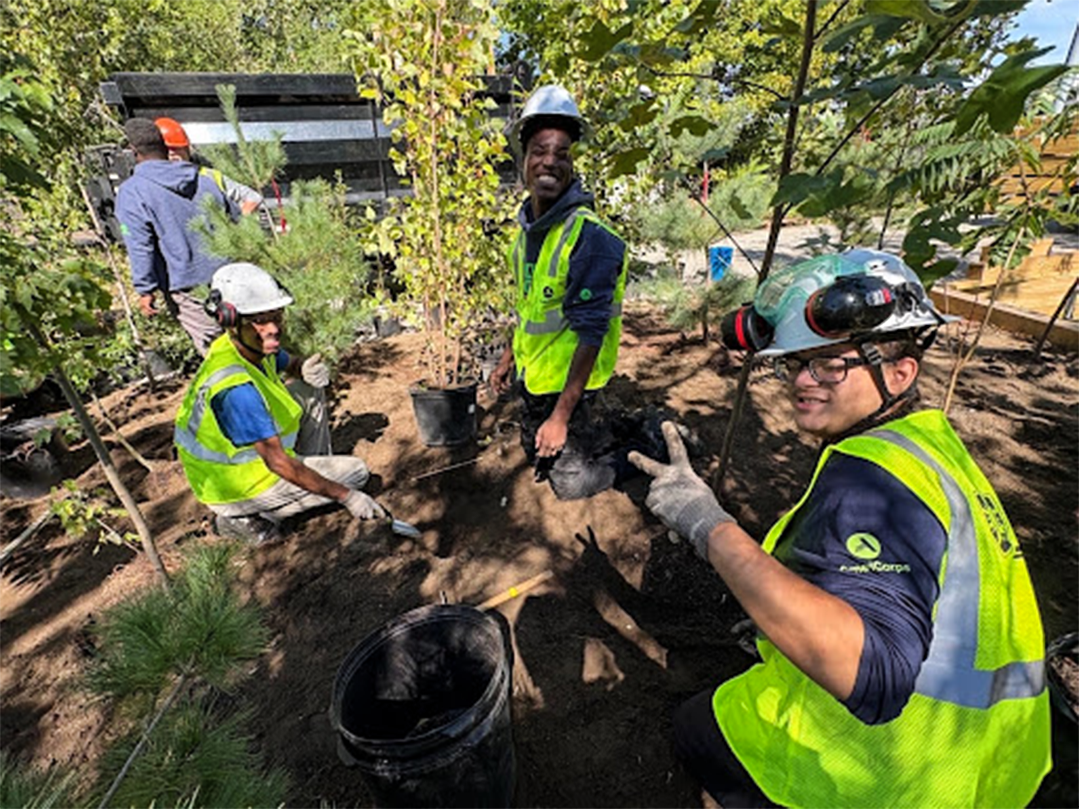
A new native planting in the Miyawaki style went into the ground beside the Jerry’s Pond restoration site on Rindge Avenue in Cambridge, near Alewife Station.
Fans of Belmont’s Miyawaki forest, planted last fall in front of Belmont High School, will be glad to hear that the method is spreading. On Wednesday, September 23, a new native planting in the Miyawaki style went into the ground beside the Jerry’s Pond restoration site on Rindge Avenue in Cambridge, near Alewife Station.
The work was led by Offshoots Inc., the landscape design, planning, and installation firm subcontracted to oversee planting around Jerry’s Pond as part of the site’s restoration. Offshoots staff trained and directed about a dozen crew members from PowerCorps Boston, the City of Boston’s paid “learn and earn” green-workforce program for residents ages 18 to 30, which provides hands-on training in urban forestry, green infrastructure, and climate resilience.
The site now holds about 60 young native trees, each roughly one inch in trunk diameter, including white pine, gray birch, swamp white oak, red maple, and tulip tree. The Alewife planting joins a growing regional network: Cambridge’s first Miyawaki forest was planted at Danehy Park, and at least 20 Miyawakistyle plantings now grow in Massachusetts.

Sorry, the comment form is closed at this time.