
By David Chase
Decades of improvements in batteries and motors have made e-bike assists practical and affordable, putting far more of them on the road today. People use them to commute, transport children, shop, make deliveries, and just for fun. These same advances have spurred a variety of other motor-assisted “micromobility” devices—e-scooters, e-skateboards, hoverboards, and monowheels—increasingly popular for commutes and short trips.
Unfortunately, cheaper motors and batteries have also enabled what are effectively electric mopeds and motorcycles, marketed and sold as “e-bikes.” Because they carry pedals and are called “bikes,” people ride them in bike lanes and on multiuse paths, and parents buy them for their children. These overpowered—and overpowering—machines can be dangerously fast for shared paths and young riders. Yet current Massachusetts law has no explicit category for them, leaving regulations inadequate and contributing to fatal crashes involving children.
To address these problems, the Legislature formed the Special Commission on Micromobility, which delivered its report in February 2026 recommending legal changes. Governor Maura Healey filed the Ride Safe Act (S.3077) on May 4, 2026; the Joint Committee on Transportation redraft version is S.3168. At the end of the formal legislative session on July 31, the bill was still in the Ways and Means Committee. It may yet be considered during informal sessions later this year, though passage would be a steep hurdle because it requires unanimous consent.
The Existing Law and Confusion Around “E-Bike”
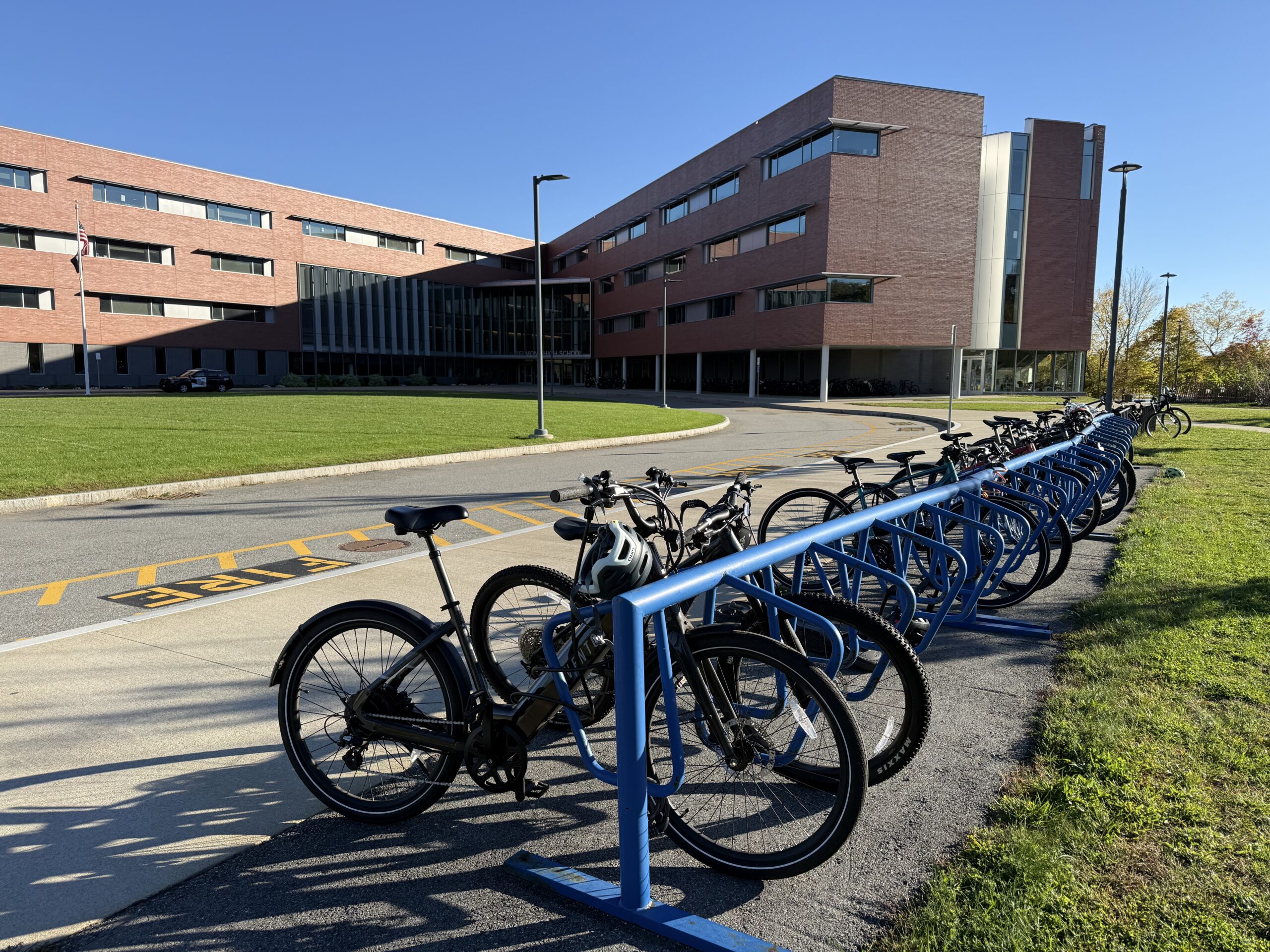
E-biles are popular among students at Belmont High and Middle School.
Current Massachusetts e-bike law defines and regulates electric bicycles ( General Law – Part I, Title XIV, Chapter 90, Section 1 , General Law – Part I, Title XIV, Chapter 85, Section 11B3/4), but it does not define or regulate electric vehicles that fall outside that category. Less ethical manufacturers exploit this gap to market machines far more powerful than legal e-bikes under the same “e-bike” label—some boasting 3,700-watt motors capable of 45 mph to 55 mph. Some are sold to parents for children; children make the mistakes we fear from children, and the resulting crashes can be fatal. The lack of statutory definitions also hinders enforcement, as regulations are tied to defined vehicle classes. Social media has even reported cases of riders attempting to obey the spirit of the law by registering what is effectively an electric moped at the RMV, only to be turned away because it did not meet statutory registration criteria.
Under current state definitions, a legal e-bicycle has an electric motor rated at no more than 750 watts and a speed limiter that removes all assistance above 20 mph. When meeting these criteria, an e-bike is treated almost entirely like an ordinary bicycle. This encompasses federally defined Class 1 (pedal-assist only) and Class 2 (throttle-assist, where pedaling is not required) e-bikes, but excludes federally defined Class 3 e-bikes, which provide assist up to 28 mph. The law also requires a manufacturer or distributor label certifying the e-bike’s type, assist-limit speed, and wattage, and that the label be updated if these things change.
Bicycles and e-bikes are subject to standard rules of the road and posted speed limits, but many bike paths or mixed-use paths have no posted limit. Some local regulations ban e-bikes from certain trails, some ban Class 2 e-bikes, some depend on the road surface, and some post local speed limits, creating an ad hoc patchwork.
The core problem is that Massachusetts law stops there, leaving an unregulated gray area. Statutory definitions of mopeds use cylinder “displacement,” not power. Because electric motors have no displacement, those laws do not apply. While one can convert displacement to motor wattage, that is not what the statute says. State law is equally silent on handlebar-less, non-bicycle devices like e-skateboards, and monowheels. Scooters (with handlebars) have their own, different, old law. Cross a state line, and different rules apply, as federal law and neighboring states formally recognize 28 mph Class 3 e-bikes. Motorcycle definitions do not use displacement, but do require compliance with Federal Motor Vehicle Safety Standards, which the faster e-vehicles do not meet (these are the least-likely-legal “e-bikes”).
We might assume that an undefined vehicle is prohibited on public roads, but roads are public ways where travel is a fundamental right (taken for granted in the Bill of Rights after appearing in Article IV of the Articles of Confederation). Highway access may be restricted only because alternative routes exist; by default, the public may use roads to travel. While Massachusetts regulates cars, trucks, motorcycles, bicycles, and horses, those rules apply only to defined vehicle classes. Without clear statutory categories for other electric vehicles, enforcement is legally fraught.
Consequently, there is virtually no regulation governing the sale or speed of high-speed e-bikes, e-scooters, or e-skateboards. Devices that are effectively electric motorcycles with pedals are sold freely. As prices drop, their popularity has surged, alongside news reports of an “explosion” in injuries—largely tracking ridership, but exacerbated by speed.
The popularity of these vehicles can trap well-meaning parents. Seeing pedals, a bike frame, and an “e-bike” label, parents may assume a machine is as safe as a bicycle, when it actually possesses motorcycle power. Under current law, a parent must know to ask: “How fast can it go?” and “How easy is it for my kid to get around that limit?”
What the Proposed New Law Provides
The proposed law removes this gray area.
Drawing on the Special Commission’s recommendations, the proposed legislation (S.3077 / S.3168) defines four speed-based tiers, with increasing restrictions tied to each tier:
Tier 0, 0–20 mph, maintains existing e-bike rules (“treated like a bicycle”) and extends them to other low-speed micromobility vehicles whose motors do not assist past 20 mph, including e-scooters, e-skateboards, and hoverboards, as well as unpowered kick-scooters and skateboards. Riders remain subject to bicycle laws, youth helmet mandates, standard rules of the road, and sidewalk restrictions (the current blanket ban on sidewalk e-bike riding will likely be preserved). Unpowered bicycles and boards may still exceed 20 mph under human power.
What’s new: Formal “like a bicycle” treatment for low-speed e-scooters, e-skateboards, and hoverboards, alongside a new minimum operator age of 14 for motorized devices (the House version specifies 16).
Tier 1, 21–30 mph, covers faster small e-devices, mopeds, and Class 3 e-bikes. Operators must be at least 16 years old and wear helmets. Traditional mopeds retain their existing driver’s license and RMV registration requirements.
What’s new: Formal legal definition and authorization for Class 3 e-bikes, including minimum age and helmet mandates, and an expanded stickering system called “Mass Micro ID.”
Tier 2, 31–40 mph, covers high-speed micromobility devices and “limited use motorcycles.”
What’s new: Explicit statutory definitions for faster electric two-wheelers, imposing all Tier 1 requirements (age 16+, helmets, Mass Micro ID) plus mandatory liability insurance.
Tier 3, 40+ mph, covers electric vehicles that are effectively motorcycles.
What’s new: An explicit definition so that high-speed electric two-wheelers are regulated and insured as motorcycles, closing the pedal loophole.
Beyond the tiered restrictions, the proposed law would:
- Impose a default speed limit of 20 mph on mixed-use paths, and ban mopeds (but not Class 3 e-bikes) from on-road bike lanes.
- Impose electrical safety regulations on batteries and motors for all these devices, addressing severe fire concerns.
- Establish a working group to standardize reporting of crashes involving motor vehicles, micromobility devices, or vulnerable road users (including pedestrians), while clarifying rules for dealers and manufacturers.
Hoped-for Benefits: Enforcement and Safety
A simplified, speed-based classification will make these laws easier to understand, obey, and enforce. For small vehicles, safety is closely tied to speed. Legitimizing and regulating low-speed Tier 0 devices while restricting higher-speed machines should significantly improve safety.
Classification by speed simplifies police enforcement: radar guns easily clock small vehicles traveling faster than 10 mph. On flat ground, an unpedaled vehicle moving faster than 20 mph is clearly not in Tier 0, giving officers a definite, objective standard.
Clearer classification at the point of sale and universal age restrictions on motorized tiers will prevent children from riding dangerously fast vehicles. For parents, the new law provides a welcome “blame the law” justification to refuse unsafe purchases, much like youth helmet laws.
Better battery safety standards will be a major improvement. Cheap, uncertified lithium-ion batteries are prone to catching fire, sometimes causing catastrophic building fires. Without state standards, transit agencies and landlords have strong reasons to ban e-assisted vehicles from buildings and trains. Robust standards protect riders and preserve access.
A 20 mph speed cap on multiuse paths will also help. Relatively few path users exceed 20 mph today, but those who do create outsized risks: less control, less reaction time, and more severe crash impacts. High-speed passes are also deeply uncomfortable for pedestrians. A clear limit establishes mutual expectations and discourages reckless riding.
Hoped-for Benefits: More Adoption and Wider Use
Headlines about battery fires and reckless riding might tempt some to ask: why not simply ban e-bikes? In practice, ordinary legal e-bikes are extraordinarily practical for short trips. Compared to driving, an e-bike is cheaper, quiet, nonpolluting, safer for bystanders, and trivial to park. During rush hour in Greater Boston, an e-bike is often faster than driving. While regular bicycles share many of these benefits, electric assist is what makes cycling broadly feasible for carrying children, tackling steep hills, commuting without sweating, or replacing a car. Families across Boston and its suburbs already rely on e-cargo bikes to haul kids to school, run errands, and eliminate second cars.
This transition is well documented. A focused UK study of 42 households found that 60% of trips taken on newly provided e-cargo bikes directly replaced car trips (“Understanding e-cargo bike substitution of car, cycling, and walking through domestic trials in three UK cities”).
A clear legal framework should also encourage commercial short-haul delivery. In congested cities, cargo e-bikes deliver goods faster, cleaner, and more safely than vans, avoiding competition for loading zones (The Guardian, August 2021). Clarifying which vehicles are legal removes regulatory uncertainty for logistics businesses. Furthermore, app-based food couriers currently using loud, polluting mopeds could transition to legal, regulated e-bikes, making streets quieter and cleaner.
Originally published in the Somerville Beacon, September 24, 2026
Earlier this year, Ben Orenstein and Ethan Ludwin-Peery spent four hours on the Somerville Community Path with a radar gun, systematically recording speeds and classifying 832 passing vehicles (some e-bikes look nearly identical to standard bikes). Over 96% were pedal bicycles (73.2%) or e-bicycles (23.2%). Stand-up scooters accounted for 2.8% (though Somerville prohibits motorized scooters on the path), alongside three monowheels, two recumbent bikes, and two inline skaters. On average, e-bikes were about 10% faster than pedal bikes.
By speed, only 37 of 832 vehicles (4.4%) exceeded 20 mph:
- 19 were e-bikes (about 10% of all e-bikes observed), exceeding Class 1 and Class 2 assist limits and almost certainly representing Class 3 models currently unclassified under state law.
- 11 were pedal bicycles (about 2% of pedal bikes).
- 5 were stand-up scooters (out of 23 observed).
- 2 were monowheels (clocked at 23 and 25 mph; a third traveled at 16 mph).
If speeds above 20 mph on a multi-use path are considered “too fast”—as they would be under proposed legislation—then only 4.4% of users currently exceed that threshold. The researchers noted that noisy tires often made bikes seem faster than their radar readings, and speeds above 20 mph genuinely felt uncomfortable. 4.4% is not that many, but enough to create real comfort issues and increase crash hazards. A 20 mph limit would not be onerous: it would slow down fewer than one in twenty path users, and only 10% of e-bike riders, while reining in excessive speeds.
Summary
Much of the confusion surrounding “e-bikes” arises because Massachusetts law defines standard e-bicycles but leaves faster, bicycle-shaped electric vehicles and smaller micromobility devices unregulated. This loophole has allowed dangerously fast motorbikes to be marketed as bicycles to parents and children, contributing to fatal crashes and leaving police without clear enforcement authority.
Pending legislation would establish a comprehensive, speed-based classification system that clarifies the rules for riders, parents, and law enforcement. By setting sensible speed tiers, establishing age limits, enforcing battery safety, and capping path speeds at 20 mph, the Ride Safe Act would improve public safety while supporting the practical, climate-friendly benefits of e-bikes.
David Chase is a director of the Belmont Citizens Forum.

Sorry, the comment form is closed at this time.