
By Fred Bouchard and Jean Devine
By Clay Pit Pond’s bridge on that brilliantly sunny October morning, dozens of eager planters — aged 12 to 80, armed with shovels and trowels — were swarming among hundreds of potted saplings and bushes at Belmont’s inaugural Miyawaki Forest. (Akira Miyawaki, 1928-2021, was a Japanese botanist who developed the practice of restoring small plots of degraded land with densely planted pocket parks.) Curious joggers, dog-walkers, strollers, and pram-pushers who paused for a look-see or polite query barely slowed the feverish activity that unrolled all day long, from 8 AM to 6 PM.
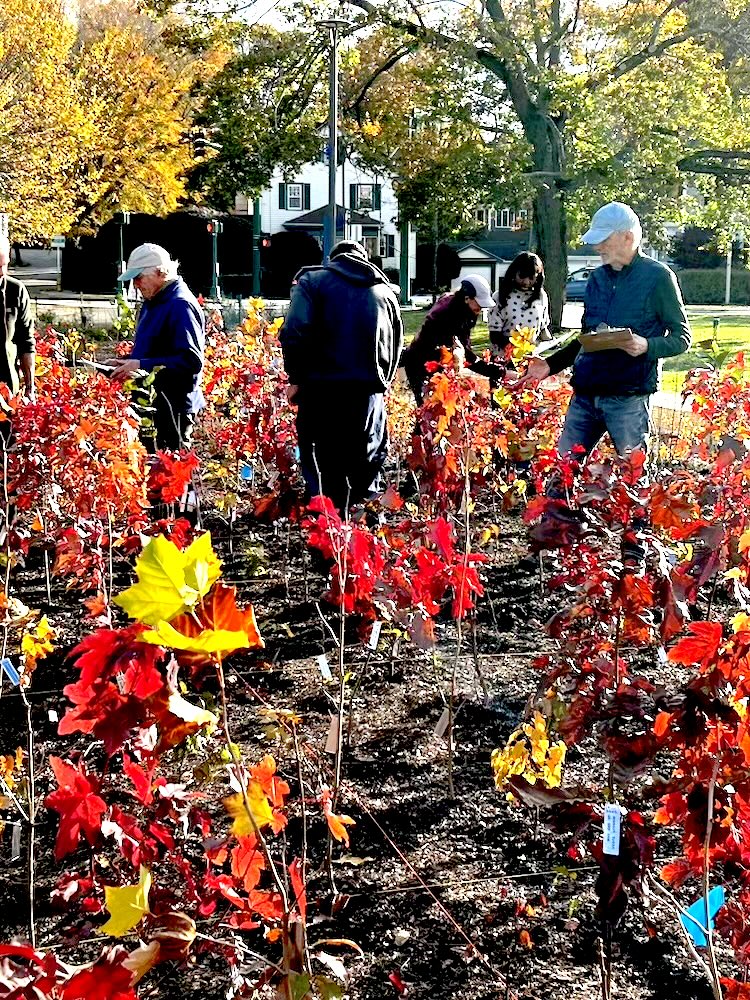
Planting day at Belmont’s Miyawaki forest. Photo Courtesy of Jean Devine
The group spearheading the effort to create this BHS “mini forest” is Miyawaki Forest Action Belmont (MFAB), an intergenerational team of Belmont residents. They started working together in May of 2024 and have shown little sign of letting up. The highly collaborative MFAB united the efforts of Belmont High and Middle School (BHS/BMS) students, local scout troops, families, citizens, and church groups, all advised and directed by Miyawaki veterans and Bio4Climate professionals who’d planted mini-forests in Cambridge, Somerville, Watertown, and Worcester.
Historically, the site of the forest had been a brickyard, a landfill and a baseball diamond. It was the original location of Wellington Brook before it was channelized, culverted, and rerouted in the 1930s to prevent stagnation in Clay Pit Pond, and a path to Little and Blair Ponds long before the railroad came in the 1840s.
Sarah Wang, MFAB leader, had managed its myriad details with determination. She invented several solutions that made engagement and staging successful. She created the foster-a-tree program where nearly 100 Belmont families baby-sat tender saplings over the summer. “On the day before planting,” said Sarah, “we staged and spaced the plants using a novel technique: 1,100 chopsticks marked each tree location. That helped us to manage the scores of volunteers on planting day and keep them all organized.”
On planting day, Sarah and native plantscaper Jean Devine, owner of Devine Native Plantings, instructed the volunteer planters (some of them proud tree fosterers) in planting techniques. Devine had been advising BHS Climate Action Club students on the creation and maintenance of the campus native plant garden since 2021.
In August, she supervised students and volunteers in relocating the native plant garden from the center of the now forest to an adjacent plot closer to Concord Avenue. “The point,” said Jean, “is to show us how trees can thrive when nurtured and grown closely together to form a living community rather than exist in lonely isolation. Since Miyawaki Forests restore biodiverse habitats, our stormwater will be a little bit cleaner, our air a little bit cooler, and our residents a little bit wiser.”
Sarah Wang gave further background: “The Conservation Commission approved the siting as long as we added erosion control. We consulted with Bio4Climate on tree research, final plant selection, and sourcing of all materials—soil, mulch, biochar, wood chips, and tree seedlings. We organized small volunteer groups for preparatory steps including laying cardboard and wood chips around the border and hanging fences to keep rabbits out.”
BHS students Holly Kong, AJ Shaw, Sophia Miao, and Albert Ying worked hard with signage and interaction with the school to ensure a good turnout of peers. Jessica Hausman implemented the PR campaign that proved so effective in building awareness and participation from business owners, young families, and scouts; 275 volunteers showed up to plant on planting day! Michelle Oishi handled many of the technical details including irrigation. Ranganath Nyack and Kirsten Waerstad provided funds and advice throughout the process.
Jean explained, “We view the forest as a ‘Living Lab,’ a key place in Belmont for citizen scientists, budding artists, and natural historians to observe and appreciate nature.” The learning began by observing and taking lessons from other Miyawaki forests (aka mini- or fast-forests) in the area. The first to be planted in New England, in 2021, is in Cambridge’s Danehy Park. The lesson from that site was one of avoidance: do not plant sumac, an early successor and aggressive plant.
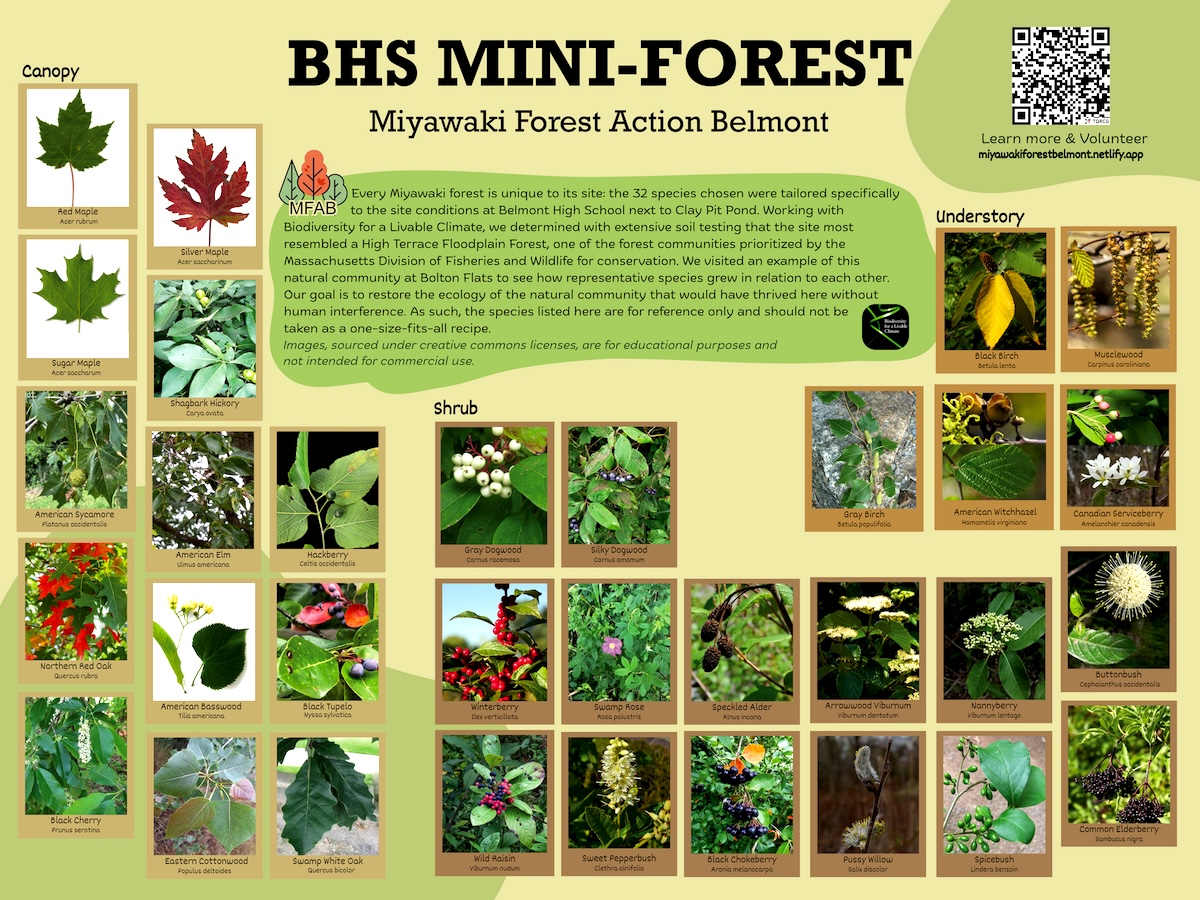
Species at the Belmont Miawaki forest. For a complete species list, visit Miyawaki Forest Action Belmont, miyawakiforestbelmont.netlify.app . Graphic courtesy of Jean Devine
Monthly Miyawaki Log
Jean Devine undertook to record month by month the forest’s progress. Here are excerpts from her log.
October
At first we watered the forest several times per week. By the third week, seasonal rain rendered irrigation unnecessary. We replanted some of the trees to optimal growth depths, and checked that each tree had a metal tag containing a unique number and species code. At least 20% of the tags had fallen off during planting or subsequent wind. We started the process of digi-mapping the entire forest to collect baseline data on each specimen. We laid a grid onto the forest using orange twine and working in teams, manually recorded the location of each specimen, square by square. Sarah entered this information into a spreadsheet useful for matching tags to trees. Meanwhile, an Arlington friend, Jenifer Tidwell, took a drone photo to precisely map the location of each tree.
November
We affixed to the fence a beautiful BHS-student-designed sign depicting the 32 native species in the forest and we replanted more trees. Strong winds and rain knocked many ID tags off trees, so we reattached what we could. Sarah, Jenifer, and Judy Sheldon worked to reconcile trees shown in the drone photo with those in the database. The MFAB Education team of Jean, Sarah, two MFAB students, juniors AJ Shaw and Albert Ying, and college freshman Holly Kong met to outline ideas for ways teachers, students, and community members could study and appreciate the forest.
February
The education team discussed the idea of implementing a phenology program where students and volunteers can collect data on seasonal phenomena such as bud break, leaf growth, flowering, fruiting, and leaf drop. This study runs spring through fall and data will be fed into the National Phenology Network’s (NPN) database which helps citizen scientists study the impact of climate change in our region. Meanwhile, another team—Sarah, Jean, Kelly Schlabach, Pritha Mitra-Stiff, and Aparna Mujumdar—met to develop a list of native perennials and to sketch a design for the “perennial plant collar” that will surround the forest. In 2026, we will plant half of this collar, the west and southern sides, approximately 130 linear feet. It’s a large undertaking, and we want to ease perennials into place.
March
The education team, now expanded to include Barbara Garrity, Pritha Mitra-Stiff, Jessica Smith, and Mariloly Wood, began planning the phenology program. We identified 10 species that would be a representative sample. We took online tutorials offered by NPN. At the end of the month, with all traces of snow gone, we marked the trees (three samples of each species for a total of 30 trees) for the study, recycling our chopsticks now adorned with pink bows!
April
For Earth Month, we will launch three projects: the perennial collar, [Phase 1 soil preparation], the phenology program, and a Haiku contest for all students grades K–12. On April 4, volunteers raked wood chips, added premium soil, and scattered native annual seeds. On April 12, we started the phenology program with teams of volunteers observing the 30 specimens to identify bud burst and other signs of spring emergence. Throughout the growing season, volunteers will meet weekly on Sundays at 4 PM (or their own schedule) to record phenology (plant life cycle) data.
Summer and Fall: Volunteers will weed the forest and selectively water if irrigation has missed certain spots. The phenology program will continue and forest visitors are encouraged to note signs of life, including lepidoptera, other insects, and birds, by using iNaturalist and/or adding notes to a laminated sheet affixed to the fence. Winning Haikus will be affixed to the fence!
May
We will continue the phenology program and give forest tours to teachers, students, and the public. Deadline for Haiku submission is May 24. Winners in each age category will be announced on June 21 (first day of summer).
October
On October 3, the one-year anniversary of the forest, volunteers will plant the western and southern sides of the collar with native perennials, and on October 4, we will dedicate the forest!
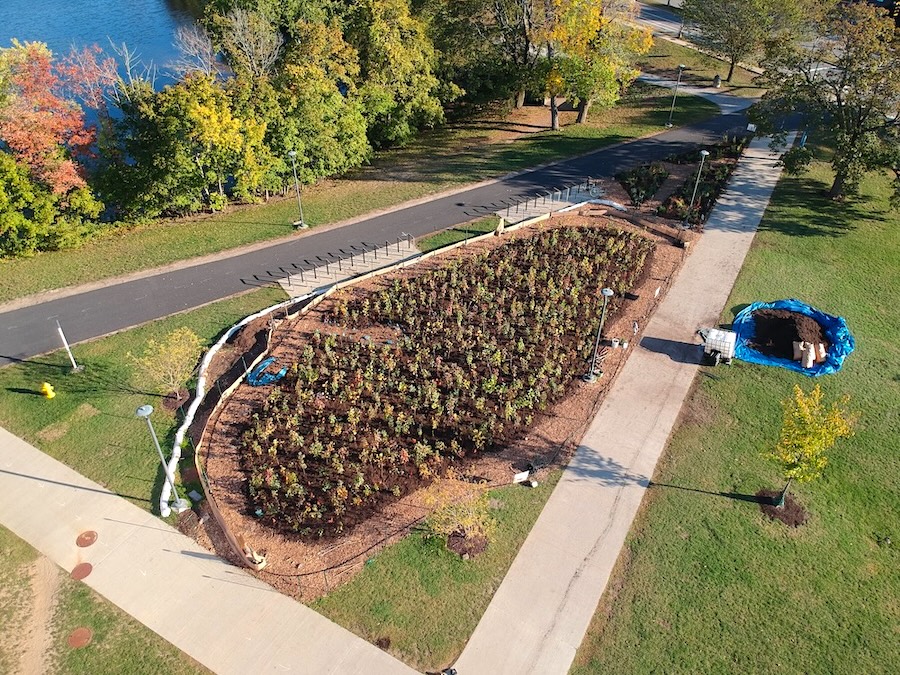
DCIM/101MEDIA/DJI_0070.JPG
Fred Bouchard is a member of the Belmont Citizens Forum Newsletter Committee. Jean Devine is a Belmont resident, cofounder of the Mystic Charles Pollinator Pathways Group, and is executive director of the Biodiversity Builders youth environmental education program and Devine Native Plantings, LLC.

Sorry, the comment form is closed at this time.