
By Jeffrey North and Eric Grunebaum
The abbreviated answer is both.
Jerry’s Pond sits behind a chain-link fence on Rindge Avenue in North Cambridge, a short walk from the Alewife MBTA station, across the street from Cambridge’s largest environmental justice community, and near the Belmont line. Since 1962, the pond and surrounding land have been visible but off-limits: a nine-acre remnant of The Great Swamp, and later a site of clay extraction, industry, and outdoor recreation.
The site’s inaccessibility is now changing due to the advocacy of Friends of Jerry’s Pond (FOJP) beginning in 2015, which encouraged the property owner, lab developer IQHQ, to advance a public access plan. The Cambridge Conservation Commission reviewed the plan at length and received significant contributions from community groups, including, principally, the Alewife Study Group (ASG), which focused on pollution concerns, as it had for more than 25 years. The resulting project offers a useful case study for how communities across Greater Boston, including Belmont, might approach the restoration of damaged urban wilds and those perceived to be damaged.
A Site Shaped by Nature First and Then by Industry
Jerry’s Pond is one of the few untouched lowlands formed after the glaciers’ retreat 25,000 years ago, leaving a tidal estuary running north to the Mystic River, a name meaning “Great Tidal River” in Algonquian, pronounced “Missi-Tuk.” The swamp stretched from the Mystic to Spy and Fresh Ponds and provided rich hunting and fishing grounds for the indigenous Massachusett people. Alewife refers to the saltwater, anadromous fish which spends its life in the ocean, swimming upriver only to spawn in freshwater.
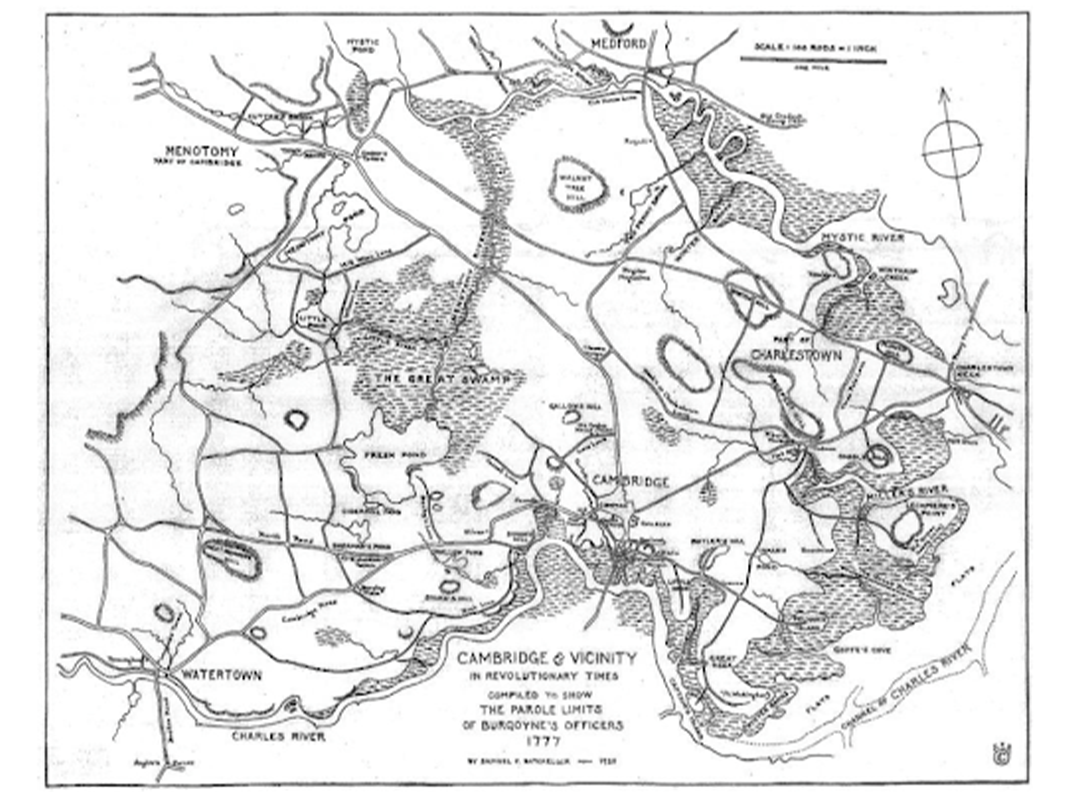
1777 Map of The Great Swamp
The Great Swamp, including Jerry’s Pond and the land around it, had many uses in the 18th and 19th centuries; famously, the rich marsh clays were mined to make the bricks that built much of Boston. As the clay ran out, many pits filled with water and, from the late 19th century onwards, some, including Jerry’s, became popular swimming holes; a respite from the city, frequented by Irish and French-Canadian immigrants living nearby.
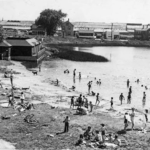
“Jerry’s Pit,” 1945. Bath house built by Dewey & Almy Chemical Co.; brick drying sheds in the distance. (Cambridge Historical Society)
In the early and mid-20th century, land around the pond hosted a factory using pond ice to make ice cream, a metal fabricator (later used as the band Boston’s practice venue), and a burger joint.
Meanwhile, more nefarious activities were taking place on the other side of the light rail tracks, which later became the “rail-to-trail” corridor of Alewife Linear Park. A series of chemical companies used the approximately18 acres north of the tracks, leaving hazardous pollutants behind. Later, this area was conflated with the nine-acre Jerry’s Pond site south of the tracks, especially after the infamous polluter, W. R. Grace & Company, purchased land on both sides. In 1962, the thriving swimming hole and natural areas of Jerry’s Pond were closed, and an MDC pool (now DCR) opened—no more access to nature. Concrete pools and the perception of danger ruled.
Yet Cambridge’s long-time Historical Commission director, Charlie Sullivan, related in 2022, “I remember a study from the 1970s or ’80s that gave Jerry’s a clean bill of health. I think the urban legend about a grossly polluted pond was maybe a product of the actual pollution discovered nearby during construction of the Red Line Extension combined with W. R. Grace’s terrible environmental reputation, which supported the city’s perception that it wanted nothing to do with owning the property.”
In 2020, Grace’s successor company agreed to sell all 27 acres to lab developer IQHQ and, knowing the pond would receive intense oversight due to FOJP’s long advocacy for reopening the pond and watchdog group ASG’s asbestos monitoring, in March 2021, IQHQ hired VHB to prepare a wildlife habitat assessment, which described Jerry’s Pond as an approximately 4-acre water body bordered by 5 acres of vegetated wetland and mature trees, and steep or vertical banks. Despite the disturbance, the assessment recorded great blue heron nesting (ending in 2020), waterfowl, turtles, muskrat, and a range of birds and small mammals. It also found heavy stands of invasive plants, including phragmites, knotweed, buckthorn, garlic mustard, tree of heaven, and multiflora rose.
That combination – real ecological value paired with mostly perceived contamination and real degradation (much of the land is paved below the invasives), along with the city’s active disinterest, and backtracking on a grant to study the site – has made Jerry’s Pond a challenging restoration project. Though consulting engineer Haley & Aldrich’s 2021 testing for IQHQ showed that the nine-acre Jerry’s Pond site was not greatly polluted with hazardous waste, much of the ~ 18 acres north of the Linear Path contains asbestos related to the former industrial use. That fact has shaped nearly every design decision that followed.
 The Approved Restoration Plan
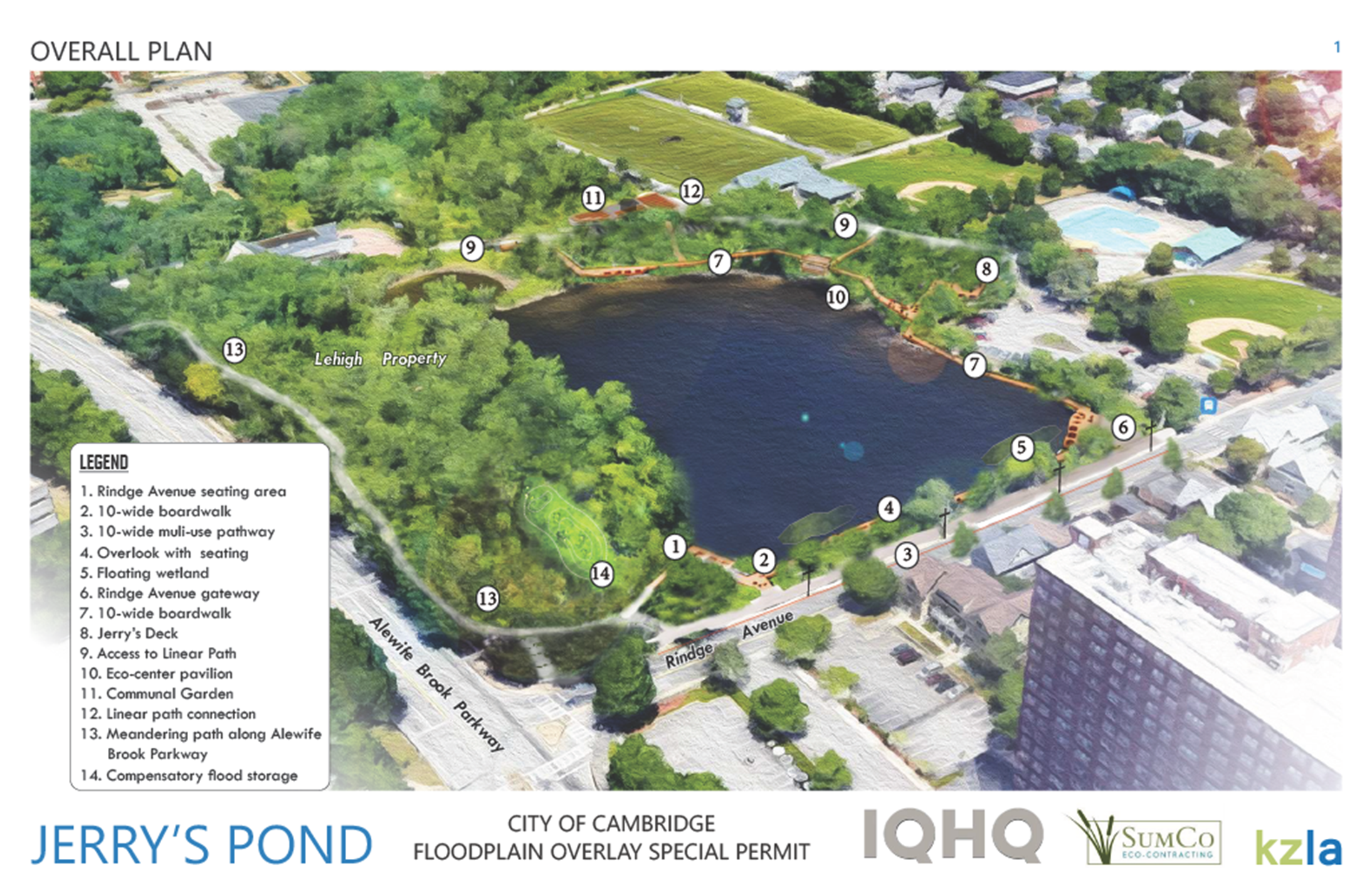
IQHQ’s approved plan does not attempt to remake the pond from scratch and re-naturalize it. Instead, it relies on above-ground interventions designed to open the site without undertaking a broader ecological restoration as proposed by FOJP; one which would remove most of the pavement, create natural banks, and reshape the pond, creating a large greenspace on Rindge Ave. The construction plan, now underway, includes raised, boardwalk-style pedestrian paths along Rindge Ave., pond overlooks, seating areas, and links to the city’s Alewife Linear Park and bicycle routes.
The plan also calls for removing pavement and replacing it with clean soil and a conservation seed mix, adding trees, and installing two floating wetlands intended to improve habitat and water quality. An ecological education pavilion, developed in partnership with Mass Audubon (introduced to the project by FOJP) is planned. IQHQ has also committed to a communal garden effort with Green Cambridge.
A design review commissioned through the Alewife Study Group in 2023 described the IQHQ plan as “minimalistic,” noting that it relies on above-ground boardwalks rather than shoreline regrading. That restraint was deliberate, although perhaps overly founded on fear. Reviewers and city staff repeatedly pointed to the value of keeping construction off the “contaminated” bank and away from an area in the northwest corner of the site that functions as a “wildlife refuge.”
However, rather than avoiding digging along the pond’s banks, a nearly half-acre water detention basin was excavated next to the pond without the highest “tent and vent” asbestos protections because, as FOJP, Sullivan and Haley & Aldrich had noted, there was no substantial asbestos here. FOJP had proposed instead to de-pave the banks, creating biodiverse wetlands in this location with the underlying logic, that if we’re going to excavate, why not restore and create new wetlands? Instead, the excavation of a water detention basin was designed to support the lab development’s water storage obligations and will remain mostly dry except during rare “25-year” storms. (Excavator and red tarps are visible in satellite view here.)
How the Plan Moved Through Permitting
Jerry’s Pond improvements became a formal requirement of the Plan in May 2022, when Cambridge granted IQHQ a special permit for its broader Alewife Park lab development. The pond work then went through separate review under the Wetlands Protection Act, since the site includes bordering vegetated wetland and other regulated resource areas.
At a February 2024 hearing, IQHQ presented a revised design that added twenty trees over the previous version, expanded the depaved area intended for flood storage, and outlined how vegetation would be protected during construction. (As of fall 2026, IQHQ now states that many of the trees proposed along Rindge Avenue cannot be planted due to “clay and wood conduits” along Rindge. FOJP had instead proposed an approximately three-quarter-acre greenspace with room for 150-175 trees, without the need to plant close to the street.)
The Cambridge Conservation Commission voted to approve the project and issued its Order of Conditions on March 18, 2024, under Department of Environmental Protection (DEP) file number 123-322. That approval requires a formal operations and maintenance plan covering the floating wetlands, plantings, and other regulated features, including a process for removing them if they fail. The ConCom however was not responsive to DEP’s statement that boardwalks cast shade detrimental to the wetlands below nor require mitigation. Had the design been of clean fill, rather than boardwalks, there would be no shade. (Mass-DEP’s Environmental Notification Form review stated: “Shading impacts to Bank and Land Under Water are likely to be deemed alterations and should be evaluated in the NOI. Mitigation may be required.”)
The Unresolved Debate
Not everyone considers the current plan sufficient. Friends of Jerry’s Pond had pushed for years for a more ambitious restoration: re-grading the pond’s steep banks into sloped wetland habitat, planting well over one hundred additional trees, and creating a public greenspace on one of Cambridge’s busiest streets and in the city’s largest environmental justice neighborhood. Some versions of that alternative carried estimated costs in the ten to fifteen million dollar range, a small fraction of the billion dollar lab development’s value.
A Cambridge City Council vote in January 2024 declined to restore the city’s grant offered to study that larger vision. The tension between the two visions, a constrained improvement plan and a more expansive public investment in habitat and climate resilient greenspace, remains the central unresolved question at Jerry’s Pond.
Why It Matters Beyond Cambridge
For Belmont readers, Jerry’s Pond is worth following for reasons that go beyond geography. It sits in the same Alewife Brook watershed that touches Belmont’s own conservation concerns, and it illustrates a challenge many towns will eventually face: how to treat land that is ecologically valuable, publicly desired, and environmentally compromised – or at least perceived to be compromised – all at once. And to keep a clear-eyed view of facts, rather than fear-based legends.
The Cambridge approach landed on a somewhat limited vision rather than leaning into a full ecological transformation. It permanently locks in paved land, allowed excavation of a water detention facility, and casts large sections of the pond’s banks into permanent shadow. Whether the constructed boardwalk approach qualifies as a masterclass in reopening urban wilds depends in part on what happens after construction: will the floating wetlands persist? Will the newly planted trees survive? the sensitive habitat remain undisturbed once the boardwalks open?
While not restoring the pond’s banks and creating a new green-space with over 100 trees providing heat and air pollution relief, the plan does create many positive qualities. It reopens a long-closed site, creates access through the woods on both sides of the pond, adds an “EcoCenter” staffed by Mass Audubon, and potentially enacts a Conservation Restriction to be held by Audubon in perpetuity. Withthe land forever unbuilt, future stewards of Jerry’s Pond may someday entertain more enlightened views of ecological restoration, environmental justice, habitat improvement, and climate resilience.
Jeffrey North is the managing editor of the Belmont Citizens Forum Newsletter.
Eric Grunebaum is a cofounder of Friends of Jerry’s Pond, a community group formed in 2015 to explore ways to revitalize and restore Jerry’s Pond and reopen it to the community.

Sorry, the comment form is closed at this time.