
By Fred Bouchard
“I saw the Wellington Brook as the most important ‘book’ in the library’s collection.” – Glen Valentine
Whenever you visit the new Belmont Public Library, take time to visit the garden. Time out a bit from words and pages. Sit on a bench or rock wall. Amble about the paths. Read a poem aloud. Breathe in the trees’ oxygen. Quiz a robin. Play a wooden flute. Admire the bright azaleas. Look up at the seductive magnolias. Worship the majestic Dawn Redwood. Declaim from the amphitheater. But, above all, be sure to watch (and listen to) the Wellington Brook burbling by.
Landscape architect Glen Valentine of Stimson, principal on the garden redesign in collaboration with Oudens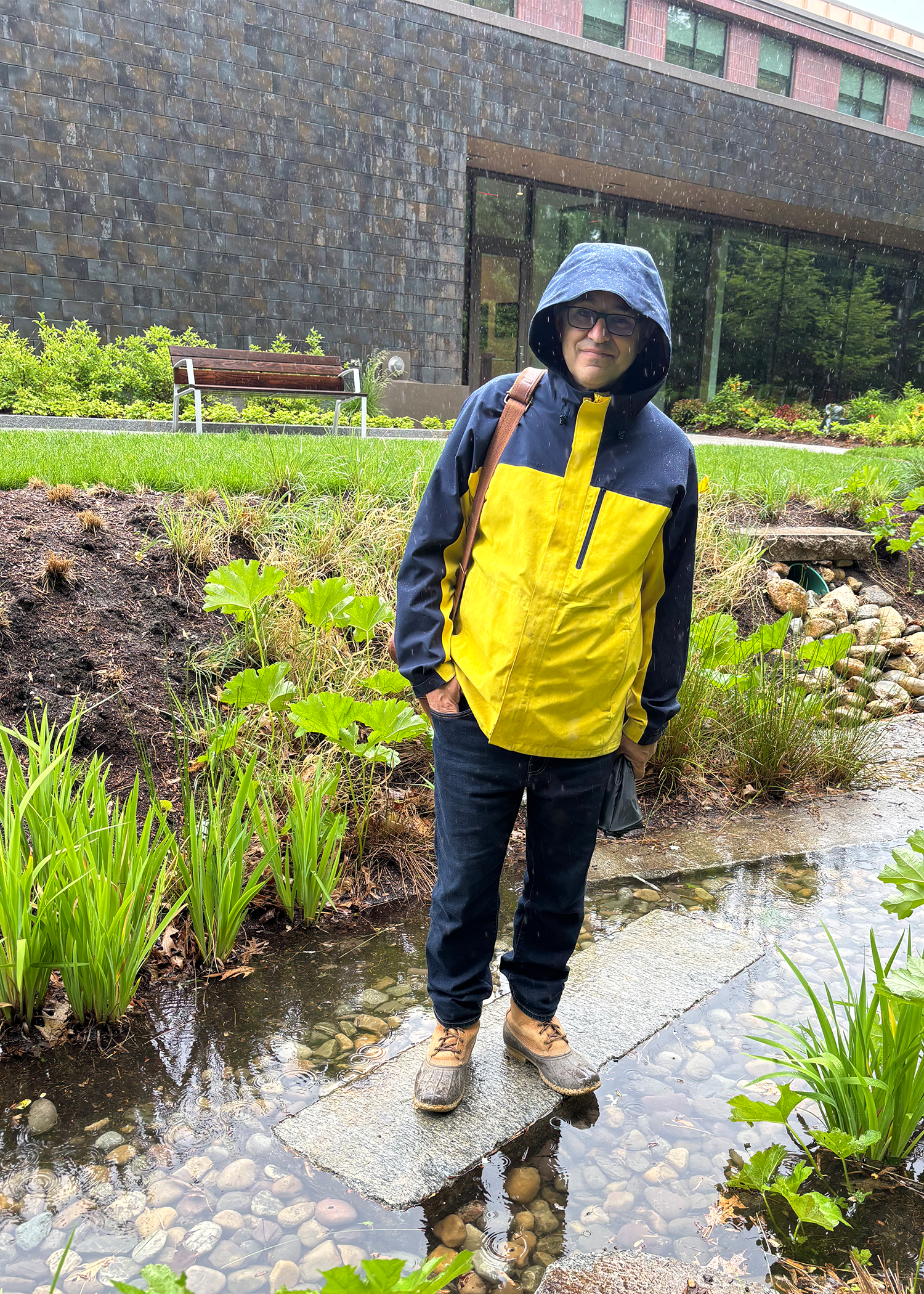 Ello Architecture, was intrigued by the idea of revealing and celebrating Belmont’s beloved brook. A 20-year town resident and University of Virginia graduate, Valentine’s local career highlights include designing the gardens at the Arnold Arboretum, Boston College, and MIT, and nationally with Stimson, a 60-acre floodplain park in Shaker Heights, Ohio, and a wildlife land-bridge in San Antonio. He enjoys architectural drawing with his son.
Though Belmont’s system of streams and brooks threads throughout town, nearly all of these wonderful waterways have been culverted and buried. Behind Belmont Library flows the only stretch of Wellington Brook on public town land that sees the light of day. Valentine explains: “Throughout the library’s 70 years on this site, this precious 200-yard stretch has been ignored and abused. Polluted runoff from old parking lots ran directly into its waters and Japanese knotweed choked out native flora. Here was an opportunity to reveal and celebrate this stream and give it a voice. I worked with the team to make this happen by designing a set of waterways to celebrate the stream, make it visible, and let people interact with it in various ways. Essentially, I saw it as the most important ‘book’/‘volume’ in the library’s collection.”
In several public meetings, Valentine worked closely with town committees, planning board, Conservation Commission, Historic District Commission, and the Shade Tree Committee (STC) to share design concepts and welcome and incorporate community feedback. The committees and town engineer reviewed all plans carefully. The Library Building Committee, a dedicated team of volunteers, and library director Peter Struzziero, were the primary public body throughout the process and made critical decisions.
Though convinced that the stream was the heart of the site, Valentine discovered that when the team showed images of Wellington Brook, few people had ever actually seen it and some barely knew of its existence. ”What began as proximity issues,” he said, “became assets to bring people closer to the water. Beyond its tight size, the site presented few challenges.
“The STC helped us celebrate the diversity of Belmont’s native trees,” said Valentine. “Pawpaw, Big Leaf Magnolia, and Catalpa trees are, I believe, the first of their species to be planted in Belmont’s public landscape. We connected the new garden’s paths to the Belmont Garden Club‘s existing wonderful collection of native woodland plants, now accessible in compliance with the Americans with Disabilities Act (ADA). To complement the Garden Club’s native plants, we developed a palette that reflects a stream-side wetland community. This community suits the sunny microclimate of the new spaces and the town’s maintenance limitations, and provides habitat and food for many species of insects, birds, and mammals.”
Existing flora of the garden site were largely prized and showcased. “The Dawn Redwood,” enthused Valentine, “is at 80 feet the site’s tallest tree and one of Belmont’s true giants. To protect this beloved community member, we carefully built the adjacent ADA walkway with minimal impact on the land. We planted over 30 trees: Tupelo, Tulip Tree, and Pin Oak. The Underwood Estate’s woodland, an amazing town resource, beautifully complements the library’s park spaces. We preserved open vistas into this landscape and historic home from both the outdoor gathering spaces and from spaces within the library.” Two-story 30-foot glass walls permit dramatic long and wide views straight through the entire complex, from Concord Avenue through the Morrissey Room concert space to the mixed deciduous forest out back.
When a wild and windy storm rolls in, the whole ensemble flows with magnificent force. Rocky rivulets (framed by blue flag iris and Indian rhubarb) trickle under pedestrian canals from Concord Avenue; cascade in hidden downspouts from the “green” roof; wind their way through boulder-lined verdant channels thick with a riot of grasses, sedges, rushes, and ferns; and seethe into the Wellington Brook. On cue, the Underwood Estate’s looming grove of lindens, oaks, and maples wave and sway beyond the rocky berm.
The STC is known to be on a constant crusade to increase diversity among native trees and to improve the health and scale of the town’s tree canopy and biome. “The Library Garden,” says Valentine, “is just one patch connecting that much larger quilt of the town’s green spaces. As a major new link along Belmont’s green artery, the garden may instill wonder and delight in a setting where people can slow down and contemplate the world around them.”
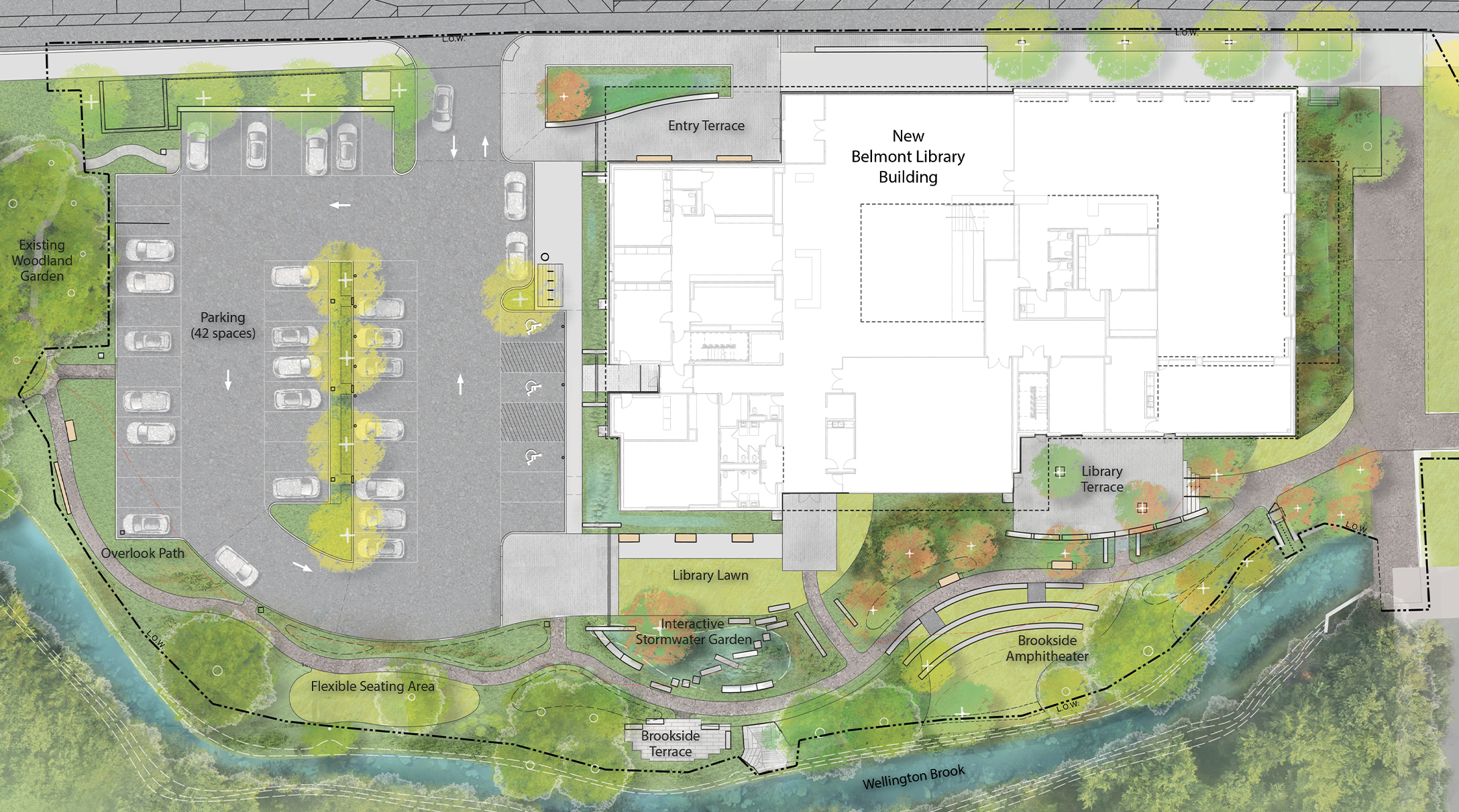
Yet it’s mainly the kids who command Valentine’s attention. “My hope,” he says, “is that children will be drawn to the brook now that they can see it, hear it, sit next to it. I hope they’ll notice that all the water flowing from the sky and the library itself is gathered in a series of iris-filled channels that all flow together, feeding the plants in a series of swales and pools and then finally flowing into the stream. Maybe this will fire kids’ imaginations to realize that we’re all connected—library, roof, rocks, cars, trees, people—in this larger interconnected system. Every drop of rain that lands on site goes into the brook, so everything we do there contributes.” Even the slender, bark-brown light-posts remain unobtrusive—until they illuminate.
“My hope is that kids will come to understand this intuitively, by seeing the water splash into the swales from the roof downspouts; or stepping on the stones to explore the big rainwater basin, whether it’s dry or flooded. Maybe they’ll get wet! When they’re sitting in the amphitheater right by the stream, they hear the water flowing over the rock and are drawn to the edge to catch a glimpse of our neighbor, the muskrat! At a curve in the brook, a lean-rail vista looks upstream, where the banks are still being eroded by Japanese knotweed. Maybe teens will lean on the rail, talk on their phones, and see we’ve got a lot to do to repair damage already done.”
The wider ecological picture harks back to the romantic pragmatism of proto-naturalist Charles Eliot, the landscaping genius of Frederick Law Olmsted, and locally the insightful vision and philanthropy of Judy Record. “Let’s talk about the failure of imagination in the modern age and the loss of contact with nature,” Valentine concludes. “My firm belief is that our science-and-technology driven culture has completely blown it over the last 100 years. If we can’t get our kids off their screens to engage with the natural world, one day soon they will look up and say, ‘Hey, what happened to our planet? Are you telling me it can no longer sustain us and we are all going to die? When did that happen?’ Hopefully we can open their eyes.”
Fred Bouchard, a Belmont Citizens Forum Newsletter Committee member and regular contributor, is a long-time avid bird- and butterfly-watcher, a fairly keen naturalist, and a so-so newbie gardener.

Sorry, the comment form is closed at this time.