
A Summary of OSRP Virtual Public Meeting, Thursday, May 28, at 6:30 PM
By Jeffrey North
Belmont’s Open Space and Recreation Plan (OSRP) is nearing completion after eight months of technical analysis and public engagement. At the final public meeting on May 28 residents called for a balance between recreational uses and the protection of natural resources. The 10–year plan will now be refined and submitted to the state’s Division of Conservation Services (DCS), within the Executive Office of Energy and Environmental Affairs. Upon DCS approval Belmont will become eligible for important open space and recreation grants. Belmont’s last OSRP was completed in 2000 and has expired; plans should be updated every decade.
The Select Board formed a comprehensive plan committee last spring (see March 2025 newsletter), whose scope of work includes updating the town’s OSRP. Then last fall an OSRP Advisory Committee started work, and hired consultants from Vanasse Hangen Brustlin, Inc., (VHB), a multidisciplinary civil engineering consulting and design firm headquartered in Watertown, to help develop the plan.
What the plan will do
An OSRP is intended to guide decisions on land use, growth, and climate resilience through high level goals and action plans, rather than to dictate the exact design of individual projects.
The OSRP also serves as a funding tool. A current, approved plan is required to access certain state grant programs, including:
- LAND (Local Acquisitions for Natural Diversity): Helps municipal conservation commissions acquire land for conservation and passive recreation.
- PARC (Parkland Acquisitions and Renovations for Communities): Funds the acquisition of parkland and the development or renovation of public parks.
- Conservation Partnership: Assists non-profits in acquiring interests in land for conservation or recreation purposes.Landscape Partnership: Supports the preservation of large, contiguous blocks of forested and other important conservation lands.
- Land Acquisition for Forest Reserves: Helps municipalities and non-profits acquire forest lands to protect them as reserves.
- Massachusetts Land and Water Conservation Fund (LWCF): A federal/state matching program for acquiring and developing public outdoor recreation areas
How the plan was developed
The planning process began in late 2025 and was designed to include substantial front‑end public engagement. VHB and the committee conducted topic‑focused stakeholder interviews, held an initial in‑person public workshop on existing conditions and opportunities, and administered a town‑wide online survey.
The survey drew just over 600 responses, providing planners with a robust sample of residents’ open-space uses, the facilities they value, and the investments they would prioritize. In parallel, the team reviewed prior planning documents, GIS data, and other records to understand what has been done over the past decade and what efforts are underway.
This second public meeting was the final formal engagement step before submission to the state, but both VHB and committee members said that comments received at the meeting and by email will still shape the final draft.
Major themes from earlier outreach
VHB project manager Julia Mintz summarized the key themes that emerged from the first meeting, survey, and stakeholder interviews. Residents and stakeholders highlighted:
- Heavy demand on athletic fields and concerns about maintenance capacity and staffing.
- Strong interest in better bicycle and pedestrian connections, including shared‑use paths and trail access.
- Support for native plantings, habitat restoration, and protection of wetlands, wildlife habitat, and tree canopy.
- Desire for basic amenities such as improved signage, bathrooms, seating, better trash management, and more accessible facilities.
- Persistent tensions among user groups in shared spaces, including dog owners, youth sports, and casual park users.
Stakeholders also emphasized the importance of planning for climate resilience and coordinating the use of open spaces so they remain safe and enjoyable for all.
Six goals for the next decade
Mintz and VHB planner Nour ElZein presented six overarching goals, each supported by specific actions. They are:
- Enhance, connect, and steward Belmont’s trail network for recreation and mobility.
- Maintain and improve recreation facilities to support safe, flexible, high‑quality use.
- Improve shared use of parks and reduce user conflicts.
- Improve safe, equitable access to parks, schools, and conservation areas.
- Strengthen governance, protection tools, and long‑term capacity to steward and expand open space.
- Protect and restore Belmont’s natural systems and water resources.
Under Goal 1, recommended actions focus on infrastructure upgrades and stronger coordination with the Department of Conservation and Recreation, local volunteers, and regional trail partners at places such as Rock Meadow and Lone Tree Hill, with the aim of creating a better maintained and more connected trail system.
Goal 2 combines site‑specific improvements at facilities like Belmont High School fields, the Winn Brook area, the rink complex, and the “Golden Bowl” (the large grassy pit between the pool and Concord Avenue) with policies on field maintenance, waste management, and oversight.
Goal 3 addresses shared‑use conflicts, especially involving dogs. Actions include reviewing the “Paws in the Park” shared‑use program, clarifying off‑leash hours and locations, improving signage around leash rules, and evaluating options for a designated dog park or smaller fenced dog areas.
Goal 4 focuses on safe and equitable access, particularly for youth and seniors. Proposed actions include better bike parking at schools, village centers, and major parks, safer crosswalks, and improved wayfinding to connect neighborhoods to parks and community destinations.
Goal 5 emphasizes governance and legal protections. Potential actions include creating a permanent open space committee, pursuing stronger protections for key conservation lands like Rock Meadow, tracking Chapter 61 and 61A properties (forest land), and considering tools such as zoning overlays, conservation restrictions, and formal stewardship structures.
Goal 6 centers on ecological protection and climate resilience, focusing on habitat corridors such as Rock Meadow, Lone Tree Hill, the Beaver Brook corridor, wetlands, the Western Greenway, and possible vernal pools. Actions include invasive species management, habitat mapping, and stronger buffer protections.
Public comments: skate park and dogs
The public comment period opened with a detailed statement from Seetha Burtner of Townsend Road, who criticized the omission of skate park questions from the town–wide survey and framed it as an equity issue for youth in “wheeled sports.” She cited a 2021 Friends of Belmont Skate Park survey—distributed through schools, PTAs, and social media—in which over 90% of 579 student and 246 adult respondents supported building a skate park in town.
Burtner argued that without a local facility, children and teens skateboard, rollerblade, ride scooters, and ride BMX bikes unsafely on streets or in prohibited spaces, or must be driven to other towns. She contrasted the one–time capital cost of about $500,000 and modest annual maintenance of a few thousand dollars for a skate park with the higher ongoing costs of the new ice rink, and urged the committee to clearly include a skate park in the plan. Chair Paul Cowing responded that Burtner’s concerns and earlier advocacy had already been incorporated into the draft and that he had spoken with Recreation Commission chair Mike Capitani about how to move a skate park project forward.
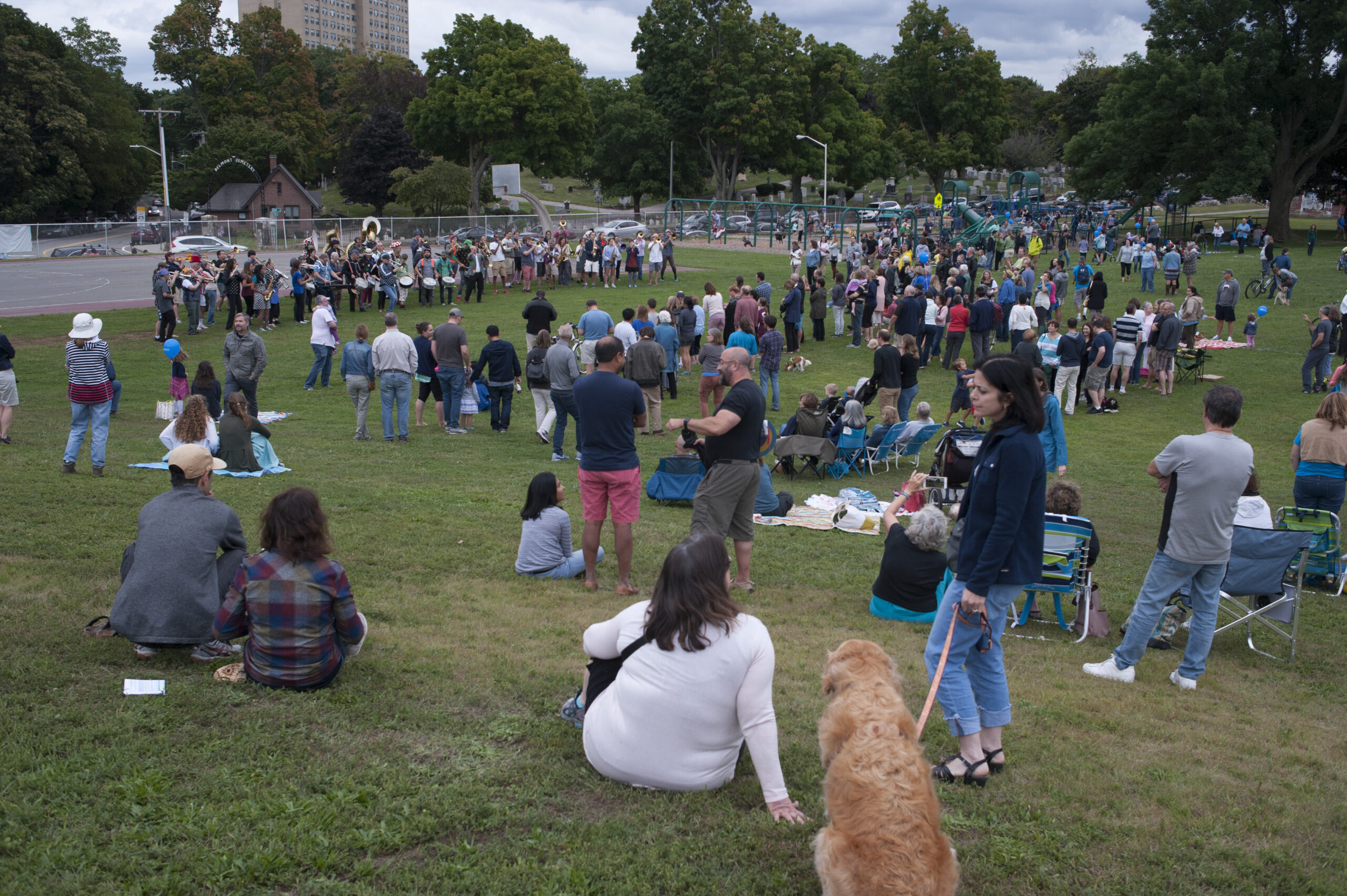
Several commenters focused on dogs and fields. Town Meeting member and dog owner Kelly Michaud of Precinct 1 urged the town to add a simple, low‑maintenance dog park, noting that Belmont has more than 1,200 licensed dogs yet is one of the few nearby communities without a dedicated dog park and one of the few that allows off‑leash dogs on municipal fields. She argued that a fenced gravel area with benches and shade could provide a safe space for dogs and owners, relieve pressure on heavily used athletic fields, and build community among residents.
Youth soccer coach and dog owner Cedric Dubois of Richmond Road strongly supported the dog park goal and described driving to dog parks in other towns so his dog could run without disturbing children, some of whom he has seen frightened by dogs on Belmont fields. In contrast, resident Enrique Pizaña praised off‑leash spaces for keeping geese off fields and said he values children playing on real grass rather than synthetic turf.
Former Recreation Commission member Steve Warner of Oxford Avenue argued that in a built‑out town, Belmont must make existing space available to as many people as possible by investing in current parks, improving maintenance, and re‑using “dead” areas, such as an old shed at Grove Street, potentially through small “pocket parks.” Town Meeting member Ira Morgenstern of Precinct 7, a dog owner who helped craft the earlier Paws in the Park shared‑use plan, urged the town to try that compromise before committing to a separate dog park and warned that a distant dog park could be less accessible to older dog owners.
Next steps
Committee member Erin Rowland thanked participants and said the committee is committed to incorporating public feedback into the OSRP. Mintz explained that VHB will now integrate comments from this meeting and any additional written input into a refined draft, which will then go to the Massachusetts Division of Conservation Services for review and approval. Cowing closed by emphasizing that the OSRP will guide Belmont’s open space and recreation decisions for the next 10 years and encouraged residents to work with the boards and commissions identified as “champions” in the plan to move specific projects forward once the plan is adopted.
Jeffrey North is the managing editor of the Belmont Citizens Forum Newsletter.
Links for more information
Belmont’s last OSRP from 2000. This link is to a draft version dated April 1999
Report on Belmont’s 2000 OSRP in the July 2000 issue of the BCF Newsletter.
Massachusetts Division of Conservation Services list of cities and towns with up to date OSRPs (Belmont has an “Expired Plan” as of January 1 2026).

Sorry, the comment form is closed at this time.