
By Omar Albarbari
Every summer, harmful algal blooms (HABs) affect lakes and ponds across Massachusetts, sometimes leading to swimming advisories or closures. These blooms can produce toxins that threaten people, pets, and wildlife. Monitoring is expensive, and many of our local bodies of water are affected by these algal blooms. At the time of this writing, Hardy Pond in Waltham has an active bloom, resulting in warnings against swimming, fishing, and boating.
HABs are rapid overgrowths of cyanobacteria or algae that have many negative consequences. They can block sunlight, exhaust dissolved oxygen and nutrients, and release cyanotoxins into the water. Algal blooms are becoming more common because of increased stormwater runoff and the resulting nutrient pollution and as a consequence of global warming, which also brings warmer temperatures and more intense rainfall. Available monitoring methods have many problems that prevent usage in our beloved local ponds and lakes. For example, laboratory testing is slow and expensive, as it requires multiple people and sending water samples to a laboratory with specialized equipment and staff. Satellite imagery misses small ponds and early signs of bloom development because of its low resolution, and it only takes pictures once algal blooms already form. Continuous monitoring equipment is oftentimes too expensive for towns and organizations that steward these small and local bodies of water. A Cambridge report stated that a water-quality buoy costs $47,000, with other water-quality buoys landing in the range of thousands to hundreds of thousands of dollars!
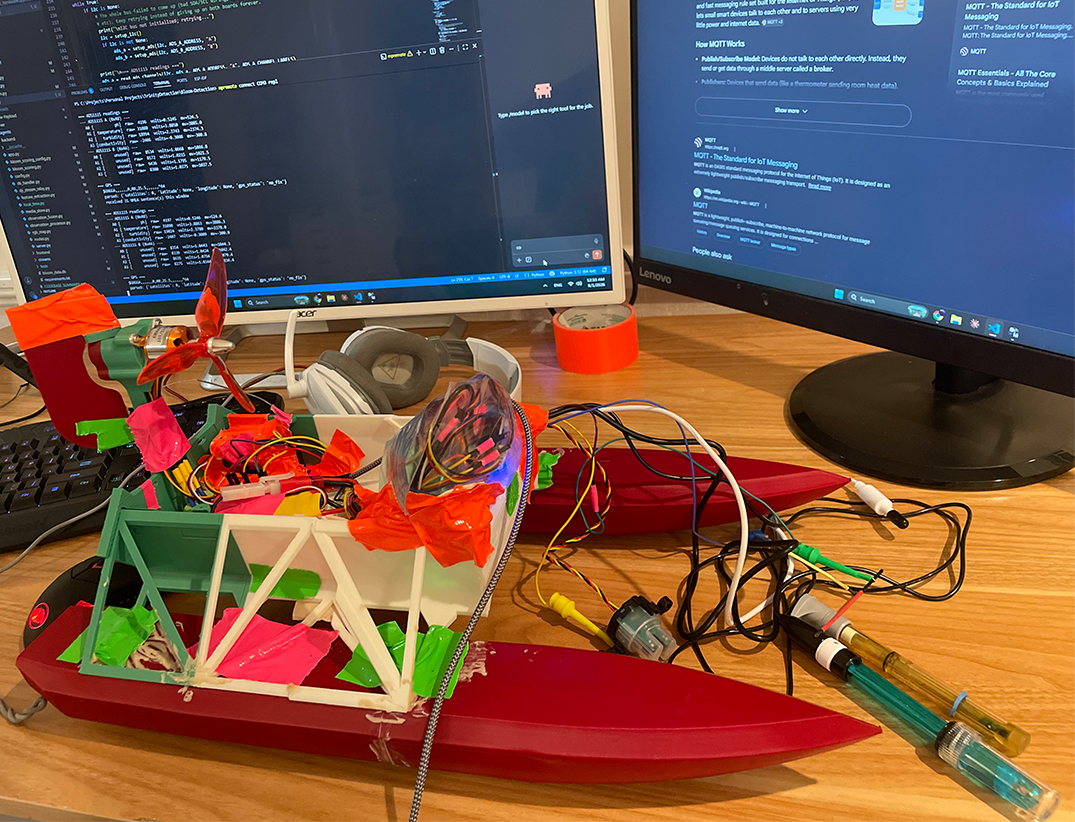
Omar’s prototype is currently under development with field testing ongoing. Photo: Omar Albarbari
Algal blooms are a real and worsening problem, so I decided to take action. I’m a Belmont High School senior, and with my friend Yassin Abdelazim, I designed a system intended to tackle all of these environmental challenges. Early prototypes of my system have a drone that flies and captures specialized imagery, a boat that collects water-quality measurements like temperature, pH, turbidity, conductivity, nitrate and ammonium, and a central server that connects the devices and returns a real-time spatial map that shows areas at risk for a bloom using machine-learning methods. Then, a device like a phone or laptop can be connected to the server and access the map through any browser.
This system is designed to be low-cost, hyperlocal, and accessible for our waters. Alternatives, such as the water-quality buoy mentioned above, are much more expensive than the system I’m developing, which currently costs about $500. Additionally, my system provides mapping, imagery, and adaptability to multiple different bodies of water rather than simply numbers and measurements from one static location. The goal is to get essential technology in the waters where it is needed most to improve local monitoring efforts. This may allow for preventative action to be taken, and for earlier and more specific warnings to prevent adults, kids, and pets from getting sick.
Currently, this system is under development with field testing ongoing. This system will shift and transform as different needs and concerns become clear in testing. I am always interested in collaborating with people and organizations who share an interest in protecting our waters. If you wish to contact me about this project or to collaborate on it, please reach out to me at omarbarbari9@gmail.com. My inbox is always open!
Omar Albarbari is a senior at Belmont High School.

Sorry, the comment form is closed at this time.