
By John Beaty
This story is the second article about the William Flagg Homer House in Belmont. The first, “Who Built the Homer House?” (BCF Newsletter, September/October 2025 issue), focused on how the house was financed, designed, and built. Here, we will describe the extraordinary effort local women made to purchase the grand old house for their Belmont Woman’s Club (BWC). This purchase was made in the context of the suffragists’ campaign for women’s rights across the country. Women’s clubs were established to free women from the home and to provide them refuge, empowerment, enjoyment, and opportunities to serve their communities.
Belmont’s William Flagg Homer House owes its survival not only to a famous painter uncle and a handsome mansard roof, but to hundreds of determined women who decided that this place, and their own public lives, were worth investing in.
From private villa to women’s haven
Boston merchant William Flagg Homer acquired the land and built his 1853 Italianate villa on Wellington Hill. In 1927, local women turned that grand home into a clubhouse and, in the process, claimed a new kind of civic space for themselves.
Homer used the house first as a summer residence and later as his year‑round home until his death in 1883; meanwhile his nephew, Winslow Homer, sketched and painted Belmont scenes inspired by the house and its surroundings. Today, the house anchors Belmont’s Pleasant Street Historic District and its BWC owners use the property to host social gatherings, lectures, and community events.
A landmark passes from hand to hand
Between William Flagg Homer and the BWC, the house had a busy real‑estate life. In 1884, neighbor Susan Blake
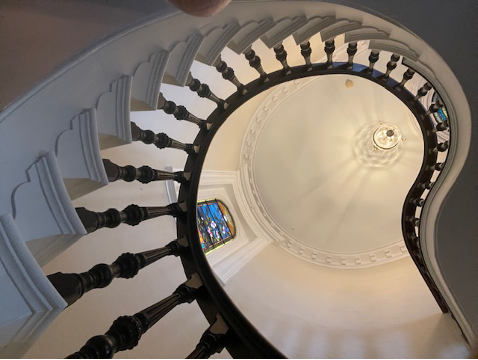
William Flagg Homer House staircase. Photo: John Beaty.
bought the property for $21,000, added paneled woodwork and a grand fireplace, and installed etched “B” glass panels and stained glass that still catch the light today.
Over the next decades, the deed moved quickly. A string of sales and “conveyances” in 1893 ended with Lillian Russell, wife of Joseph B. Russell, brother of Governor William Eustis Russell, and uncle of Cambridge mayor Richard Russell. In 1904, Judge Arthur Stone purchased the property and, through same‑day transfers, ensured that both he and his wife, Alice Stratton Stone, were recognized as co-owners on the deed. That detail quietly reflects changing thinking about married women and property.
In 1911, the Stones sold the house to “Miss” Martha Frost, who lived there until her death in 1927. That same year, her executors received court permission to sell, and developer Carl B. Stenstrom quickly drew up plans to demolish the house and subdivide the land into seven lots. Before any demolition could begin, however, Belmont women intervened.
A woman’s club steps in
The BWC, formally established in 1920 as women gained voting rights, had already become a 600‑member organization devoted to education, philanthropy, and civic work. When members learned that the Homer House was threatened, club president Belle (Emory) Chaffee and her colleagues moved even more quickly, working with town officials to buy the property from Stenstrom and save it from destruction.
On March 1, 1927, the BWC purchased the Homer House for $25,000, using $5,000 from club funds and two $10,000 mortgages, one from Belmont Savings Bank and one privately from Chaffee herself. The house needed work, from inadequate gas service to the lack of modern electrical wiring, but the club’s leadership concluded that the acquisition was both a sound “business venture” and an important civic act.
At the time, women’s clubs around the country served as crucial semi‑public spaces where women, newly enfranchised but still constrained by expectations of domesticity, could organize, learn, and lead. Belmont’s club followed that model, providing refuge, empowerment, enjoyment, and opportunities for large‑scale community service in an era when many women had only recently gained the legal right to own property.
Nine months to retire the debt
The scale and speed of what followed are striking. In only nine months, from March through the end of 1927, the club retired both $10,000 mortgages, which represented 80 percent debt on the purchase price, while also contributing $3,640 to charity that same year.
To put that effort in perspective, $25,000 in the mid‑1920s equates to roughly $450,000 to $500,000 in today’s consumer purchasing power, yet that inflation adjustment still understates the change in Belmont real estate values since 1927. A 1850s Italianate landmark on a prominent site in an affluent town would almost certainly be valued in the multimillion‑dollar range today.
If we assume a conceptual $5 million, the women of the BWC effectively took on the equivalent of a $4 million debt and paid it off in less than a year, while still funding significant philanthropic work. Their records note that the second mortgage’s payoff was celebrated by “burning of the mortgage by the President and the three past‑presidents,” a ritual that underscored both relief and pride.
A whole town chips in
Club records show that the women did not act alone; Belmont residents and businesses rallied to help furnish, modernize, and maintain the house. The Marcy Coal Company supplied equipment and workers to move the club’s possessions and discounted coal costs that first winter, while the Arlington Gas Company relocated and reconnected the gas stove.
Contractors and merchants donated labor and goods. A decorator offered to finish part of the house, a lumber company contributed materials for a stage, and an insurance agent provided fire insurance for an arts and crafts exhibition. Individual residents contributed items that still shape the interior today, including mirrors, rugs, light fixtures, furniture, artwork, and even a swinging outdoor sign bearing the club’s seal.
The club’s suggestion box generated an ongoing stream of fundraising ideas. Members ran food sales around meetings; operated a “woman’s exchange” selling candy, cards, hooked rugs, and even mincemeat at 15 cents a pint; and staged dramatic performances whose profits helped paper and paint one of the rooms.
Women’s labor, women’s leadership
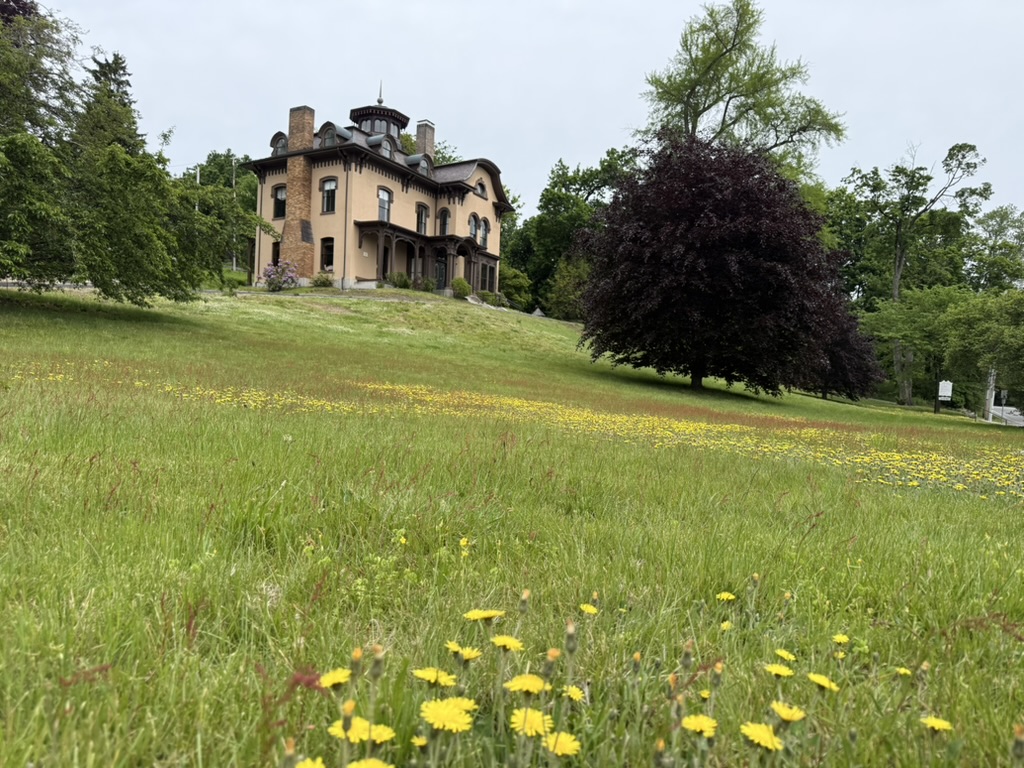
The William Flagg Homer House in May 2026. Photo: Frederique Rigoulot
President Emory Chaffee did not soft‑pedal the obligation that came with owning a clubhouse. She told the 600 members, “If all of us are not going to share the responsibility of owning a clubhouse, then you had better vote against buying it,” and the vote was overwhelmingly in favor of the purchase.
Members backed that vote with time and money. Each pledged to contribute five dollars, a substantial sum at the time, while also buying dishes and participating in an endless schedule of bridge luncheons and suppers, some of which raised $75 to $80 per event. Six afternoon bridge luncheons organized by a single member generated $502.75, while a Harvest Bazaar contributed another $915.24.
Gifts of furnishings doubled as symbols of membership and care. Donations ranged from chandeliers and lamps for the halls and dining room to an eight‑day clock for the boardroom, draperies and carpets, rattan furniture, tables and chairs, and a mahogany piano that arrived with moving and tuning already paid. In her will, one member left $500 specifically to be applied to the mortgage, a final gesture that literally helped pay down the debt.
Preservation as ongoing civic work
On the cusp of a centennial, the Belmont Woman’s Club still owns and uses the Homer House, now as a 501(c)(3) organization open to all. In 2010, the club granted a conservation restriction on the property to the Belmont Land Trust, effectively donating the land’s development rights to ensure that the house and grounds could not be carved up by future developers.
Recent landscape and restoration projects, supported in part by Community Preservation Act funds, have opened up new views of the house and stabilized deteriorating features. As restoration continues, every public event on the lawn or in the parlor rests on the financial and political groundwork laid by the women who, in 1927, burned their mortgages and kept showing up for meetings.
On the eve of the club’s 100th anniversary of ownership, the Homer House stands as both a physical landmark and a record of what organized volunteers, most of them women whose names rarely appeared on deeds before the mid‑nineteenth century, could accomplish together. The question those early members posed implicitly with their actions still resonates: would we today take on the equivalent of a 5‑million civic project and then work, month after month, to pay it off for the sake of history, community, and each other?
John Beaty is a Belmont resident and lives in the Pleasant Street Historic District. He is an alternate member of the Belmont Historic District Commission, and is retired from Northeastern University.
Women’s Rights and the Woman’s Club
In 1850, Belmont’s women lived under legal and social constraints that limited their rights to vote, own property, or control their wages after marriage. The common‑law doctrine of coverture meant a married woman’s legal identity was effectively merged into her husband’s, leaving her unable to enter into contracts or retain most property in her own name.
Massachusetts took a major step with the Married Women’s Property Act of 1855, which allowed married women to own and control real and personal property and keep their own earnings. By the 1920s, the ratification of the 19th Amendment and the rise of groups like the League of Women Voters opened new avenues for civic education and political participation, even as expectations around marriage and motherhood remained strong.
The Belmont Woman’s Club, founded in 1920, emerged from that shifting legal and cultural terrain. Its purchase of the Homer House in 1927 not only preserved a landmark associated with Winslow Homer but also marked a tangible moment when women in Belmont moved from hosting meetings in private parlors to owning a public‑facing institution in their own collective name.

Sorry, the comment form is closed at this time.