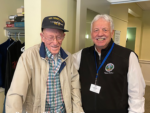
The article “Serving Those Who Served” (BCF Newsletter, November/December 2025) contained a mistaken identity. The gentleman pictured on the left on page 3 (and above) is Mr. Robert Young, a 100-year-old veteran, not Robert Taylor. We apologize for the mistake, and we salute Mr. Young’s service
Belmont Farmers Built Chicago Skyscrapers

By Edmund McDevitt In 1831, in the section of Watertown that later became the south part of Belmont, Peter Chardon Brooks was born. The child was to become one of the most important historic figures in the development of the skyscraper. Little is known about his family’s residence in Watertown. Peter Brooks’s grandfather, the original Peter Chardon Brooks (1767–1849), was, at the time of his death, quite possibly the wealthiest man in Boston. His wealth came from a marine insurance business, some of which insured ships involved in the Atlantic slave trade—no surprise, given that the family were slaveholders prior [READ MORE]
First Church History

John Howe (left) speaks with attendees after his talk at the Beech Street Senior Center about the history of First Church in Belmont, Unitarian Universalist, which was built in 1890 in the Romanesque Revival style. The church is one of Belmont’s important historic buildings, adjacent to the 1853 Lyman Underwood House. His presentation included photos showing the church in its original location on the north side of Concord Avenue, with the railroad tracks at street level. Howe was a long-time Belmont resident, and remains an active member of First Church. The Belmont Historical Society hosted Howe’s talk last November.
Profile in Belmont: Ken Stalberg

By Elissa Ely Few of us recognize our path in this spinning world until long past childhood. It’s usually vague, convoluted, unclearly marked. If we’re lucky, we don’t wander down too many side streets leading nowhere (or worse, to unhappiness). For some, the wandering never ends. Ken Stalberg, former “Mailing Maestro” for the BCF Newsletter, principal violist with the Boston Lyric Opera Orchestra, the Boston Classical Orchestra, and the Boston Landmarks Orchestra, as well as a violinist with the Boston Ballet Orchestra, took a straight path from a young age. His mother was an amateur pianist (“and a very good [READ MORE]
Why Recycling Stagnates

Belmont’s options for dealing with waste woes By Jeffrey North Dr. Jonathan S. Krones, associate professor of engineering at Brandeis University, gave a virtual presentation titled “Garbage 101: How the waste system actually works, and what we can do to achieve a more circular economy” sponsored by the Belmont Public Library last November. The talk offered a rare behind-the-scenes look at how waste and recycling systems actually function in Massachusetts and around the country. It also delivered a clarifying message to communities like Belmont: our recycling system is struggling not because residents are necessarily doing it wrong, but because the [READ MORE]
OPINION: Treat Invasive Plant Removal as a System

By Jeffrey North Belmont’s conservation lands—Rock Meadow, Lone Tree Hill, Habitat, and our many wooded edges and wetland buffers—face a quiet but relentless challenge. Aggressive invasive plants threaten the fundamental health and richness of our local native plant communities, and consequently the fauna that rely on them for food and shelter. Invasive species such as glossy buckthorn, bittersweet, knotweed, and tree of heaven do not care about property boundaries or budget cycles. Yet our response to this threat is fragmented: volunteers clear a patch, a contractor mows a section, a grant funds a pilot project. Then, when the effort cannot [READ MORE]
Letter to the Editor: November/December 2025
To the Editor: Love the publication of this article [“Where Does the Water Go?”, BCF Newsletter, September/October 2025], but there is an important correction to make: “It briefly enters Clay Pit Pond, then exits via a culvert beneath Concord Avenue, flowing into Wellington Brook.” should read: “It briefly enters Clay Pit Pond, then exits via a culvert beneath Brighton Street, flowing into Wellington Brook.” Basically Wellington Brook flows from the library to a culvert under Concord Avenue, and then into Clay Pit Pond. Water flows out of Clay Pit Pond into a culvert under Brighton Street into another part of [READ MORE]
Town Meeting OK’s Community Path Right of Way
By Vincent Stanton, Jr. On October 22,Town Meeting voted overwhelmingly to approve two warrant articles that clear the way for the town to assemble the right of way (ROW) for the community path. Article 5 authorizes the Select Board to acquire the land necessary for the community path. That land totals 265,805 square feet, and most of it is owned by public or nonprofit entities: 45.2% by the MBTA, 40.3% by the Belmont Citizens Forum, and 8.9% by the Town of Belmont. The Belmont Citizens Forum has communicated to the town its intent to donate the 107,172 square foot parcel [READ MORE]
Who Built the Homer House?

By John Beaty The William Flagg Homer House is a Belmont story with two mysteries. The first mystery is who was the architect who designed and built the Homer House. The second mystery is who William Flagg Homer was and how he provided the resources to acquire the land, hire an architect, and build this magnificent home. The Homer House is listed in the National Register of Historic Places (1979) and has been a focal point in Belmont’s Pleasant Street Historic District. It is especially interesting because the artist Winslow Homer was Flagg Homer’s nephew and often visited during the [READ MORE]
Profiles in Belmont: Andrew Mountford

By Elissa Ely Twenty-three years ago, I sent my child off to Burbank Elementary School. I had moist eyes. She had a yogurt, a few pretzels, a single Oreo, and a bag of carrots, which returned unopened several hours later. She moved through the grades and the years mostly uncomplainingly. What enchanted her, though, was the Belmont Before and After School Program (BASP). She wanted to be the first dropped off each morning and the last picked up each night. Staff must have worried about her home life. The head teacher at BASP was square-shouldered, frank-eyed, and pony-tailed; contagiously energetic, [READ MORE]
Miyawaki Forest Planted at Belmont Middle and High School

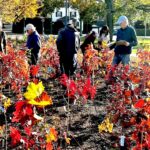
On Saturday, October 4, dozens of volunteers of all ages gathered at Belmont Middle and High School to plant a Miyawaki forest, also known as a mini forest. (See “Belmont’s First Miyawaki Forest Comes to BHS,” BCF Newsletter, July 2025.) They planted 1,400 native tree and shrub seedlings on 3,000 square feet—about the size of a public swimming pool. Photos by Jeffrey North.
Opinion: Service in Belmont

By Angus Abercrombie One of the greatest assets of our community is the many residents who take time out of their busy schedules to work on bettering our town. Some choose to serve on public bodies, some coach youth sports, and others dedicate their time to the numerous nonprofits making Belmont and its surrounding communities even stronger. That we see, time after time, our neighbors take on these noble efforts instills a valuable trust in shared values of the town. There is a distinct need for this work, both to complete tasks and to sustain our community’s character. It is [READ MORE]
Rock Meadow Lacks a Conservation Restriction

By Dan Nolan A pastoral gem in Belmont, Rock Meadow is in full splendor each fall as the leaves turn, providing a backdrop for Instagram posts, family holiday cards, and yearbook photos. It’s a treasure year-round for people, animals, pollinators, and the entire ecosystem it shares with the rest of the Western Greenway. What it doesn’t share is the same level of protection. As the crow flies, the deer trots, and the water flows, the land is all connected. The Belmont Conservation Commission is seeking to strengthen that connection by providing Rock Meadow with the same level of enduring protection [READ MORE]
Serving Those Who Served

A Conversation with Belmont’s Veterans Services Officer By Jeffrey North In every community, veterans are our living connection to history, service, and sacrifice. In Belmont, the responsibility for ensuring these neighbors receive the benefits, care, and respect they have earned rests with the town’s veterans service officer. For this installment of Vision for a Better Belmont, we sat down with Bob Upton, who leads this initiative, to learn how Belmont supports its veterans, the challenges they face, and how all of us can contribute to building a stronger community for those who have served. BCF What led you to become [READ MORE]
Belmont Community Path Hits Major Milestone

By Holly Muson and Jeffrey North On September 10, the design team led by Nitsch Engineering delivered the 75% design submission to the Massachusetts Department of Transportation (MassDOT). This submission marks a significant step forward for Phase I of the Belmont Community Path. The 75% design stage means that detailed plans are now largely complete. The submission covers alignment, grading, drainage, fencing, landscaping, and structural components such as the underpass, retaining walls, and other supporting features. This level of design provides MassDOT with the comprehensive materials needed to move the project toward final review, permitting, and construction. With this milestone, [READ MORE]
Letter to the Editor – September/October 2025
To the Editor: “PILOT Program Could Ease Tax Burden,“ by Max Colice (Belmont Citizens Forum Newsletter, July/August 2025) is an interesting discussion of the possibility that entities exempt from taxes, such as religious organizations and private schools, could make a meaningful contribution to Belmont’s bottom line. As part of his piece, Colice lists the 10 top tax-exempt entities. Last on the list is the Jewish Community Center; the name is not one that is commonly known. In fact, the Jewish Community Center is the Beth El Temple Center located at 2 Concord Avenue. It came into being when the Belmont [READ MORE]
Profiles in Belmont: Angus Abercrombie

By Elissa Ely Angus Abercrombie—21-year old Emerson College senior, Belmont Town Meeting Member, door-knocker on 850 Precinct 8 homes before his 2023 election victory–is so articulate, so quotable, that he should write his profile himself. Here are a scant few phrases to include in some future Abercrombie archive. The lucky person who assembles it will find themselves drawn in: “I was the right kind of nerd, a lover of spreadsheets.” “I love a good meeting! I’m never the guy who complains. A couple of times, I’ve voted NO to adjourn student government meetings.” “You can’t be an idealist in local [READ MORE]
Where Does the Water Go?

Understanding Clay Pit Pond and Belmont’s Hidden Rivers By Ry Emmert People don’t often think about where a raindrop goes after it hits the ground. It may splash on the pavement, flow toward a storm drain, and then seemingly disappear. However, if that droplet falls outside Belmont High School, it embarks on a complex and unexpected journey. This journey connects Belmont’s sidewalks to kayakers on the Mystic River, fish in the Charles River, and ships in Boston Harbor. The story begins with Clay Pit Pond, a shallow and iconic body of water situated between the high school and Concord Avenue. [READ MORE]
Belmont Boasts Bountiful Owls

by Fred Bouchard Let’s open with, then qualify, two generalizations about Barred, Snowy, and Saw-Whet Owls. Females run a bit larger than males; one might (erroneously) surmise that their voices are somewhat deeper in pitch. Most owls are strictly nocturnal. That said, our first two are crepuscular and diurnal, respectively. Barred Owl (Strix varia) Ubiquitous and crepuscular (active and vocal from dusk to dawn), Barred Owls rank among our easiest woodland owls to see. They tend to roost in outer branches, exposed. They don’t hug trunks for camouflage like Great Horned Owls or snuggle in holes like Screech Owls. Their [READ MORE]
Habitat Renovation is Underway

By Thomas Phillips Mass Audubon’s Habitat Education Center and Wildlife Sanctuary is currently renovating its entry circle to enhance visual appeal and incorporate accessibility accommodations for people with disabilities. The first phase of this project began in late April when the walkway was repaved and the entry circle widened. In early fall a new path will be built for people with disabilities with new plantings. The staff at Habitat are hopeful that, in addition to promoting inclusiveness for individuals with disabilities, the renovation will increase the check-in rates among visitors to the sanctuary. Staff believe that increasing check-in rates at [READ MORE]