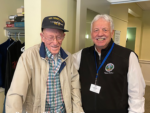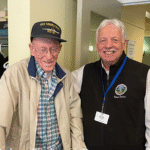
The article “Serving Those Who Served” (BCF Newsletter, November/December 2025) contained a mistaken identity. The gentleman pictured on the left on page 3 (and above) is Mr. Robert Young, a 100-year-old veteran, not Robert Taylor. We apologize for the mistake, and we salute Mr. Young’s service
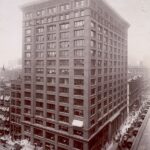
Belmont Farmers Built Chicago Skyscrapers

By Edmund McDevitt In 1831, in the section of Watertown that later became the south part of Belmont, Peter Chardon Brooks was born. The child was to become one of the most important historic figures in the development of the skyscraper. Little is known about his family’s residence in Watertown. Peter Brooks’s grandfather, the original Peter Chardon Brooks (1767–1849), was, at the time of his death, quite possibly the wealthiest man in Boston. His wealth came from a marine insurance business, some of which insured ships involved in the Atlantic slave trade—no surprise, given that the family were slaveholders prior [READ MORE]
First Church History

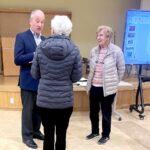
John Howe (left) speaks with attendees after his talk at the Beech Street Senior Center about the history of First Church in Belmont, Unitarian Universalist, which was built in 1890 in the Romanesque Revival style. The church is one of Belmont’s important historic buildings, adjacent to the 1853 Lyman Underwood House. His presentation included photos showing the church in its original location on the north side of Concord Avenue, with the railroad tracks at street level. Howe was a long-time Belmont resident, and remains an active member of First Church. The Belmont Historical Society hosted Howe’s talk last November.
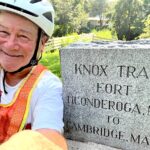
Bicyclist Rides the Henry Knox Trail

By David Webster When I lowered my bicycle on the grassy bank of the Sudbury River in Wayland and stared at the granite marker and historic broken Stone Bridge, time froze. The marker identified this place as being on the Knox Trail. I imagined steam rising from sweaty horses and oxen and then evaporating into the frigid winter air as the straining animals pulled their heavy loads of captured cannons across the bridge towards Boston. This winter marks the 250th anniversary of an extraordinary Revolutionary War event that was pivotal in forcing the British evacuation of Boston in 1776. During [READ MORE]
Profile in Belmont: Ken Stalberg

By Elissa Ely Few of us recognize our path in this spinning world until long past childhood. It’s usually vague, convoluted, unclearly marked. If we’re lucky, we don’t wander down too many side streets leading nowhere (or worse, to unhappiness). For some, the wandering never ends. Ken Stalberg, former “Mailing Maestro” for the BCF Newsletter, principal violist with the Boston Lyric Opera Orchestra, the Boston Classical Orchestra, and the Boston Landmarks Orchestra, as well as a violinist with the Boston Ballet Orchestra, took a straight path from a young age. His mother was an amateur pianist (“and a very good [READ MORE]
Beth Lambert: Restoring Rivers and Wetlands

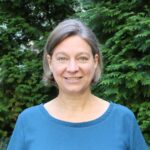
By Jeffrey North This article is part of the Belmont Citizens Forum’s series on environmental leadership in Massachusetts. The Massachusetts Division of Ecological Restoration (DER), part of the Department of Fish and Game (DFG), works to restore and protect rivers, wetlands, and watersheds across the commonwealth. From removing aging dams to revitalizing salt marshes and wetlands, DER supports projects that strengthen ecosystems, improve climate resilience, and reconnect communities to nature. The Belmont Citizens Forum spoke with Beth Lambert, director of DER, about the division’s statewide restoration priorities and her vision for the future. Jeffrey North conducted the interview. BCF What [READ MORE]
Why Recycling Stagnates

Belmont’s options for dealing with waste woes By Jeffrey North Dr. Jonathan S. Krones, associate professor of engineering at Brandeis University, gave a virtual presentation titled “Garbage 101: How the waste system actually works, and what we can do to achieve a more circular economy” sponsored by the Belmont Public Library last November. The talk offered a rare behind-the-scenes look at how waste and recycling systems actually function in Massachusetts and around the country. It also delivered a clarifying message to communities like Belmont: our recycling system is struggling not because residents are necessarily doing it wrong, but because the [READ MORE]
OPINION: Treat Invasive Plant Removal as a System

By Jeffrey North Belmont’s conservation lands—Rock Meadow, Lone Tree Hill, Habitat, and our many wooded edges and wetland buffers—face a quiet but relentless challenge. Aggressive invasive plants threaten the fundamental health and richness of our local native plant communities, and consequently the fauna that rely on them for food and shelter. Invasive species such as glossy buckthorn, bittersweet, knotweed, and tree of heaven do not care about property boundaries or budget cycles. Yet our response to this threat is fragmented: volunteers clear a patch, a contractor mows a section, a grant funds a pilot project. Then, when the effort cannot [READ MORE]
How Rail Trails Can Serve Public Housing

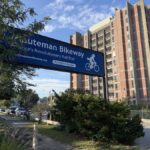
Drake Village, Arlington, and Lessons from Across the Northeast By Jeffrey North & Vincent Stanton, Jr. Development of the Belmont Community Path is proceeding in two phases. Phase I is close to the 100% design threshold. Planning for Phase 2, which will run from the Clark Street Bridge to the Waltham border, started in late 2022 when the town hired Pare Corporation and Toole Design. The Pare team studied the route options during winter and spring 2023 and recommended a final route to the Community Path Project Committee (CPPC) in May 2023 (see “Belmont Community Path Route Take Shape, BCF [READ MORE]
January/ February 2026 BCF Newsletter

Read the January/February 2026 BCF Newsletter. In this issue: How Rail Trails Can Serve Public Housing What would it be like to have the path close to Belmont Village? Are there any local precedents for paths adjacent to public housing? Read more. OPINION: Treat Invasive Plant Removal as a System Invasive species such as glossy buckthorn, bittersweet, knotweed, and tree of heaven do not care about property boundaries or budget cycles. Yet our response to this threat is fragmented. Read more. Why Recycling Stagnates Our recycling system is struggling not because residents are necessarily doing it wrong, but because the [READ MORE]
Letter to the Editor: November/December 2025
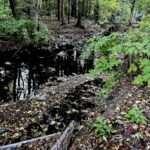
To the Editor: Love the publication of this article [“Where Does the Water Go?”, BCF Newsletter, September/October 2025], but there is an important correction to make: “It briefly enters Clay Pit Pond, then exits via a culvert beneath Concord Avenue, flowing into Wellington Brook.” should read: “It briefly enters Clay Pit Pond, then exits via a culvert beneath Brighton Street, flowing into Wellington Brook.” Basically Wellington Brook flows from the library to a culvert under Concord Avenue, and then into Clay Pit Pond. Water flows out of Clay Pit Pond into a culvert under Brighton Street into another part of [READ MORE]
Town Meeting OK’s Community Path Right of Way
By Vincent Stanton, Jr. On October 22,Town Meeting voted overwhelmingly to approve two warrant articles that clear the way for the town to assemble the right of way (ROW) for the community path. Article 5 authorizes the Select Board to acquire the land necessary for the community path. That land totals 265,805 square feet, and most of it is owned by public or nonprofit entities: 45.2% by the MBTA, 40.3% by the Belmont Citizens Forum, and 8.9% by the Town of Belmont. The Belmont Citizens Forum has communicated to the town its intent to donate the 107,172 square foot parcel [READ MORE]
Book Review: Here Comes the Sun by Bill McKibben

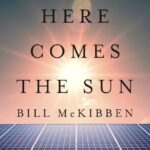
By Jeffrey North with assistance from Roger Wrubel In his latest book, Here Comes the Sun, environmental writer and activist Bill McKibben offers a compelling case for why solar energy may be the most hopeful—and practical—path forward in the fight against climate change. McKibben, who has long been a voice for climate action and grassroots mobilization, weaves together history, science, and policy to argue that solar power is not only technologically viable but also socially transformative. McKibben begins by tracing the origins of the modern solar movement, reminding readers that the technology is hardly new. What has changed, he notes, [READ MORE]
Who Built the Homer House?

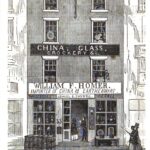
By John Beaty The William Flagg Homer House is a Belmont story with two mysteries. The first mystery is who was the architect who designed and built the Homer House. The second mystery is who William Flagg Homer was and how he provided the resources to acquire the land, hire an architect, and build this magnificent home. The Homer House is listed in the National Register of Historic Places (1979) and has been a focal point in Belmont’s Pleasant Street Historic District. It is especially interesting because the artist Winslow Homer was Flagg Homer’s nephew and often visited during the [READ MORE]
Profiles in Belmont: Andrew Mountford

By Elissa Ely Twenty-three years ago, I sent my child off to Burbank Elementary School. I had moist eyes. She had a yogurt, a few pretzels, a single Oreo, and a bag of carrots, which returned unopened several hours later. She moved through the grades and the years mostly uncomplainingly. What enchanted her, though, was the Belmont Before and After School Program (BASP). She wanted to be the first dropped off each morning and the last picked up each night. Staff must have worried about her home life. The head teacher at BASP was square-shouldered, frank-eyed, and pony-tailed; contagiously energetic, [READ MORE]
MyRWA Protects and Restores Mystic Watershed

Our Environmental Stewards: Patrick Herron, Mystic River Watershed Association The Mystic River Watershed Association (MyRWA) has been a leader in restoring and protecting one of the most urbanized watersheds in New England. There are 44 lakes and ponds within the watershed, with its headwaters beginning in Reading and flowing to Boston Harbor. From ecological restoration and climate resilience projects to education, community engagement, and policy advocacy, MyRWA has built a reputation for turning data and public participation into lasting change. The Belmont Citizens Forum spoke with Patrick Herron, executive director of MyRWA, about the challenges and opportunities of protecting the [READ MORE]
Miyawaki Forest Planted at Belmont Middle and High School

On Saturday, October 4, dozens of volunteers of all ages gathered at Belmont Middle and High School to plant a Miyawaki forest, also known as a mini forest. (See “Belmont’s First Miyawaki Forest Comes to BHS,” BCF Newsletter, July 2025.) They planted 1,400 native tree and shrub seedlings on 3,000 square feet—about the size of a public swimming pool. Photos by Jeffrey North.
Opinion: Service in Belmont

By Angus Abercrombie One of the greatest assets of our community is the many residents who take time out of their busy schedules to work on bettering our town. Some choose to serve on public bodies, some coach youth sports, and others dedicate their time to the numerous nonprofits making Belmont and its surrounding communities even stronger. That we see, time after time, our neighbors take on these noble efforts instills a valuable trust in shared values of the town. There is a distinct need for this work, both to complete tasks and to sustain our community’s character. It is [READ MORE]
Rock Meadow Lacks a Conservation Restriction

By Dan Nolan A pastoral gem in Belmont, Rock Meadow is in full splendor each fall as the leaves turn, providing a backdrop for Instagram posts, family holiday cards, and yearbook photos. It’s a treasure year-round for people, animals, pollinators, and the entire ecosystem it shares with the rest of the Western Greenway. What it doesn’t share is the same level of protection. As the crow flies, the deer trots, and the water flows, the land is all connected. The Belmont Conservation Commission is seeking to strengthen that connection by providing Rock Meadow with the same level of enduring protection [READ MORE]
Serving Those Who Served

A Conversation with Belmont’s Veterans Services Officer By Jeffrey North In every community, veterans are our living connection to history, service, and sacrifice. In Belmont, the responsibility for ensuring these neighbors receive the benefits, care, and respect they have earned rests with the town’s veterans service officer. For this installment of Vision for a Better Belmont, we sat down with Bob Upton, who leads this initiative, to learn how Belmont supports its veterans, the challenges they face, and how all of us can contribute to building a stronger community for those who have served. BCF What led you to become [READ MORE]