
By John Beaty
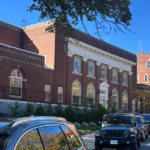
Anyone who has walked past Belmont Center’s Town Hall complex has seen it: a stately 1934 brick building on Concord Avenue, its Colonial Revival/Georgian Revival lines echoing the Police Station next door. Fewer people have been inside—and for good reason. Behind its handsome facade, the old Municipal Light Building is, by every recent account, a mess.
The building sits on a quarter-acre municipal campus next to the Police Station at 450 Concord Avenue and across the street from Town Hall, the Town Hall Annex and the School Department Building. Some of the land behind the BMLD building will be used for Belmont’s Community Path, Phase I (Belmont Community Path project plans). Designed by architect George Robinson (who also designed the Winters Block in Cushing Square), the two-story office building was constructed in 1934 on the site of the old Adams Store, with Public Works Administration funding, and dedicated on BMLD Superintendent Edwin “Ned” Taylor’s 70th birthday. It was built onto an earlier 1925 substation designed by Francis Galaher (Town of Belmont, “Representative Distinctive Areas”; Belmont Light history). It is listed on the state’s historic-resources inventory.
And it needs help.
What the Engineers Found—and Wouldn’t Go Near
In 2022, the town hired the structural engineering firm LeMessurier to assess the building’s exterior. Notably, the engineers inspected only from the outside. Their report states plainly: “LeMessurier’s knowledge of the building is based on visual assessment. Forensic analysis to determine the building’s construction or affiliated exterior assemblies was not performed.” The team had also decided, before the inspection even began, that any hazardous materials inside would be “collected and tested at a later date,” testing that, as far as we can determine, was never done. LeMessurier’s engineers stated they did not review all interior areas because of “potential organic growth” in the interior space, a clinical way of describing the mold and mildew that years of water damage have left behind (the engineers appear to have been reluctant, even wary, to spend much time inside). This 2022 facade assessment remains the most recent evaluation of the building.
What LeMessurier could see from outside was concerning enough. The complex is really three connected structures—the original 1934 office building, a brick-faced west wing, and the older concrete substation—and they are not aging well together.
- The brick walls: “performing adequately but suffering from movement-related stresses,” visible as cracking, delamination, and planar movement where the main building meets the west wing. The two sections expand and contract in different directions and are slowly pulling apart; without an expansion joint, engineers found, the damage will continue.
- The concrete substation: “spalling and delaminating in multiple areas.” Where the concrete has flaked away, the steel reinforcing bar underneath sits close to the surface and has corroded,most likely because water seeped through cracks over the years and reached the rebar, which then expanded and forced the concrete to crack further. LeMessurier called for further investigation, including ground-penetrating radar, to determine how much of the structure is affected.
- Windows, doors, and roofing: largely original, failing, and, in the case of many older steel-framed windows, broken outright, allowing water and air infiltration.
In short: the outside requires extensive, costly remediation, and the inside may not currently be safe to occupy without protective equipment.
Whose Building Is It, Anyway?
The building’s ownership history is almost as tangled as its structural problems. Belmont Light built and long operated the facility, but at some point handed maintenance responsibility to the Town without ever completing a formal property transfer through Town Meeting. During the years the Town maintained the building, a burst pipe caused significant water damage, utilities were eventually shut off altogether, and the resulting moisture created the mold problem that persists today. According to Belmont Light General Manager Craig Spinale, the building has not been formally declared surplus by Belmont Light, so ownership legally remains with the utility even though the town has long used parts of it (Light Board Advisory Committee minutes, May 2021). About four to five years ago, responsibility for the building reverted from the Town back to Belmont Light.
Today the building is mostly unoccupied, though not entirely vacant. Belmont Light still operates an active substation, transformers, and network switching equipment in the west wing and a portion of the concrete substation, and the Town has used parts of the building for offices, file storage, and a teen center. Because live electrical equipment remains on site, the building is not available for full reuse or redevelopment, and workers still should not enter without personal protective equipment because of the mold.
Belmont Light has spent five to seven years gradually shifting its equipment out of 450 Concord Avenue to its Flanders Road facility, which came online in 2016 as part of the utility’s broader “Project C” modernization effort (Belmont Light, Projects). Spinale told us the transition should take another four to five years to finish; then Belmont Light expects to hand the building over to the town. In the meantime, he said, the utility plans largely to maintain the building as-is. Parking behind the building is already limited, and what remains will eventually be absorbed by the Community Path.
What Could Belmont Do With It?
The building’s fate has been studied before. A 2008 Belmont Center Planning Group (BCPG) study, commissioned by the Select Board, examined the site and proposed several options for reuse once the electrical infrastructure is fully relocated or decommissioned (Belmont, “A Planning Vision for Belmont Center”).
- Mixed-use redevelopment combining residential, retail, and/or restaurant space and parking, potentially in conjunction with the adjacent former Police Department building and nearby public land on Concord Avenue
- A two-level parking structure that would preserve the historic facades, capitalizing on the site’s proximity to the commuter rail station and Belmont Center’s businesses
- Alternative municipal uses, such as an expanded library or police station
The BCPG’s report was candid about the constraints: the lot’s irregular shape and its tight proximity to the railroad tracks limit what kind of redevelopment is realistically achievable.
Two longtime Belmont civic figures we asked about the building’s condition told us they’d heard little beyond its reputation. Wesley Chin, MPH, Belmont’s Health Department director, said he has “always been fascinated by the elegance of that building” but has never been inside and hadn’t seen any condition reports, adding only that he understood it “would require significant renovation to be repurposed for anything other than storage.” Belmont’s Inspector of Buildings, Ara Yogurtian, said he wasn’t aware of any reports either. Their responses underscore how little public information has circulated about the building’s actual condition; most of what’s known comes from the 2022 facade report and conversations with Belmont Light staff.
A Building Stuck in a Historic Gray Zone
The Municipal Light Building’s protected status is as murky as its ownership. Town planning documents state outright that it is “not part of the Pleasant Street Historic District,” even though, alongside the Police Station, it “contributes significantly to the character of the municipal center” (Belmont, “Representative Distinctive Areas”). In 2022, the Historic District Commission recommended folding both the Police Station and the Light Building into the Pleasant Street Historic District, a proposal that, by implication, confirms neither building had formal historic-district protection up to that point.
A 2015 update to the town’s survey of historic buildings only muddies things further. That update removed 36 properties from the prior “Buildings Subject to Demolition Delay” list because they had “significantly changed” or were judged “not as significant as others” on re-evaluation, and it notes that municipal buildings within existing historic districts are handled separately from that list altogether (Belmont, “Significant Buildings & Sites by Location”). There’s no single, clearly documented vote or explanation of a formal “delisting” of the Light Building specifically. Instead, the record shows a building that has spent decades in a gray zone: architecturally significant enough for the state register and for repeated preservation advocacy, yet excluded from local historic-district protection and, per the 2015 review, possibly reassessed downward in significance compared to earlier inventories.
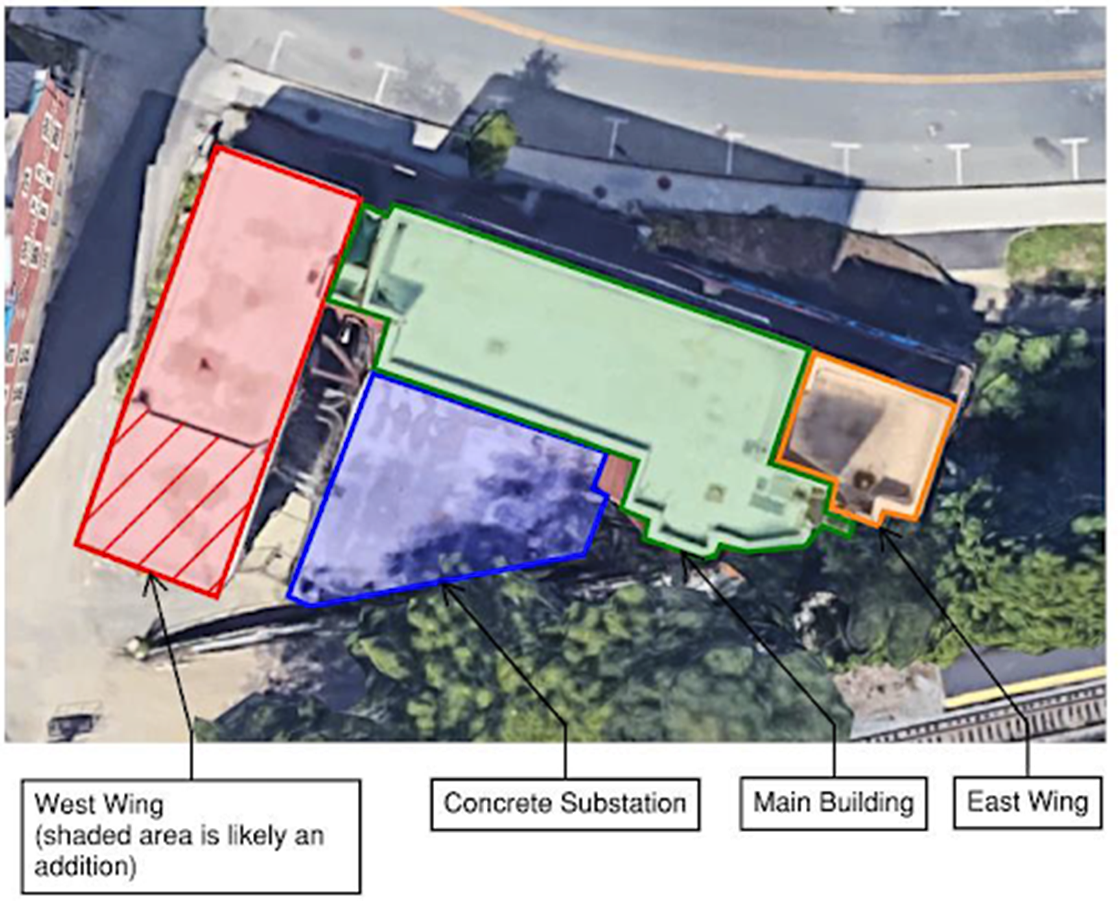
Today the building is mostly unoccupied, though not entirely vacant. Belmont Light still operates an active substation, transformers, and network switching equipment in the west wing and a portion of the concrete substation, and the Town has used parts of the building for offices, file storage, and a teen center.
What’s Next?
The building is a mess, ownership has bounced between the town and Belmont Light without ever being cleanly resolved, and multiple studies over nearly two decades have floated ideas without producing a plan. At some point, Belmont needs to face this building squarely — to demolish what can’t be saved, remediate whatever hazardous debris and contaminated soil is discovered, and free up the land for the Community Path and other public or private uses. A full building-and-disposition reassessment probably makes most sense once Belmont Light’s substation relocation is complete and the building is fully vacant, but that is still four to five years away, and the underlying costs will only be better understood once someone actually goes inside and does the forensic testing that’s been deferred since 2022.
Whatever gets done, it won’t be cheap. Demolition, hazardous-material remediation, and soil cleanup are all significant, and no comprehensive cost estimate has yet been made public. Someone will eventually need to put a number on what it will take to make this land usable again.
It’s worth being honest about what that number means for Belmont taxpayers. This is our mess — the citizens of Belmont’s mess. If the town hands the building back to Belmont Light, or Belmont Light hands it back to the town, the cost doesn’t disappear; it simply resurfaces later as higher property taxes or maybe higher electric rates. Belmont Light has served the town well since 1898, offering competitive rates and steadily expanding capacity to meet a more electricity-dependent world. It maintains a reserve fund, but that fund exists for genuine emergencies and future infrastructure needs, not for absorbing a legacy building’s remediation costs. Town government, likewise, does a good job under real constraints, stretching limited resources across schools, roads, water, sewer, and much more. Neither institution has a hidden pot of money set aside for this. Eventually, Belmont’s residents, not some abstract “government,” will pay to solve this problem, one way or another. The sooner the town faces that reality and plans for it, the less painful the eventual bill is likely to be.
John Beaty is a Belmont resident, and the views expressed in the article are his own.
Sources: LeMessurier facade assessment report (2022); interviews with Belmont Light General Manager Craig Spinale, Health Director Wesley Chin, and Inspector of Buildings Ara Yogurtian; Town of Belmont, A Planning Vision for Belmont Center; Town of Belmont, Representative Distinctive Areas; Town of Belmont, Significant Buildings & Sites by Location; Belmont Light, Our History and Projects; Belmont Citizens Forum, 20 Years of Historic Preservation; Belmont Community Path Phase I project materials.

Sorry, the comment form is closed at this time.