
By Vincent Stanton, Jr.
On August 10, 2026, the Belmont Select Board approved the land transfers and easements necessary to secure the right of way for the Belmont Community Path. Right-of-way acquisition, together with path design, constitute the town’s obligations with respect to financing the community path. It now becomes a MassDOT construction project, 80% funded by the federal government, 20% by the state.
The final “Right of Way” plans, representing the 11th revision since December 2022, were posted to the Belmont Community Path website (www.belmontcommunitypath.com) on February 20, 2026. They show that 25 temporary easements affecting 80,652 sq ft and 30 permanent easements encompassing 275,805 sq ft were required. (Note that “permanent easement” encompasses a broad spectrum of potential uses, many of which do not prevent enjoyment of the land by the owner, as explained by Select Board member Matt Taylor at the August 10 meeting.)
Altogether 19 property owners were affected, four by temporary easements only, the remainder by both temporary and permanent easements. The three largest property dono
rs were the MBTA (120,243 sq ft), on whose land most of the path will lie, the Belmont Citizens Forum (BCF) (107,172 sq ft), whose land will include part of the path but mostly buffer Channing Road back yards from the path, and the town of Belmont (32,845 sq ft, including 9,182 sq ft provided by the School Committee, where the path will cross the high school campus from the Alexander Avenue underpass to Concord Avenue). Together those three entities contributed 260,260 sq ft, or 94.36% of the permanent easements, at no cost to the town. An additional 12,633 sq ft of permanent easements (4.58%) were acquired from two businesses along with 1.054% from residential property owners.
-
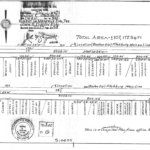
- The 1971 Land Plan, filed at the Middlesex South Registry of Deeds, was drawn by the engineering department of the BMRR and depicts, in two rows, the dimensions of the “Duddy parcel” donated by the BCF to the town of Belmont for the path. (The left end of the bottom row is contiguous with the right end of the top row.)
-
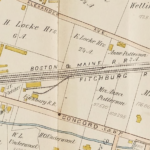
- Detail from the 1900 Atlas of Middlesex County (George W. Stadly & Co., Boston, MA) showing the parallel tracks of the Fitchburg and Central Massachusetts railroads. The Fitchburg Line was double tracked throughout Belmont, while the CMRR was only partially double tracked. The former CMRR right of way east of 7 Channing Road was sold by the Boston & Maine Railroad to John Duddy in 1971.
A History of Railroad Decline or The Twilight of the Railroad Age
How did the BCF come to own a 3,558.7 foot long parcel of former Central Massachusetts Railroad (CMRR) right of way? The story starts with the long, slow decline of the Boston & Maine Railroad (BMRR), the largest rail system in New England during the first half of the 20th century, having acquired or merged with 111 mostly smaller railroads over its long history. During the years of economic distress leading up to bankruptcy in 1970, the BMRR was closing loss-making train lines and selling off surplus property, including railroad right of way.
The business model of the railroads was of course undermined by the American infatuation with automobiles, and the development of the interstate highway system starting in the 1950s. Particular to the BMRR, the gradual deindustrialization of New England during the latter part of the 19th century into the first half of the 20th century also contributed. In 1976, the Massachusetts Bay Transportation Authority (MBTA) acquired all of the passenger assets (track and rolling stock) of the BMRR. The BMRR and its successor entities (now CSX Corporation) retained the right to ship freight over those tracks, including the Fitchburg Line which to this day accommodates occasional freight trains.
The BMRR had acquired the CMRR via its purchase of the Boston & Lowell railroad in 1887, then leased the Fitchburg railroad in 1900, making the parallel trackage of those two rail lines in Belmont redundant; the two rail lines converge at Beaver Street in Waltham. The CMRR right of way in west Belmont became an even more obvious candidate for disposition following the 1952 depression of Waverley Station and adjacent track to address the unsafe at-grade railroad crossing that had existed since 1844. Much of the former CMRR land in that area became part of a steep embankment on the north side of the tracks. Consequently, in the 1950s and 1960s, the BMRR sold many parcels of former CMRR right of way in Belmont.
- 1958: a long, thin 10,226 sq ft parcel of former CMRR land was sold to Walter Vannasse, now owned by the City Side Subaru car dealership at 800 Pleasant Street.
- 1961: 4,917 sq ft of former CMRR land sold to Burton Whitestone, now part of the 1000 Pleasant Street multi-business property.
- 1962: 48,705 sq ft of former CMRR land sold to Paul L. Tocci, now the Belmont Car Wash.
- 1962: 12,870 sq ft of former CMRR land to Amedeo DeMilia at 1000 Pleasant Street.
- 1964: 39,536 sq ft of former CMRR land sold to Nicholas Sacca, now part of the F.E. French Construction Company property at 40 Brighton Street.
- 1967: 8,552 sq ft of former CMRR land sold to Warren Farrell, now behind the former Artifact Home & Garden at 1000 Pleasant Street.
- 1971: 107,172 sq ft of former CMRR land sold to John R. Duddy, a real estate developer. This parcel runs parallel to the Fitchburg tracks starting from the eastern border of Chase Bank at 7 Channing Road to behind 291 Channing Road, where it abuts the 1964 Sacca parcel.
How BCF Acquired the Land
BCF board member John Dieckmann became aware of the Duddy parcel in the mid-1990s at a public meeting of the Belmont Bikeway Planning Committee, appointed by the Select Board in October 1994. That committee, cochaired by Bob Livermore and Don Becker, had developed considerable momentum by 1997, when the town commissioned a feasibility study for a bicycle-pedestrian path to be part of the Massachusetts Central Rail Trail (MCRT) then being planned by the Central Transportation Planning Staff (CTPS) of the Boston Metropolitan Planning Organization (MPO). A 1997 CTPS MCRT feasibility study also included Belmont, at the town’s request. Much of that momentum dried up in December 1997 when Weston Town Meeting voted against participating in the MCRT (reversing a May 1997 vote), a decision only formally changed in 2017. The five-mile Weston segment of the MCRT opened in 2019.
Notwithstanding the lack of any active Belmont effort to implement the MCRT in 2008, Dieckmann, with the support of the BCF board, contacted the then-owner of the Duddy parcel, Walter Duddy, who was prepared to sell. By the time the BCF board voted to acquire the Duddy parcel, the MCRT project had been dormant for a decade, and the future route of any path through Belmont was uncertain. Nonetheless, the BCF had adequate funds, having recently settled a lawsuit against Northland Residential Corporation over a sewer connection permit for “The Woodlands” (Phase I of the McLean development) for $300,000 (for details see “Litigation Was Not in the 20 Year Plan” in the January/February 2020 Newsletter). The BCF acquired the Duddy parcel for $77,000 as described in (“Rail Trail Gets Back on Track to Belmont Center”) in the November/-December 2008 Newsletter . Dieckmann recalls hearing that the “Duddy parcel” was a throw-in, along with several other more attractive parcels the BMRR sold to John Duddy and partners in that period. The parcel is landlocked (lacking the frontage required for a building permit) and probably unusable for any purpose other than the path.
The BCF was also instrumental in securing the easement along the former Sacca parcel, connecting the Duddy parcel to Brighton Street; Dieckmann learned from realtor and long-time MCRT supporter Craig Della Penna about the section of Massachusetts law (Chapter 40, Section 54A) that forbids municipalities from issuing a building permit for any structure on former railroad right-of-way without first obtaining written consent from the Secretary of Transportation. He brought that information to the attention of the Belmont Select Board and then Representative Will Brownsberger. That led to the negotiation of an easement across the Sacca parcel for a possible future path. The easement was granted to the Massachusetts Division of Conservation and Recreation by F & M Investment Enterprises, LLC (James Mahoney and Frank French) as a condition of obtaining a building permit for 40-42 Belmont Street.
The Belmont Community Path was advertised on the MassDOT construction bid portal on September 12, 2026, meeting the budgetary requirement that the project be advertised in Federal Fiscal Year 2026, which ended September 30, 2026. (In 2023 the Boston MPO allocated funds for construction of the Belmont path in FFY2026; if that deadline had been missed those funds would have returned to the MPO.) The deadline for contractors to submit bids was November 10, 2026. On that date, at 2 PM, bids will be opened and a winner selected. A preliminary timeline for the project was displayed by Select Board member Matt Taylor at the August 10 meeting.
Vincent Stanton, Jr., is a director of the Belmont Citizens Forum.
Links
1997 Wallace Floyd Associates feasibility study of Belmont Community Path
1997 Central Transportation Planning Staff study includes Belmont: “Central Massachusetts Rail Trail Feasibility Study”
https://www.mapc.org/wp-content/uploads/2017/11/CTPS.central_mass_rail_trail_study_1997.pdf
“Litigation Was Not in the 20 Year Plan” by Sue Bass in the January/February 2020 Newsletter
https://www.belmontcitizensforum.org/2020/01/06/litigation-was-not-in-the-20-year-plan/
“Rail Trail Gets Back on Track to Belmont Center” by John Dieckmann in the November/December 2008 BCF Newsletter
https://www.belmontcitizensforum.org/newsletters/2008/BCFNov08.pdf
Massachusetts General Law Chapter 40, Section 54A (development on railroad right- of-way)
https://malegislature.gov/Laws/GeneralLaws/PartI/TitleVII/Chapter40/Section54A
MassDOT web page for Belmont Community Path (project 609204)
https://hwy.massdot.state.ma.us/projectinfo/projectinfo.asp?num=609204
August 10, 2026 Select Board meeting (discussion of community path land transfers and easements starts at 14:25)
https://www.belmontmedia.org/watch/select-board-town-belmont

Sorry, the comment form is closed at this time.