
by Fred Bouchard
For unfailing cheeriness, perky curiosity, and its amiably purring “henk-henk,” White-breasted Nuthatches get my vote for favorite yard bird. With no flashy looks, melodious songs, nor commanding calls to vouch for them, ‘nuts’ are your year-round, work-a-day, dependably peppy garden gremlins: twist this-that-a-way to grab a bug, glean a gnat, slam a seed, tipple sap.
The Sittidae f amily worldwide i ncludes 24 nuthatches, mainly Eurasian; Concord nature author and bird-trip guru Peter Alden (sparkbirding.com) reports they have recently been merged with gnatcatchers and wrens. Its catchy English handle, Merriam & Webster tell us, “refers to the propensity of some species to wedge nuts or seeds in a crack and hack at them with strong bills.” I delight in watching nuthatches bang sunflower seeds on backyard lilac branches ‘til they cry “uncle!”
 New England’s two species come in White and Red. White-breasted Nuthatches, widespread in woods and ‘hoods from city to deep suburb, are familiar to all yard-watchers. This year-round trunk buddy sports a spiffy black-and-white pattern; its white face scoop surrounds a bare, candid black eye. You’ll likely hear one first: grittily grating calls, nasal “nyet” or “yank,” mid-pitched. Big-headed and stubby-tailed, it’s a chunky 5-incher; as it zig-zags down a trunk and zips arrow-fast to your feeder, glimpse its under-tail chestnut patch. You may get more than a peek: they also zoom along branches and feed upside down! (Another rare down-branch feeder in spring is our Black-and-White Warbler.)
Brookline Bird Club President Cliff Cook offers a note on nuthatch demographic fluctuations since the days of influential Harvard ornithologist Ludlow Griscom: “They were common locally in olden times, disappearing along with the cut forests. By the 1950s, they were present in some numbers during winter, but rare breeders. By the time I started birding here during the mid-80s, they were again widespread.”
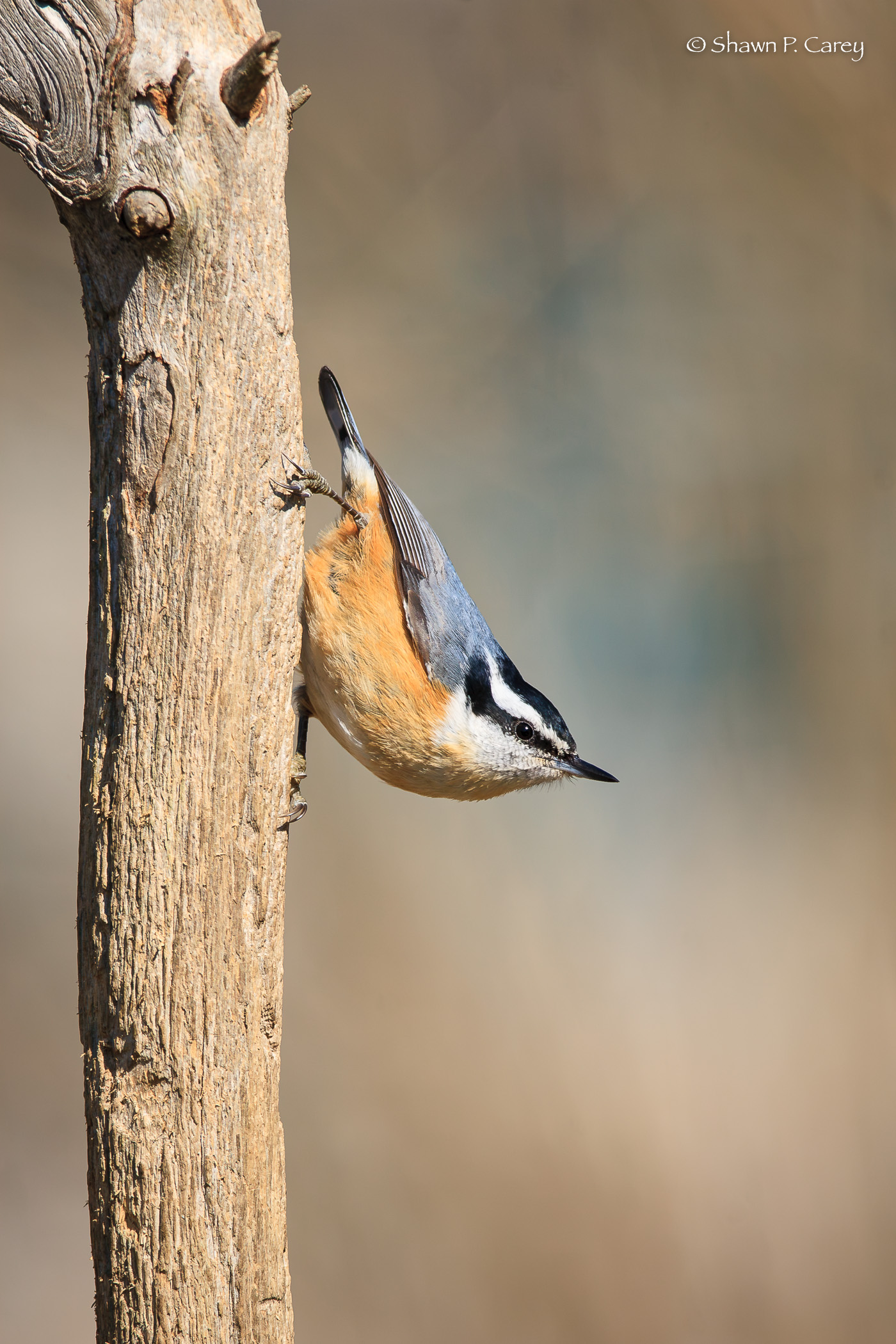
Sprightly, strikingly eye-striped red-breasted nuthatches do their thing high in lofty evergreens, and largely avoid feeders—except for suet! They prefer nesting in groves of White Pine or White Cedar (even Mount Auburn Cemetery’s ornamental conifers), where they pry open cones and nibble nibs. A tidy 4.5″, with dashing black over white eye-lines and light ruddy chest, they utter a distinctive high, nasal “enk-enk” or bray like a “tiny tin horn” (thank you, Roger Tory Peterson).
Elsewhere across America, we find Brown-headed Nuthatches southward from the Carolinas, and Pygmy Nuthatches out west. Both are smaller yet (4″) than Red-breasteds. All four ‘nuts’ nest in tree cavities (cracks, holes, even nest boxes) they may cover with sticky resin or stinky squashed beetles to deter invaders—like pesky squirrels and sneaky woodpeckers. And all four have slate-gray backs, pale tummies, sturdy bills; like most New England yard birds—titmice, jays, thrushes, chickadees—they’re monomorphic.

Sorry, the comment form is closed at this time.