
By Jeffrey North
On a summer day at Stonefield Farm in South Acton, rows of lettuce, tomatoes, and callaloo are harvested not for a farmstand or supermarket but for food banks, pantries, and community kitchens. That distinction captures what makes Boston Area Gleaners unusual: it operates as both a working farm and a regional food–access organization, using Stonefield to grow food and move large volumes of fresh produce efficiently to communities facing hunger.
For Belmont readers, the story is worth attention not only because it involves a nearby preserved farm, but also because it shows how food access depends as much on infrastructure as on agriculture. Growing vegetables is only part of the challenge; storing, sorting, refrigerating, and transporting highly perishable food are just as essential if fresh produce is to reach households that cannot easily afford or access it. Boston Area Gleaners (the Gleaners) has built a model that aims to solve both problems at once.
The Gleaners began in 2004 as a volunteer gleaning effort and became a nonprofit organization in 2007, focused on recovering surplus crops from local farms. The core idea was simple: healthy food was being left in fields because farmers lacked a profitable market or could not justify the labor to harvest it, while many families and food pantries lacked reliable access to fresh produce. Over time, that effort expanded beyond volunteer gleaning into a broader regional system that now includes farm donations, wholesale recovery, trucking, cold storage, and dedicated on‑farm production.
That evolution took a major step forward in 2021, when the Gleaners purchased Stonefield Farm from the Simeone family, who had farmed the land for nearly a century. Stonefield had grown vegetables and plants since 1929, and its preservation had long been a local priority in Acton. The Gleaners’ acquisition, combined with a permanent Agricultural Preservation Restriction held by the town of Acton and Sudbury Valley Trustees, ensured that the 51‑acre property would remain in agricultural use and open space in perpetuity.
Growing food for food banks and pantries
That preservation story matters, but the most striking development is what the Gleaners have chosen to do with the farm. About 25 acres are actively cultivated, and the crop plan is designed not for retail sales but to meet the needs of food access partners. All food grown at Stonefield now goes to pantries, food banks, and community kitchens rather than to commercial outlets. In practical terms, Stonefield functions as a mission–driven production farm, with its harvest planned for hunger relief.
This means the farm grows the foods that food banks and pantries can use and when they can use them. The Gleaners’ staff schedule plantings so that Stonefield’s harvest helps fill periods when gleaning opportunities at other farms taper off. Instead of treating the farm as an isolated business, the Gleaners treat it as one component of a larger supply system, using their own fields to smooth seasonal fluctuations and provide a steadier flow of produce to partner organizations.
The result is a farm whose output is both substantial and targeted. Recent reporting from Acton noted that Stonefield weekly ships two to four pallets of its own grown produce along with 10 to5 pallets from other farms to the Greater Boston Food Bank and grows roughly 1,500 heads of lettuce weekly, along with tomatoes and other staples for donation to food access partners. These are not symbolic donations; they represent a steady stream of food entering the emergency food network. Just as important, the farm also grows culturally important crops, including callaloo, a Caribbean leafy green in the amaranth family, reflecting the Gleaners’ effort to provide food that is not only nutritious but also familiar and meaningful to the communities receiving it.
Culturally appropriate produce
That emphasis on culturally appropriate produce deserves attention. Food access is often discussed in terms of calories, pounds, or truckloads, but the Gleaners’ approach suggests that dignity and cultural relevance matter too. A pantry visitor is more likely to use fresh produce that fits their household’s cooking traditions, and a regional food system works better when it reflects the diversity of the people it serves. In that sense, Stonefield is not simply producing volume; it is producing with purpose.
Stonefield’s own harvest is only one part of the Gleaners’ food access work. The organization’s original specialty, gleaning, remains central. Volunteers go to farms across the region to harvest surplus crops that growers would otherwise leave behind because the economics no longer make sense. The Gleaners also accept post‑harvest donations from farms and wholesalers and recover full tractor‑trailer loads of produce rejected by retailers for cosmetic or technical reasons, even though the food remains perfectly edible.
Multiple streams of recovered food converge within the same system. A load of rejected vegetables from a wholesaler, surplus produce donated by a farm, and lettuces cut that morning at Stonefield can all enter the same distribution pipeline serving partner agencies. This diversification is important because it reduces dependence on any single source and makes the overall network more resilient to weather, market disruptions, and seasonal variation.
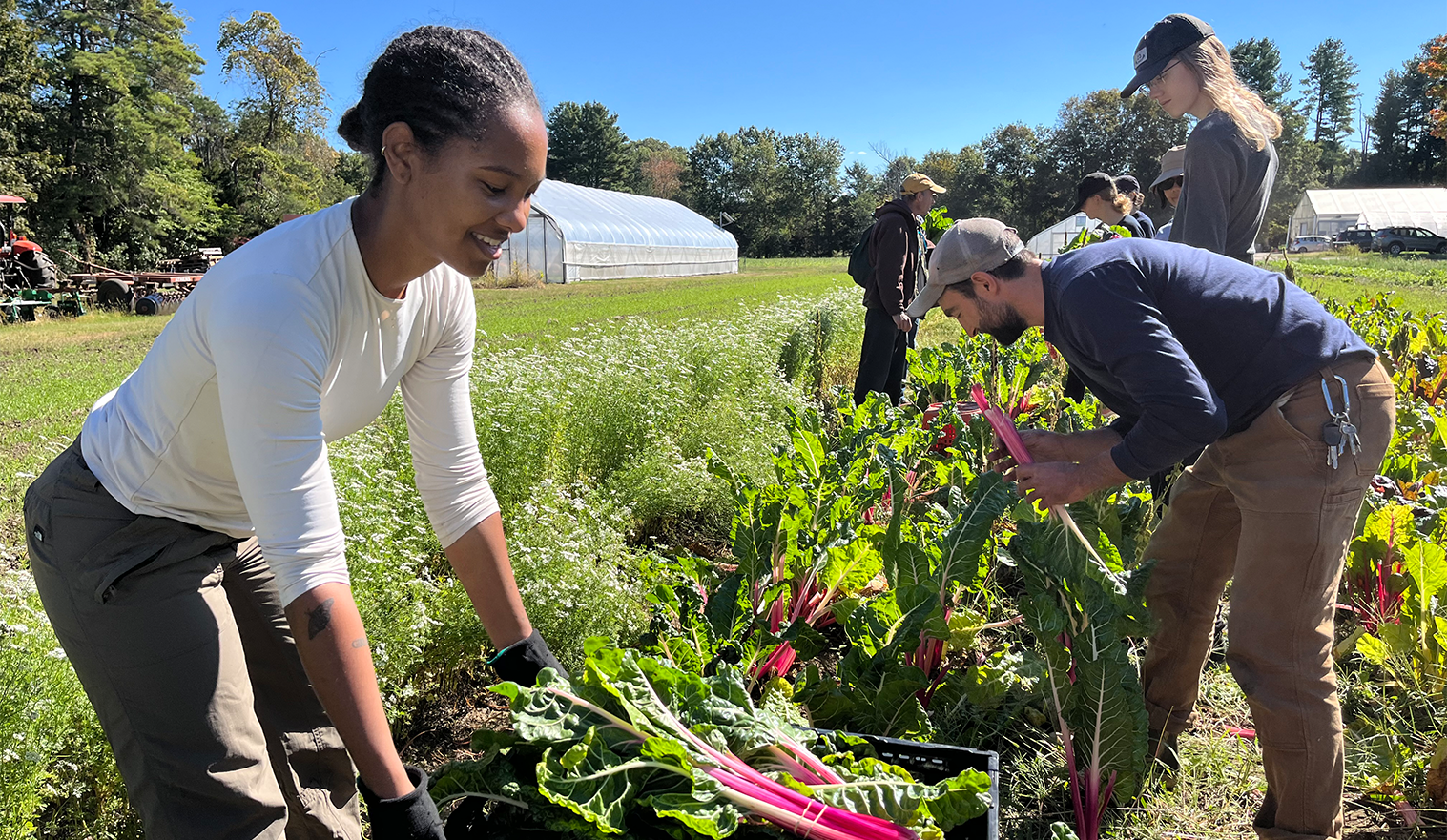
Stonefield Farm is an example of regional food structure in action. Photo: Jeffrey North
The logistical side of that network is where the Gleaners’ regional importance becomes especially clear. Farmers, wholesalers, and food banks may all want surplus produce to reach people, but without trucks, refrigeration, loading areas, and food‑safety systems, much of that food would never move, except to landfill. The Gleaners operate food‑safety‑compliant trucking to transport produce from farms and wholesale sources to Stonefield and onward to food pantries, food banks, and community kitchens. In effect, it supplies the connecting capacity that many smaller organizations lack.
Cold storage is equally critical. Fresh produce cannot simply be gathered and redistributed on an improvised schedule; it must be held at safe temperatures, sorted, and assembled into shipments that match the needs and capacity of downstream partners. The Gleaners have been expanding cold storage at Stonefield through a mix of public and private funding, aiming to triple current capacity and strengthen the farm’s role as a major supplier to food banks and food access organizations. With more refrigeration space, the Gleaners can better absorb seasonal gluts, manage a wider range of products, and maintain more consistent deliveries even when supply spikes unexpectedly.
That logistics story may be less picturesque than rows of vegetables, but it is arguably the heart of the model. Hunger is often described as a problem of scarcity, yet the Gleaners’ work is built on a different understanding: in many cases, food exists, but it is in the wrong place, at the wrong time, or beyond the reach of organizations that could distribute it. The challenge is as much geographic and economic as it is agricultural. By pairing a preserved working farm with trucks, cold rooms, and a regional distribution system, the Gleaners are addressing those barriers directly.
For Belmont, the relevance is close to home, even though Stonefield itself is in Acton. Local pantries and food programs are part of a wider network of organizations that depend on steady flows of fresh food, and the Gleaners’ model shows what it takes to create those flows reliably. It also offers a useful civic lesson: land preservation, public investment, nonprofit coordination, and practical infrastructure can reinforce one another when the goal is not only to save farmland but also to use it for a public purpose. Further, many Belmont citizens have volunteered to work with the Gleaners.
In that respect, Stonefield Farm is more than a conservation success or a generous farm donation site. It is an example of regional food infrastructure in action, a place where production and logistics are deliberately woven together. Vegetables are planted with distribution needs in mind; truck routes and cold storage are justified by real harvests from the farm and outside partners, near and far; and a preserved piece of agricultural land serves not only the landscape but also the people who need the most access to fresh food.
At a time when food insecurity in Massachusetts has risen again under the pressure of inflation and high living costs, that combination feels especially timely. The Greater Boston Food Bank’s 2026 food access report, produced with Mass General Brigham, found that about 40% of Massachusetts households experienced food insecurity in 2025. Stonefield Farm shows that fighting hunger is not only about charitable intent. It is also about building the physical systems that can move good food quickly and reliably from places of abundance to places of need.
Jeffrey North is the managing editor of the Newsletter
How You Can Help
- Volunteer for a gleaning day or farm shift. The Gleaners food recovery model still depends on volunteers to harvest surplus crops and support work at Stonefield Farm.
- Visit a public event at Stonefield Farm. Community gatherings such as June Food Day help residents see how the farm’s production and distribution systems work in practice.
- Support food-access infrastructure. Cold storage, trucks, and loading space may be less visible than farm fields, but they are essential to moving fresh produce safely and consistently to food banks and pantries.
- Follow the regional policy story. Stonefield shows how land protection, public investment, and nonprofit operations can work together to strengthen food access across eastern Massachusetts.
Learn more about how to get involved: https://www.bostonareagleaners.org/get-involved.html

Sorry, the comment form is closed at this time.