
By Anne Marie Mahoney
What should a bereavement support group and town government have in common? A deep respect for participants’ experience of loss.
I do bereavement work, facilitating programs on coping with grief and loss in church settings and the Beech Street Center. Through Boston College, I teach other facilitators how to lead bereavement programs. How is this work relevant to Belmont politics? Reflecting on the divisive controversies over the naming of the new skating rink and the Belmont Center overlay zoning proposal, I realized that many speaking out on these issues were acting from a place of loss. Residents, and Town Meeting Members in particular, were unconsciously attempting to make sense of grief over the potential loss of what they valued, what was safe, and what was familiar in their lives. Others seemed to forge ahead into a vaguely defined future Belmont with little understanding of the underlying personal dynamic at work—the tension between the two perspectives generated much of the controversy.
One of my themes in leading grievers to find their path to a new normal following the loss of a loved one is “Holding On and Letting Go.” * A pivotal task of learning to live with loss is discerning what to hold onto and what to let go of. And why we hold on or let go.
Loss comes in many forms, not only death. We experience the loss of a home, a job, our health, or our independence. Our children move away, we retire, we lose touch with old friends. Learning to cope with loss is the work of grieving. It’s hard. It takes time.
Two recent losses are good examples of holding on and letting go. The fire that destroyed Moozy’s took away a business and jobs, but what we heard from those interviewed were the memories created in that space, the feeling of community and celebration. While owner Dante Muzzioli vowed to rebuild—holding on—the reality was that the remains of the building had to be razed—letting go.
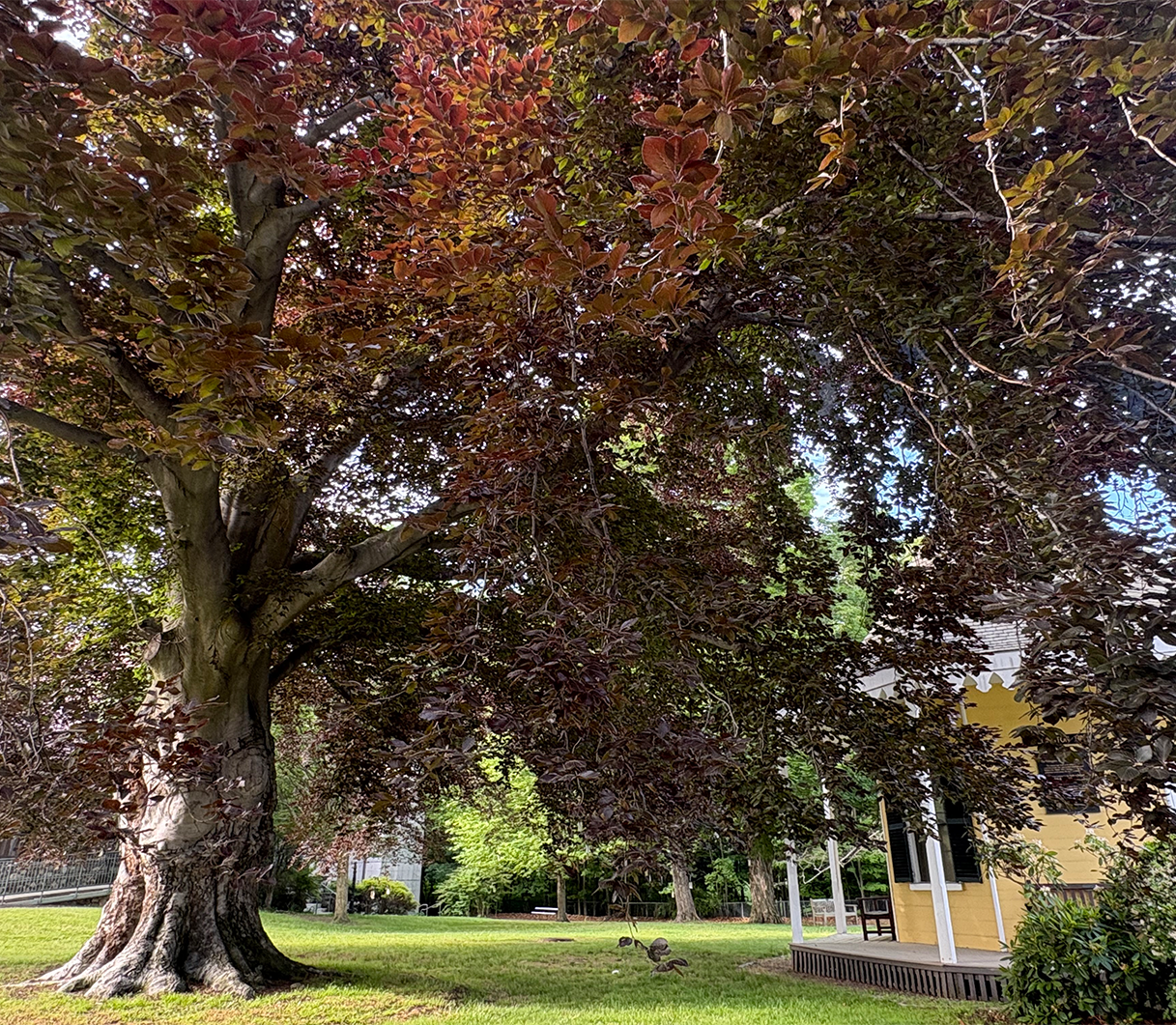 We gathered to mourn the death of the glorious copper beech tree on the Town Green. We recognized the tree’s place in the town’s landscape, having lived longer at the entrance to Belmont Center than any of us. The tree was diseased beyond recovery. Time to let go. We hope that new copper beeches will be planted to shade the green, and that Moozy’s will reopen in a shiny, new building with more ice cream flavors to celebrate.
Throughout the town, we “hold onto” those we cherish, admire, and see as role models for future generations through monuments or named places. My favorite examples include the bench at Clay Pit Pond to remember Ted Hennessey, a BHS graduate killed on Flight 11 on September 11, 2001, and the baseball field named for Chenery Math teacher and baseball coach Arthur Craig. And, sadly, the recently demolished Paul White Fieldhouse, named for the BHS athlete killed at the Battle of the Bulge.
When the Select Board decided to “let go” of the Skip Vigliorolo name on the new rink, the community erupted in an outpouring of emotion. What the board missed was that no naming policy, however detailed, could account for the gut need to hold on to the memory of a beloved coach and wonderful citizen. The timing of the Special Town Meeting debate could not have been worse. The proponents of retaining Skip’s name were not trying to be obstructionist; they were grieving the recent death of their loved one. Conversely, the Select Board seemed unable to “let go” of their authority and to understand the dynamic beneath the surface—a community unwilling to relinquish a name they cherished.
Where is the loss in the overlay proposal? Put aside the various analyses of finances, housing, school-aged children, and infrastructure. What residents saw was an overlay proposal to wipe out the existing Belmont Center, taking with it businesses, employment, small-town ambiance, and everything that was familiar about the center. Opponents reacted with anticipatory grief. They could lose their livelihood, their dentist, their favorite restaurant or prescription provider, the locus of Town Day and Farmers’ Market. The abutters feared their homes would be devalued and their property damaged. The intensity of the potential loss and the need to hold on was palpable at every Planning Board session. The disconnect between the reality of a near-fully occupied, vibrant center and the claims that the center was dying was baffling and only fed the confused grief.
Yes, our town should not stagnate. I keep hearing, “Change is hard.” I want to retort, “You have no idea!” Change is meant to be hard so that we choose change wisely and carefully. Change is hard because it’s challenging to discern what we hold onto and what we let go of, whether it’s sorting a loved one’s clothing and books or deciding which furniture to move to the downsized house. Filene’s, Brigham’s, and Bildner’s are not coming back any more than the First National or Woolworth’s would. Regardless, residents did not want to trade a wall of five-story buildings for what they treasured in Belmont Center.
People feel threatened when what they value could be taken away. The town has learned to preserve our architectural heritage by revitalizing historic buildings, such as the Police Station and the Town Hall complex, giving them decades of new life. The best decision was turning the fire station into a restaurant! Unfortunately, we heard little on what should be saved in Belmont Center.
How might everyone’s viewpoint, not just the presenters’, be respected at Town Meeting? By listening! I facilitate a monthly bereavement support group at the Beech Street Center. The session is an opportunity for those present to share their experiences of grief and loss and how they are coping. Participants listen and share, learn and chart a path forward.
Residents begged for an open forum about the overlay. A genuine exchange of ideas, an opportunity for all parties to come together and listen to each other. Wouldn’t an open exchange of data and concerns, weighing the pros and cons, have been a better preparation for Town Meeting? There was a lot of talking at, not much listening to. Would we tell grievers that their pain and loss didn’t matter, wasn’t real, held no place for memories or comfort? Couldn’t we have honestly examined the losses that residents feared and developed solutions that looked to a stronger future for Belmont?
The town is now barreling forward with a Brighton Street/Hill’s Crossing overlay proposal. This town does not need more negative labeling and misrepresentation. We need open, respectful dialogue and a shared vision for Belmont’s future. A future that includes change—well-thought-out, vetted, and agreed-upon change that rises from residents, rather than imposed on them.
No one has a corner on wisdom, but we can acquire wisdom by understanding loss. Grievers realize that life is never the same after loss, nor should it be. I suggest that Belmont’s future depends on a delicate balance between what we choose to let go of and what we need to hold onto.
*A New Parish Guide to Grief Ministry by Anne Marie S. Mahoney, Twenty-Third Publications.
Anne Marie Mahoney has held a remarkably wide range of elected offices, appointed committee roles, and volunteer service positions in Belmont over several decades, including the Select Board, School Committee, Town Meeting, Chair of the Capital Budget Committee, Permanent Building Committee, Municipal Rink Building Committee, Chair of the Police Station/DPW Building Committee, Community Preservation Committee, and other media, civic education, and public-facing roles.

Sorry, the comment form is closed at this time.