
By Jeffrey North
The long–planned “Zone 3” housing on McLean land is finally moving forward with construction of a 150‑unit, all‑electric housing complex poised to become one of the town’s most significant new sources of both market‑rate and affordable homes. Construction is visible from the Coal Road as it winds up Belmont Hill from Pleasant Street.
Brief History of Zone 3
In 1999 Belmont and McLean Hospital consummated an agreement that rezoned 238 acres of McLean land. In exchange for upzoning some of the undeveloped land surrounding the McLean campus to permit commercial development Belmont received 119 acres of conservation land (now known as Lone Tree Hill) and 14 acres for a cemetery. McLean land was rezoned to allow three new commercial developments (townhouses, an R&D facility and a senior living complex) which were projected to net the town $1,818,425 in recurring annual revenue, approximately 4% of the town’s annual budget in 1999. (For details see the 1999 report of the “Belmont McLean Hospital Land Use Task Force,” Fiscal Impacts chapter, page 75; BCF newsletter September 2022).
Among the three proposed developments the biggest financial contributor to Belmont was projected to be a 480
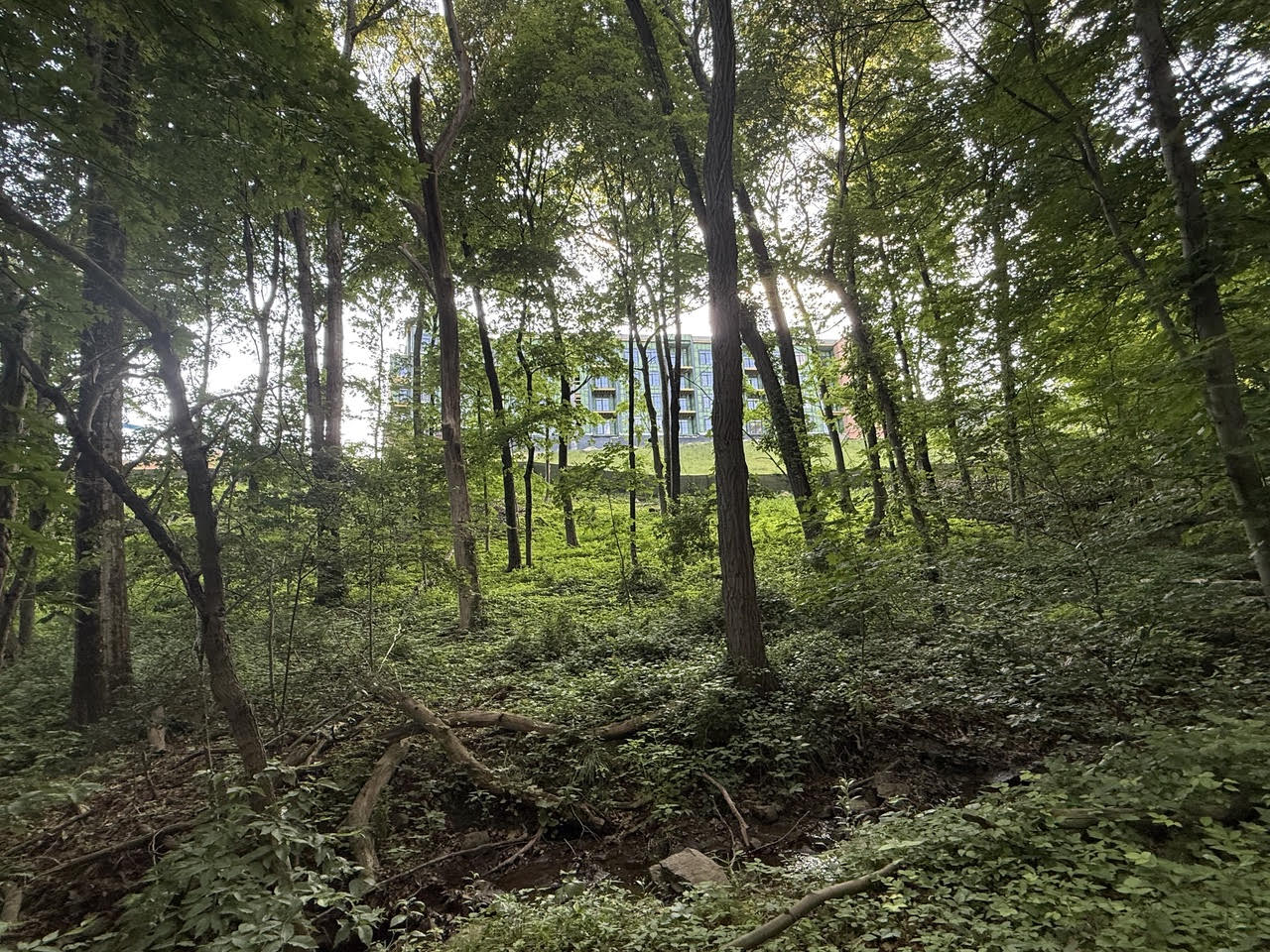
The construction is visible from Coal Road. Photo: Vincent Stanton
unit senior living complex in Zone 3 ($1,191,085 in recurring revenue; 74% of the total). Rights to develop the continuing care retirement community were licensed to American Retirement Corporation, but the market became saturated as similar facilities in nearby communities opened, and no viable development proposal was ever advanced (see BCF newsletter May 2019).
In 2018 Northland Residential Corporation proposed to instead build more housing in Zone 3, leading to a long and productive negotiation with the town that culminated in the present project. Town Meeting rezoned Zone 3 in 2020, creating the “McLean District Zone 3 Overlay District.”
What is being built now?
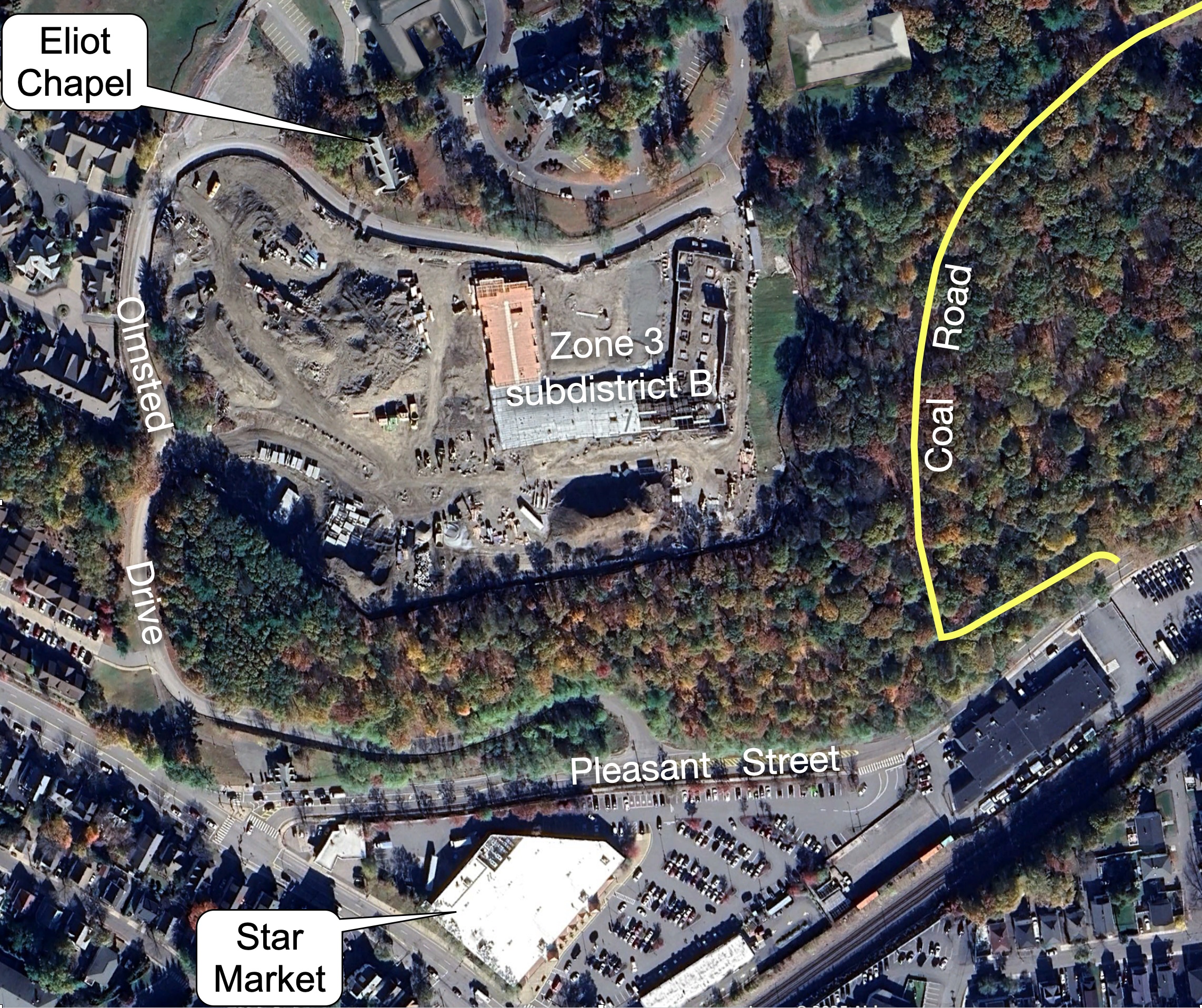
Aerial view of the construction area – November 2025.
Formally known as The Residences at Bel Mont, the new development will create 150 residences on roughly 13 acres off Olmsted Drive, the same access road used by The Woodlands at Belmont Hill.
While today’s plan entails only about one‑third as many units as the original senior living facility, the units will be larger. Still, the original facility was expected to be a six story monolithic structure, while the current plan allows smaller buildings scattered over a wider area, and requires that “wall finishes shall be compatible with the existing historic architecture … in the McLean District.” Also, while the original development would have contributed more net tax revenue, it also would have entailed significantly more traffic as a continuing care facility includes beds that require nursing support.
The 2020 Zone 3 overlay district (chapter 6B of the town’s bylaws) divides the project into two subdistricts. Subdistrict A will contain 38 age‑restricted (head of household 55 or older) townhouses plus two units created by rehabilitating the historic Samuel Eliot Memorial Chapel. Subdistrict B will contain 110 multifamily units, 53 of them age-restricted, in two 3‑ to 4‑story buildings.
Affordability and climate commitments
After two decades of pressure for more affordable housing, the Zone 3 plan has a substantial affordability
component than was lacking in earlier McLean residential development (zones 1A, 1B and 2). As part of negotiations leading up to the 2020 Town Meeting zoning vote on the overlay district Northland Residential agreed that 15% of the homes in subdistrict A will be deed‑restricted units affordable to households earning 80% of Area Median Income (AMI), and 20% of the units in subdistrict B, while a further 5% of subdistrict B units will be affordable to households earning 50% of AMI. The new affordable units will help move Belmont closer to the state’s 10%affordability threshold required for immunity to hostile Chapter 40B developments. (Belmont’s subsidized housing inventory currently comprises 6.21% of all housing units; completion of Zone 3 will increase that to 6.77%.)
The project also reflects Belmont’s climate priorities. As part of the zoning overlay the development must be all‑electric, eliminating on‑site fossil-fuel use for space heating and domestic hot water, and roofs must be “solar-ready.” These requirements dovetail with the town’s efforts to reduce greenhouse‑gas emissions and with the Energy Committee’s long‑standing concern that large new projects do not lock in new gas infrastructure.
Traffic, access, and the revised agreement
Phase 3 could not proceed until the town and McLean updated a 1999 traffic management and mitigation agreement that governed vehicle trips from the campus onto Pleasant Street. The original agreement was crafted to protect the town from excessive traffic associated with a much larger senior‑housing complex, and imposed strict trip caps and financial penalties for exceeding those caps that, according to Northland, lenders considered unworkable for the smaller 150‑unit plan.
In July 2024, Town Meeting approved changes to the 1999 traffic agreement, waiving traffic volume caps and penalty fees, while mandating a traffic signal upgrade at McLean Drive and Mill Street and a new signal at Olmsted Drive and Pleasant Street. That action cleared the final hurdle for financing and construction.
How Phase 3 fits into the larger McLean build‑out
The Residences at Bel Mont sit between the existing Woodlands neighborhood (Zone 2) and land designated as Zone 4, where McLean is moving ahead with a new child and adolescent campus. The hospital’s current plan for Zone 4 calls for two buildings totaling about 150,000 square feet: a 90,000‑square‑foot facility for the Arlington School and Pathways Academy and a separate research and development building for future clinical and scientific programs.
Together, Zone 3 housing and the Zone 4 school/R&D campus will complete the development program envisioned in the 1999 McLean Memorandum of Agreement, which permitted 1.2 million square feet of development across the campus and produced both high‑end townhouses and deeply affordable housing at Waverley Woods. For open‑space advocates, this completion is a mixed blessing: while the new developments will add to the town’s subsidized housing inventory, and to its tax base, the 119 acres of protected open space are increasingly encroached on by new construction.
What can neighbors and residents expect next?
With zoning in place and the traffic agreement revised, Northland and McLean have shifted to implementation. The town’s Construction Management Plan for Zone 3 spells out staging areas, truck routes, working hours, and noise controls, all intended to minimize disruption to neighbors in The Woodlands and along Pleasant Street as work accelerates. Residents can expect most construction traffic to use Pleasant Street and Olmsted Drive, with on‑site worker parking and limits on early‑morning deliveries.
For Belmont residents watching the project as part of the town’s broader housing and climate debates, Phase 3 at McLean will be a test of whether Belmont can add new homes—especially affordable, all‑electric ones—while protecting open space, managing traffic, and respecting the character of existing neighborhoods.
Jeffrey North is the managing editor of the Belmont Citizens Forum Newsletter.

Sorry, the comment form is closed at this time.