
By Elissa Ely
At some point, we all become experts in grief. After Anne Marie Mahoney lost her mother, husband, sister-in-law, brother, and father within a few stunning years, she became an involuntary expert. Hospice and hospital resources were available in the beginning, but after a year or so—when the paperwork was done and the casseroles were no longer delivered—she had a sense that others felt it was time for her to move along. They may have been ready. She was not. “You wake up one morning,” she remembers, “and the permanence of loss sets in. Everyone’s dead. It becomes fixed and solid.” The second grieving year is full of a different, unwanted expertise.
Someone once said the best predictor of the future is the past. Anne Marie is a long-standing, busy Belmontian. She has lived here almost her entire life; she married another Belmontian, believes deeply in community and service, has served on endless town committees for unfathomable amounts of time. Grappling with her own losses, she realized that death happens while life is continuing. “Everything I learned in my life,” she says, “came together. I said, I can do this. I can survive. I can even thrive.”
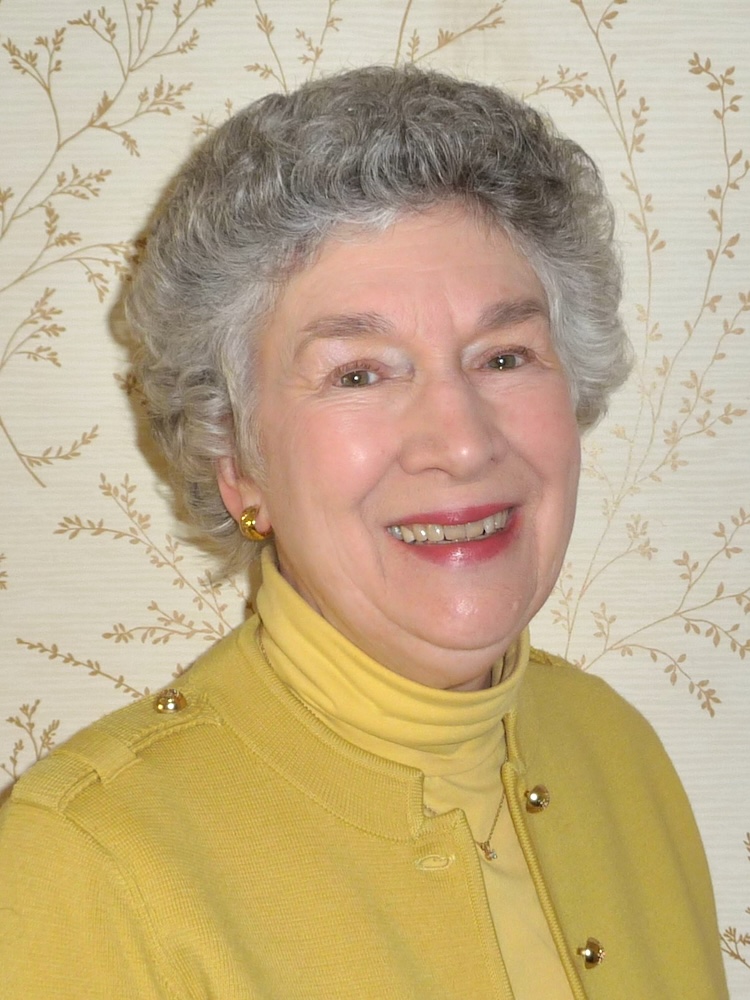
Anne-Marie Mahoney. Photo courtesy of Anne-Marie Mahoney.
She studied dying, grief, trauma. She leaned on her degree in Pastoral Ministry and returned to Boston College for an additional certificate in Spiritual Formation. She grounded herself in the music and crafts that had always mattered to her (this is a woman who sewed her own bridesmaids’ dresses, and every Easter turned out her young daughters in matching coats and hats). Because death happens while life continues, she organized all she knew into a “creative bereavement” program; piloting it first in her own church, then in the Weston church where she worked, and eventually running retreats and workshops. An hour-long monthly drop-in group continues in the Beech Street Senior Center.
One way through grief is realizing what can be offered to others — and then offering it. This is what Anne Marie did. Four initial sessions expanded into six, then eight, and ultimately, into a training manual (“they gave me five months and 31,000 words”) for other group facilitators. Each meeting rises on a scaffolding of art, music, and video clips. There are prompts for members, heartfelt listening, and empathy based on a common, yet always singular, experience.
Her book, A New Parish Guide to Grief Ministry, opens with a poem about a box full of darkness. In light, and through realization, the box becomes a gift. Anne Marie’s husband died in 2010, her father in 2012. She began assembling her program in 2014, and her book was published in 2023. The darkness that became a gift did not do so rapidly.
The constancy of Belmont played its part. She was just a girl when her family moved here from Waltham 64 years ago. She and her Belmont-bred husband bought a house a few blocks from where she was raised. All four of her children came up through Belmont public schools. The in-laws lived a few hundred feet up the street. These are such deeply submerged roots that they probably traveled under Trapelo Road, down Common Street, along Leonard, right onto Pleasant, and emerged on the Arlington property line.
Of course, the town today is not the town of 65 years ago. Anne Marie recalls it then as a destination for people growing up in Somerville, Medford. “They worked hard, saved their money, moved here, and stayed,” she says. “It was the goal of their lifetime.” Anti-Catholic and antisemitic biases were prominent, the John Birch Society thrived on Concord Avenue, and a Mormon church steeple was decades from conception. Still, then as now, quiet eminences lived among us. Anne Marie’s older brother delivered newspapers to Henry Kissinger’s doorstep when he was teaching at Harvard.
In those distant days, the Underwood Pool prohibited boys and girls from swimming together: three days a week for one gender alternated with three days a week for the other. Belmont High School was located in today’s Wellington Elementary School, and she still recalls watching the fire that levelled the building in 1967: “It was a mess of flames in the sky, the sound of glass breaking. The fire department was there for days.”
She became a teacher. She had always enjoyed writing—“when other kids groaned at school assignments, I rejoiced”—and her undergraduate Emmanuel College thesis examined the Arthurian legend in literature and poetry. Decades later, a master’s degree thesis at Boston College took on virtue ethics. Writing well served her well, even if her father, an engineer, “couldn’t wrap his head around my being an English major.” When she taught American Studies to high schoolers, art and music were ancillary aids to literature.
Her closest friends met in their high school glee club; it was the deep Belmont roots again. They married their husbands together, had their children together, became widows together, and are still dear to one another. Life proceeded as expected, and maybe a bit more than expected: Anne Marie was a wife, teacher, mother, director of religious education in local parishes, family seamstress, family baker. Around Christmas, when her kids were growing up, she used to make more than 2,000 cookies, and when two of them were stationed in Iraq at the same time, she mailed 452 cookies overseas—gingerbread men, gingerbread women, and one gingerbread Tom Brady.
For such a community-oriented being, town committees were a natural step—many, many town committees: among them, Town Meeting member (26 years, with an interruption), School Committee (12 years), Select Board (4 years), Capital Budget Committee (15 years), Community Preservation Committee (7 years).
Since COVID-19 has turned Town Meeting into a hybrid experience, it’s changed from the physical gatherings of the earliest New Englanders, when “people came together to govern themselves.” This has caused her to lament. “It’s different when members haven’t experienced being together, as the community celebrating itself,” Anne Marie says. “People don’t know each other if they’re home in their sweats.”
These many directions — bereavement groups, local politics, family — require balance. She finds hers through dancing; three days a week of ballroom lessons and more recently, group tap. In 2020, she was drafted into a fund-raising Dancing with the Stars extravaganza (“the only exercise where you can wear sequins”) and wanted to acquire some competence in order to sustain her dignity. The pandemic’s onset cancelled the dance competition, but sequins remain.
We are unbalanced by grief. It lingers. All these years later, Anne Marie’s own still rises and falls at times. But there are groups to run, committees to attend, a church calling for involvement, muffins to bake, causes to support, dances to dance. This is her balance.
Elissa Ely is a community psychiatrist.

Sorry, the comment form is closed at this time.