
To the Editor of the Belmont Citizens Forum Newsletter,
The January/February Newsletter essay on Chicago real estate investments by Belmont-born Peter Chardon Brooks III led me to think your readers also might like to know of his activity as a Boston art collector.
In the mid-1860s, Brooks joined others acquiring paintings by French artists of the Barbizon School, coming to own important works by Corot, Millet, and Vermont-born William Morris Hunt, a Barbizon enthusiast. Quality was very important to Brooks, and he was aware of Boston’s developing ambition as a cultural center, made explicit when the young Museum of Fine Arts set a goal to become a treasure house of masterpieces.
By 1890, this atmosphere helped London-based John Singer Sargent become “Boston’s portraitist,” and Brooks engaged him to paint portraits of himself and his family. After creating these at Brooks’s West Medford summer estate that fall, Sargent wrote Mrs.Anne Gorham Brooks praising the painting collection, singling out three Monets and a Corot. Brooks had bought the Corot in 1871 but only had obtained the Monets earlier in 1890. Descending to Brooks’s heirs after 1920, two of them were given later to the MFA, adding to other local donations that have made Monet’s work a notable strength at the museum.
However, other works Brooks brought to Boston had no prior connection to the city. When a major exhibition of Spanish painter Joaquin Sorolla opened in 1909 at the New York Hispanic Society, Brooks reserved four paintings and then gave the MFA one of them, the charming Lighthouse Walk, Biarritz of 1906.
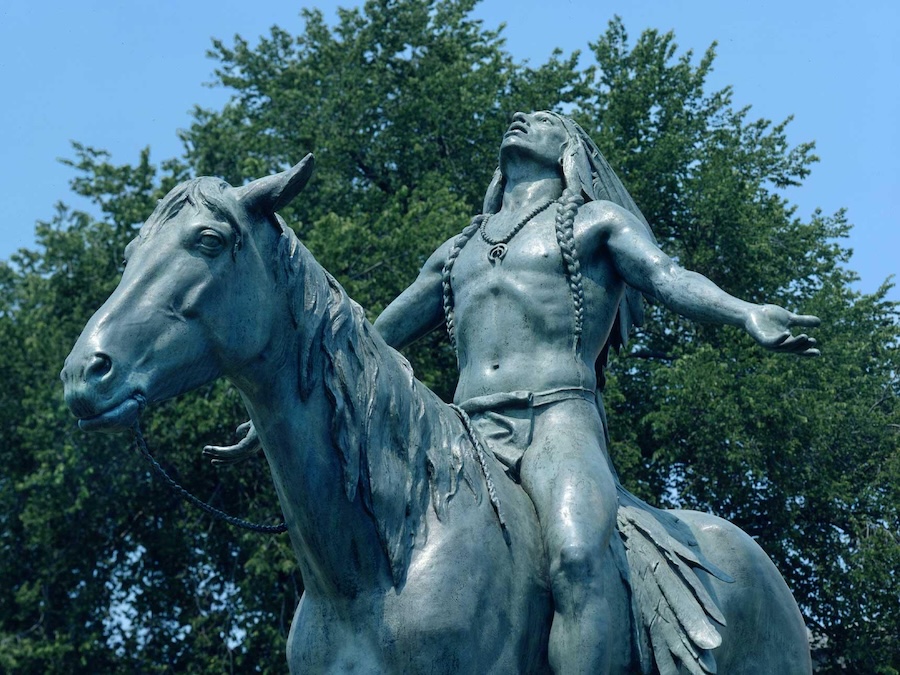
Cyrus Dallin’s Appeal to the Great Spirit, 1909, bronze and green patina; Museum of Fine Arts Boston, acc. no. 13.380. For thoughts on this sculpture, the “vanishing race” trope, and Indigenous visitors’ views of the sculpture, see www.mfa.org/collections/americas/appeal-to-the-great-spirit
Three years later, a very different work came to the MFA thanks to Brooks. In spring 1912, sculptor Cyrus Dallin offered Boston his 1909 Appeal to the Great Spirit, and it was placed at the museum’s Huntington Avenue entrance to attract donations. A limited sum was in hand when Brooks paid the entire balance, urging that the work stay put and not be moved to a site in the Fenway park system. His view prevailed, and the Dallin sculpture still calls attention to the legacy of Native American culture, a more vital subject today than in 1912. His Chicago skyscrapers boldly foretold a future, but so did Brooks’s art collecting.
Mary Crawford-Volk
Dear BCF,
I’m a long-time supporter of the BCF, going back to the first McLean negotiations 25 years ago. I just wanted to thank you for your research, work, and articles on Belmont issues. I particularly wanted to call out Jeffrey North and Vince Stanton for their work and articles on the Community Bike Path, invasives removal, etc.
Your work is greatly appreciated; keep it up!
Art Kreiger

Sorry, the comment form is closed at this time.