
By Jeffrey North and Vincent Stanton, Jr.
On March 30, the Belmont Select Board, Planning Board and Office of Planning and Building, with support from consultants able.city, held a kickoff meeting at the Belmont Library for a proposed new overlay zoning of the Brighton Street business district.
The zoning is to be developed utilizing the same form-based code that Town Meeting adopted in March when it created new overlay zoning for Belmont Center. Select Board chair Matt Taylor proposed a timeline with draft zoning in place by late spring, followed by additional public meetings and review, culminating in a Town Meeting vote in fall 2026.
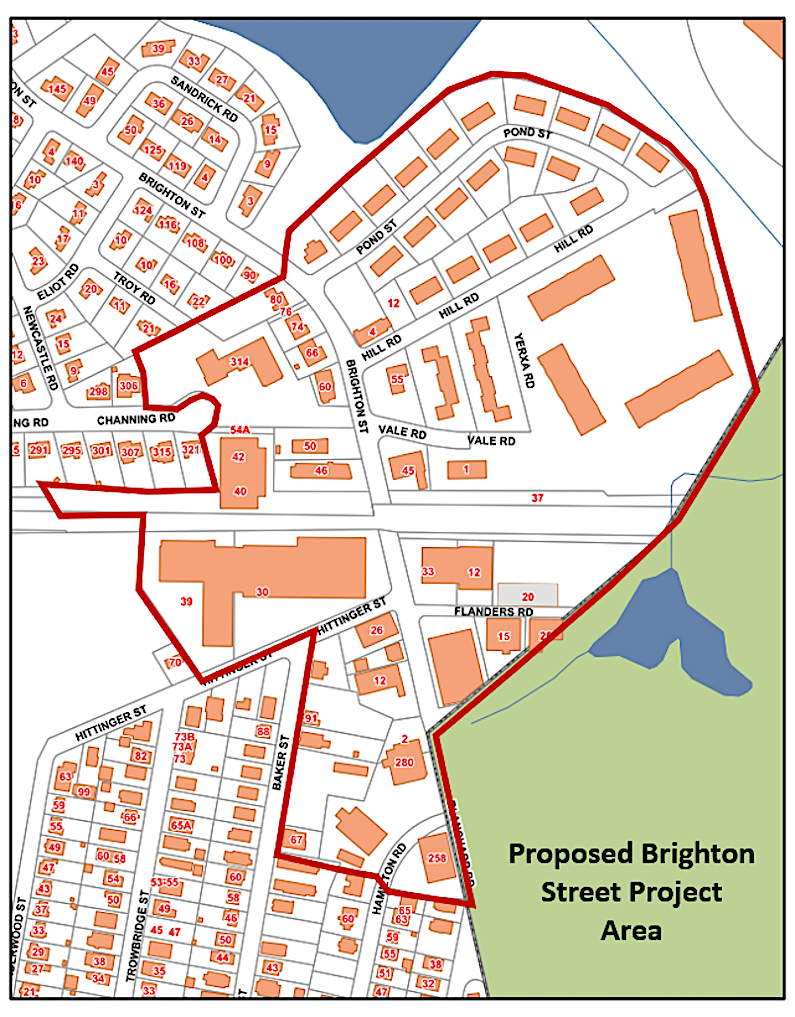
Proposed Brighton Street zoning area. Graphic: Town of Belmont
A recent Harvard Kennedy School (HKS) field study offers Belmont a detailed look at how the Brighton Street Corridor could evolve into a small, walkable center that brings in more tax revenue while still feeling like Belmont, albeit with larger buildings than exist currently. The study focuses on how to add shops, housing, and community spaces in ways that reflect what residents say they want, and what private developers say they can realistically build. Concepts and graphics from the HKS study informed the town’s presentation on March 30.
The impetus to rezone Brighton Street grew out of the 2022 Financial Organization Structure Review of Belmont (aka the Collins Report; see “Have You Read the Collins Center Report?” November/December 2022 BCF Newsletter), which warned that the town relies too heavily on residential property taxes. That report urged Belmont to expand its commercial tax base, and Brighton Street emerged as one possible place to do it. A team from the HKS Urban Politics Field Lab was asked to engage residents, businesses, and developers to help shape a shared vision for the corridor’s future.
How the Harvard team did its work
The five-person student team used multiple research methods. They analyzed current town survey data and created maps showing the locations of various amenities, such as restaurants, clinics, and entertainment venues in Belmont and nearby communities. Then, they met with 105 residents, including four focus groups and a survey of Hill Estates tenants, to gather firsthand insights about hopes and concerns for the area.
They also interviewed 14 developers and property owners to understand what makes a project feasible from a private perspective, and spoke with staff from peer communities like Cambridge and Watertown to learn from their experiences. Together, this provides Belmont with a clearer picture of what residents want, what the market can support, and where those perspectives align or conflict.
What residents say they want
Residents in the focus groups consistently asked for “third places”—settings where people can gather that are neither home nor work. The most popular ideas were family‑friendly restaurants or a brew pub, a coffee shop with outdoor seating, small local shops, a modest grocery or convenience store, and health services such as doctors’ offices. A survey of 68 Hill Estates residents produced a similar list: coffee shop, small grocer, and family‑friendly restaurant topped their rankings.
The study also probed how people want Brighton Street to look and feel. Participants gravitated to images of traditional brick storefronts, outdoor cafés, trees and flowers, and people walking along sidewalks, and largely rejected pictures dominated by parking lots or a “downtown nightlife” vibe. Many described wanting a place that feels welcoming, lively, and comfortable, not overly urban or flashy.
On building height, most focus group participants said they could accept up to four stories, especially if upper floors are set back so buildings don’t feel too tall or “oppressive” at street level. They also emphasized greenery, good lighting, and safe, comfortable sidewalks.
Concerns: traffic, flooding, affordability
Residents raised a familiar set of concerns as well. Traffic on Brighton Street today already feels heavy and sometimes unsafe, and many worry that additional development will make congestion worse unless the town improves intersections and offers better options for walking, biking, and transit. The new Belmont Community Path is a particular asset, but people stressed that side streets and crossings must feel safe for pedestrians and cyclists of all ages.
Flooding came up frequently; most of the corridor would flood in a category 2 hurricane and all of it a category 3, per Belmont’s 2020 Municipal Vulnerability Plan. Residents noted the need for careful stormwater management and raised questions about environmental contamination associated with the Pure Coat site. Many want to see any redevelopment use resilient design—such as elevating buildings, adding rain gardens, and protecting green space—so problems are not exacerbated.
Affordability is another major theme. Hill Estates residents, in particular, expressed worry about losing affordable units or being displaced. (The property was sold to a new owner in June 2025.) Interviewees broadly support creating more affordable housing in town but do not want Brighton Street to be the only place where it happens, nor do they want to see primarily luxury housing and upscale amenities in this corridor. Several residents emphasized the need to better include Hill Estates voices in decision‑making.
What developers say is realistic
Developers and property owners see Brighton Street as having potential, but they flag real obstacles. Ownership is fragmented, lots are small or constrained (see map of proposed rezoned area), and the area competes with stronger nearby commercial centers like Fresh Pond, and in the future the proposed 4.5 million square foot Cambridge Point development just east of Brighton Street (between Concord Avenue and the Fitchburg rail line). That means any major project must overcome higher costs and more complicated land assembly.
From their vantage point, housing is the most feasible primary use, with shops and other commercial space added at street level if enough residents live nearby to support them. Proximity to the commuter rail is a plus, but traffic congestion, limited access, and the high cost of building parking on poor soils all cut against redevelopment.
Above all, developers stress the importance of clear, predictable rules. They are more likely to invest if Belmont sets out a straightforward plan for where taller buildings are allowed, what kinds of uses are encouraged, and how quickly projects can move through review and permitting. Some interviewees mentioned tools like modest increases in allowed building size, reduced parking minimums, and financial incentives (for example, tax‑based tools that help pay for infrastructure) as ways to make the numbers work.
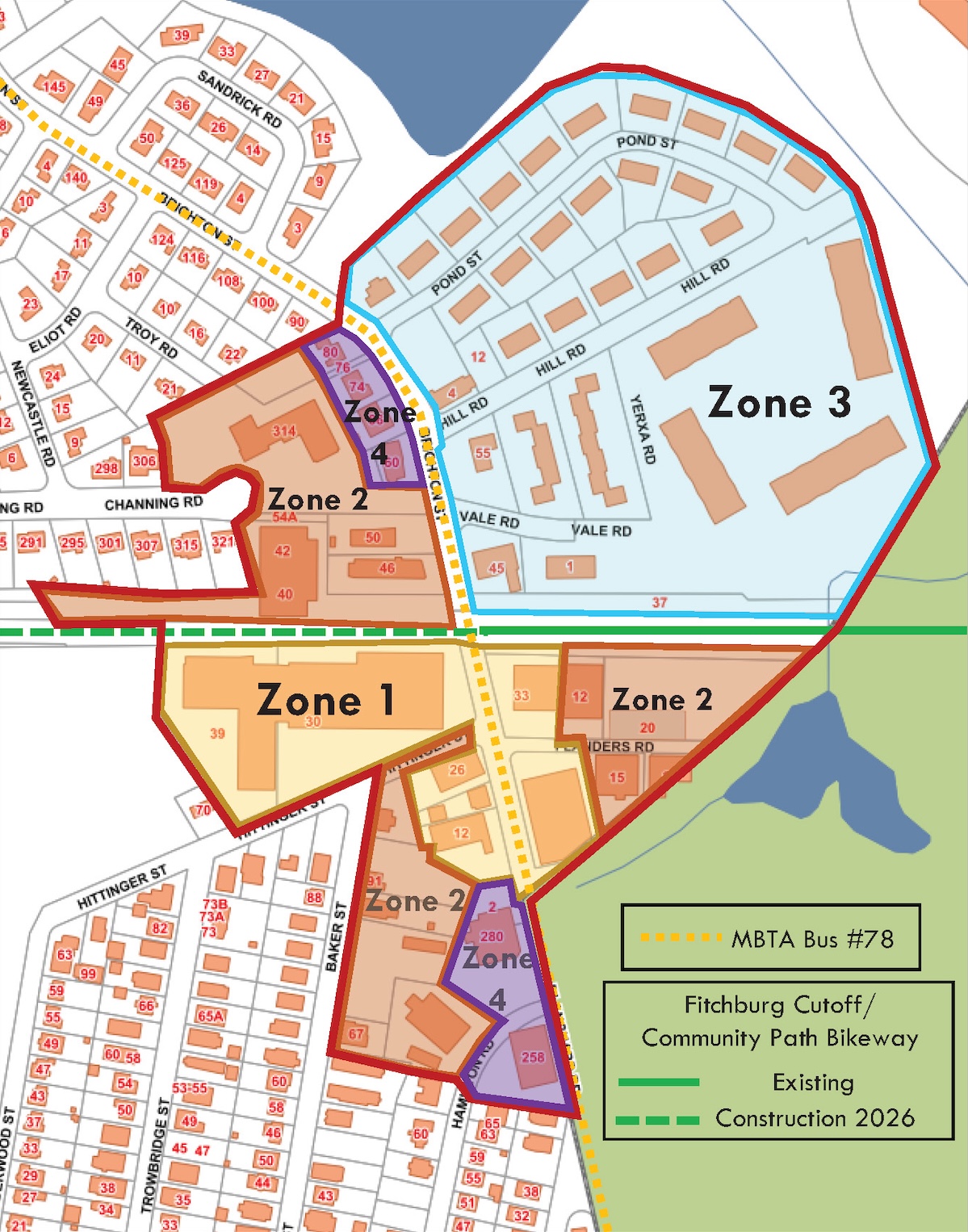
Potential zoning for Brighton Street. Graphic: Town of Belmont
A possible future Brighton Street
To pull these strands together, the HKS team offered a set of illustrations based on what they heard from both residents and the private sector. Their “after” images show a corridor with wider sidewalks, street trees, and plantings that help absorb stormwater; café seating and storefronts along the sidewalk; and mixed‑use buildings with homes above and shops or community uses at ground level. Parking is still present, but much of it is placed behind buildings or in structures, rather than fronting the street.
The authors propose a phased approach. The first step would be to map current ownership and identify a few key sites, especially properties with single owners, where zoning updates and infrastructure investments could encourage an “anchor” project to move forward. Later phases would expand improvements, add more green space, and knit together a cohesive mixed‑use district over time.
Process: keeping everyone at the table
Finally, the study underlines how important it will be to communicate clearly and early with all affected groups, including Hill Estates residents, nearby neighborhoods, and the wider town. Stakeholders said they want more than one‑time public hearings; they asked for a mix of small group meetings, online updates and surveys, walking tours, and regular opportunities to react to evolving plans.
The HKS team’s central message is that a “Belmont‑scaled” mixed‑use center on Brighton Street is possible—but only if the town carefully balances fiscal needs, neighborhood character, environmental concerns, and housing affordability, and keeps residents and property owners meaningfully involved at each step.
March 30 update
On March 30 the town’s consultant, able.city, proposed to divide the Brighton Street corridor into four subdistricts with a differing development focus and matching zoning for each subdistrict (see map).
Zone 1, comprising buildings along both sides of east Hittinger Street, including Purecoat North and Crate Escape, as well as the buildings on the east side of Brighton Street flanking Flanders Road, would be the “‘heart’ of the new district, functioning as a walkable, mixed-use district with a strong public realm” featuring residential units over retail businesses.
Zone 2, comprising lots behind Zone 1 (off Brighton Street), as well as the current Belmont Printing, N. Sacca & Sons Construction, and French & Mahoney buildings along Brighton Street north of the Fitchburg Line tracks, would be zoned as “an artisan and light industrial district focused on small-scale production, creative enterprises, and entrepreneurship.”
Zone 3, comprising the Hill Estates, the largest of the four zones, would be reconceived as “Belmont’s compact version of Arsenal Yards or Assembly Row, including a higher-intensity, destination-oriented mixed-use district, combining residential, retail, entertainment, and public amenities.”
Zone 4, comprising two small areas along Brighton Street at the northern and southern borders of the district where it abuts residences, would be restricted to smaller buildings: “A transitional district between more intense development areas and adjacent neighborhoods with some commercial space and upper floor apartments.”
To read the team’s presentation and final report, visit the town’s web page for the Brighton Street Planning and Zoning Project: www.belmont-ma.gov/2131/Brighton-Street-Planning-and-Zoning-Proj
Slide deck presented March 30, 2026, at the kickoff meeting: www.belmont-ma.gov/DocumentCenter/View/13910/Brighton-St-Workshop-Presentation-33026
Jeffrey North is managing editor of the Belmont Citizens Forum Newsletter. Vincent Stanton, Jr., is a director of the Belmont Citizens Forum.

Sorry, the comment form is closed at this time.