
By Jeffrey North
Belmont now allows small accessory apartments by right on most residential lots, putting it roughly in line with neighbors like Arlington and Lexington — but the number actually built so far remains very low.
After years of debate, Belmont has joined the growing list of Massachusetts communities that allow “accessory dwelling units” (ADUs) on most residential lots. The town’s ADU bylaw, approved at the March 2025 Special Town Meeting, was crafted to comply with the state’s 2024 Affordable Homes Act, which requires communities to allow at least one small ADU by right where residential units are allowed. This change can help residents create more flexible and potentially more affordable housing, support multigenerational living, and, in some cases, increase property value.
On paper, the change is significant. Until early 2025, Belmont allowed ADUs only by special permit in historic accessory buildings, such as old carriage houses, and even those were rare. Now, a homeowner can add a small apartment in a basement, above a garage, or in a separate backyard structure without going through a discretionary special‑permit process as long as the project meets the town’s dimensional rules and the new state limits on ADU size.
Yet almost a year after the new zoning took effect, activity remains very light. Christopher Ryan, Belmont’s director of Planning and Building, reports that the town has received four ADU applications so far. Two have been approved and are under construction, but none have been completed, and two additional potential projects were dropped after initial exploration. Ryan says he is “surprised that it’s as light as it has been,” and attributes the slow pace to high construction costs and interest rates rather than to the bylaw’s strictness.
What Belmont’s ADU bylaw allows
Belmont’s bylaw closely tracks state law. A single ADU is allowed on each lot with a residential dwelling (including two‑families). The unit must be clearly smaller than the primary home, with its area capped at 900 square feet or 50% of the principal dwelling’s floor area, whichever is less. ADUs can be internal (for example, a basement unit), attached, or in a detached accessory building, provided they meet setbacks and height limits.
The state law prohibits local rules that require an owner to live on the property and also bans “unreasonable” restrictions on renting ADUs. Belmont’s ADU FAQ and information materials reflect this fact. The town cannot require owner‑occupancy, and it cannot ban year‑round rentals of ADUs that otherwise follow state law. At the same time, the local bylaw is drafted to prevent ADUs from being used as short‑term rentals, reflecting concern about turning backyard apartments into de facto hotel rooms instead of long‑term housing.
In designing the bylaw, Ryan notes, staff and the Planning Board were acutely aware that Belmont’s residential districts already carry strict open‑space and lot‑coverage requirements. To create some room for ADUs, they added two modest forms of flexibility: a 5% bonus to maximum lot coverage and a relaxation of open‑space requirements, both available when an ADU is added. They also chose to require one off‑street parking space per unit outside defined transit areas, responding to one area of citizen concern, while still staying within the state law.
So far, though, these adjustments have not emerged as clear barriers. Ryan says that, given the very low volume of applications and pre‑application inquiries, “we haven’t seen those as specific limiting factors,” and that it is too early to say whether zoning parameters or physical constraints will be the main brake on future ADUs.
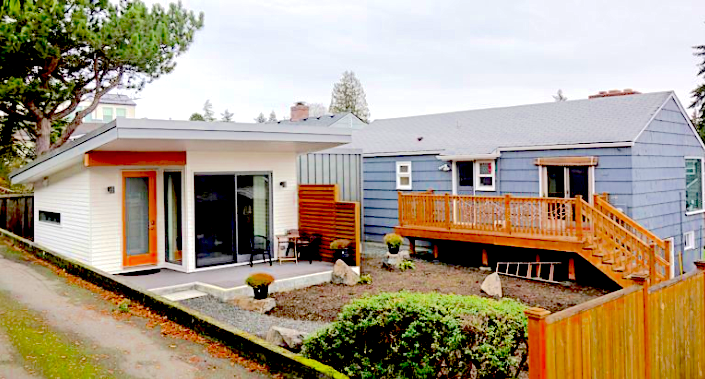
An example of a detached backyard ADU. Graphic: Mass.gov
Costs, codes, and the homeowner experience
If the bylaw itself is not the main obstacle, what is?
Belmont’s inspector of buildings Ara Yogurtian notes that applicants are often surprised by “more restrictive state building codes per 780 CMR 10th edition and current rising construction costs.” For attached ADUs inside or connected to existing homes, the typical sticking points are fire separation, fire suppression, and fire alarm systems. For new detached ADU structures, the challenges tend to be utility connections and compliance with energy‑conservation regulations for new construction. DC Structures, Inc. a national firm that delivers prefabricated free-standing ADUs, estimates a cost of $250-$500 per square foot in Massachusetts (e.g., $125-250,000 for a 500 sq ft building), depending on site conditions and design selections.
So far, Yogurtian estimates that at least two potential ADUs have never become formal applications because owners realized the work or cost was more than they expected. For those who do want to move ahead, he advises three concrete first steps to avoid surprises: obtain a certified plot plan, commission architectural drawings, and secure an existing‑building report from an architect. He and Ryan also note that the town already offers pre‑application meetings, but that this option may not be communicated clearly enough to residents who are just starting to consider an ADU.
Both staff members see room for better guidance materials. Ryan suggests that existing outreach documents from the bylaw‑adoption phase could be “fleshed out.” At the same time, Yogurtian says the town would be open to hosting typical plan sets or examples created by outside professionals, provided there is no conflict of interest. For now, they describe ADU implementation as “a work in progress.”
Belmont in a regional and long‑term context
Belmont is not alone in adjusting to the state’s ADU mandate. Neighboring Arlington had already built an ADU framework, with clearer homeowner guidance, before the state law; Lexington and Waltham are working from more complex, special‑permit‑heavy regimes that now must be reconciled with by right requirements. Belmont, by contrast, moved later but adopted a relatively simple structure that largely copies state standards with a few local adjustments for open space, lot coverage, and parking.
ADUS in Belmont and Nearby Communities
Here is a quick snapshot of how Belmont compares with a few neighbors on the basics: what’s allowed, how big the units can be, and how easy the process is on paper.
ADUs are small secondary homes on the same lot as a main house—often basement apartments, over-garage units, or small backyard cottages. They can help older residents age in place, provide a place for adult children to live, or offer one more long-term rental in a tight market. The state’s 2024 Affordable Homes Act pushed every town to open the door to these “little houses.” Belmont has done that. The question now is whether homeowners will follow.
|
Town |
Status (on paper) |
Size/ key rules |
ADUs permitted |
|
Belmont |
By right, 1 ADU per qualifying lot |
Up to 900 sq ft or 50% of main home; 5% lot-coverage bonus; no owner-occupancy; no short-term rentals. |
3 |
|
Arlington |
By right or via building permit |
Up to 900 sq ft; follows state limits; strong homeowner guidance online. |
7 |
|
Lexington |
Older, more complex ADU regime |
Multiple ADU types (including “Protected Use” ADUs up to 900 sq ft); some legacy units still tied to owner‑occupancy; adapting to state rules. |
6 |
|
Waltham |
Historically more permit-heavy |
ADUs require a special permit through the Board of Appeals under local rules, but state law now also guarantees one by-right ADU on single‑family lots. |
5 |
Ryan says the Planning & Building office has not yet conducted systematic research on how many ADUs have been built in surrounding communities since the law passed (see box for state data). He hopes that, over time, the state or regional organizations like Citizens Housing and Planning Association or the Massachusetts Housing Partnership will convene a broader conversation so communities can share experiences and lessons learned.
Looking ahead, Ryan is reluctant to label ADUs as either a major or minor element in Belmont’s housing strategy. Instead, he sees them as one of “many tools in the toolbox” that should be addressed explicitly in the town’s ongoing Comprehensive Plan and broader zoning reform. In particular, he points to the potential for ADUs to support “missing middle” housing for specific groups—such as seniors and empty nesters—and to create opportunities for residents to downsize and remain in town even if they no longer need, or cannot afford, a full‑size single‑family home.
As for what success might look like, Ryan offers one benchmark. If, in five to 10 years, annual ADU production approaches the levels staff initially estimated when they were doing outreach on the bylaw, that would be a sign that the policy is starting to work. Until then, he and Yogurtian see the picture as still forming. High construction costs and financing conditions remain major constraints; whether zoning details or neighborhood reactions will emerge as equally important factors is, for now, an open question.
The state’s housing law was promoted with the promise that small backyard homes could offer new options for seniors, caregivers, and renters. By year-end 2025, at least 1,229 ADUs had been approved statewide, based on data from 293 of 351 municipalities. Belmont has opened the legal door to these “little houses” and taken modest steps to make them feasible. Whether ADUs appear on dozens of Belmont streets—or remain a niche solution for a handful of homeowners—will depend on a combination of markets, codes, and, above all, residents’ willingness to take on a demanding building project in their own basements or backyards.
For more on how many ADUs cities and towns across the commonwealth are permitting see the state ADU website: www.mass.gov/info-details/accessory-dwelling-unit-tracker. That database shows, for example, that Milton, with a population similar to Belmont (28,630 vs. 27,295), had permitted 25 ADUs through June 30, 2025 (the most recent data available).
Jeffrey North is the managing editor of the Belmont Citizens Forum Newsletter.

Sorry, the comment form is closed at this time.