
Sustainable infrastructure has fiscal, environmental benefits
By Peter Dizikes
Belmont is entering a new era of local energy production. Today, renewable energy capacity is becoming a normal component of our public buildings and even the town’s vehicle fleet because clean energy offers both fiscal savings and environmental benefits.
Consider the flurry of recent building activity on lower Concord Avenue. Over the past five years, the town opened the new Belmont Public Library, the Belmont Sports Complex, Home of the Skip Viglirolo Rink, and the Belmont Middle and High School, all heavily powered by renewable energy. Together, these structures are turning Concord Avenue into a clean-energy corridor.
The school’s rooftop solar array produces operating savings of around $174,000 per year. It also features a geothermal energy system with 83 wells providing heating and cooling, making the entire project fossil-fuel free. The sports complex and rink’s solar array is initially projected to produce energy savings of at least $70,000 per year. And the new library building’s solar panels are expected to cover 30% to 40% of its energy needs.
Out of all this equipment, only the rink’s solar array is visible from street level. But out of sight should not be out of mind. Renewable energy, on municipal rooftops or below ground, is now saving Belmont hundreds of thousands of dollars annually.
But there’s more: Belmont’s school bus fleet is about to include electric vehicles for the first time.
In December, Belmont’s School Committee voted to pursue a contract for electric buses with the firm Highland Electric Fleets. This contract is supported by a $1.8 million grant from the Massachusetts Clean Energy Center, a state economic development agency. The grant gives Belmont the funding to add at least three electric buses to next year’s fleet with a 10-year contract for those vehicles.
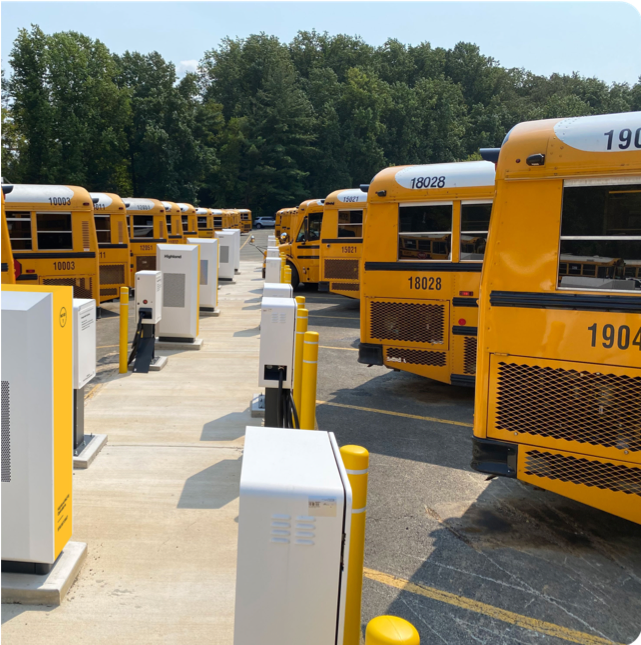
EV bus charger stations, Beverly, MA. Photo: Roger Wrubel
Like the Concord corridor building projects, the bus deal provides the town with both fiscal and environmental advantages — starting with the outside funding, making the vehicles available. The 10-year contract, as opposed to three years for a typical diesel-engine bus contract, provides more stability for the school district. Town Meeting voted in 2023 to support this longer contract for electric buses. The annual cost increases for the electric buses is expected to be near 3% — lower than average, according to the School Committee. That rate rise may also be more predictable than for fossil fuel buses, since the cost will not be linked to diesel fuel prices.
As a bonus, Highland Electric Fleets handles both installing charging infrastructure and site operations.
On the environmental side, replacing internal combustion-powered buses with electric vehicles is a clear win. And there may be very localized health benefits from reducing pollution exposure around schools. (See “Helping Belmont Students Breathe Easier,” BCF Newsletter, September/October 2021.)
Such good news should not lead us to underestimate the long-term challenges of climate change. In 2009, Town Meeting in Belmont voted to reduce our fossil fuel emissions by 80% by the year 2050. That is a formidable task, requiring rooftop solar, geothermal heat pumps, electric vehicles, home weatherization, and other sustainable technologies.
Belmont’s Energy Committee was created after the 2009 vote to help steer the town towards its goals. Our 11 members identify opportunities for renewable energy adoption in both public and private sectors. We provide information, data, ideas, and network connections to our partners in the town government and to neighbors. Further, we have organized public programs such as Belmont Goes Solar and Belmont Drives Electric.
Belmont has made progress. According to an Energy Committee inventory, town emissions were down 14% between 2014 and 2021. In 2019, Town Meeting also adopted a roadmap outlining key steps for decarbonizing Belmont.
As of January 2026, the number of solar arrays on private homes in Belmont has reached 460, with a capacity of 2,690 kilowatts, an outgrowth of the long-running Belmont Goes Solar effort.
Placing solar on municipal buildings is crucial for reaching the decarbonization target. The middle and high school building has an 840-kilowatt array. For perspective, the equivalent capacity could power hundreds of homes, and when energy use at the high school and middle school occasionally falls below the energy generated by the solar panels, the excess feeds into the Belmont Light system. The rink solar array is 360 kilowatts, and the new library has a 100-kilowatt array. All told, the three buildings account for 31% of Belmont’s solar capacity.
The new projects also show that flexibility in funding upfront capital costs is important. For the high school and middle school project and the library project, the solar installations came from the funds provided by debt exclusion votes in 2018 and 2022, respectively.
To pay for the solar array on the rink, in 2025, town administrator Patrice Garvin negotiated an agreement for Belmont Light, the Belmont Hill School, and Belmont Day School to fund the $1 million installation. As such, the rink project represents a hat trick of benefits: zero initial capital costs for the town, a reduction in annual operating expenses, and clean energy production that helps the climate.
Meanwhile, the electric bus program is supported by a state grant, representing still another type of funding source Belmont is utilizing.
Once funded and installed, rooftop solar pays for itself and then some. In 2025, solar panels were roughly 60% cheaper than they had been in 2010, while converting sunlight into energy was about 40% more efficient. More power for less money is a good deal.
Looking ahead, the Belmont Energy Committee will continue to engage with town officials about additional sources of support for clean-energy capital projects. We’re committed to identifying solutions that work in fiscal, operational, and environmental terms, and we continue to notify residents about clean-energy consumer options.
Sustainable energy solutions are cost-effective and part of the everyday process of meeting our town’s needs. So, when you’re visiting Belmont’s new library, look out of the upstairs picture window. When you see the rink and school campus across the street, know that those structures, along with the one you’re standing in, comprise our new clean-energy corridor. There is much more to be done, but Belmont is taking solid steps in its journey towards decarbonization.
Peter Dizikes serves on the Belmont Energy Committee and is a Precinct 1 Town Meeting member.

Sorry, the comment form is closed at this time.