
By Max Colice
Town Meeting changed Belmont’s zoning bylaws last year to allow new housing development and is considering more zoning changes to allow new commercial development, partly in an effort to increase property tax revenue. But simply changing the zoning doesn’t guarantee more development or higher property tax revenue. How else can Belmont encourage new housing construction and commercial development?
One very old idea for encouraging development is the Land Value Tax. Instead of taxing both land and buildings like the current property tax, a Land Value Tax applies only to land, not to the buildings. Under a Land Value Tax, an empty lot would be taxed the same as an equivalent lot with buildings on it.
Adam Smith, David Ricardo, James Mill, and John Stuart Mill all argued that taxing only land would motivate property owners to put their vacant and underused land to more profitable use rather than letting it remain idle or underused. In the late 19th century, Henry George promoted the Land Value Tax based in part on the idea that landowners benefit disproportionately from public infrastructure improvement, such as roads and sewers, and should therefore pay a larger share of their cost. Even Milton Friedman acknowledged that “the least bad tax is the property tax on the unimproved value of land,” i.e., a Land Value Tax.
The unimproved value of land depends in large part on what the property owner is allowed to do with it—the uses permitted by the zoning, in other words. Land is more valuable when zoning allows more profitable uses. For example, a lot that can support a larger home, more homes, or multifamily housing will generally be worth more than an equivalent lot that can be used only for a smaller single-family home.
Switching to a Land Value Tax would require a change in state law and so is unlikely to happen any time soon. But considering how land is valued in Belmont does suggest how recent zoning changes could increase land values and how property taxes are distributed among Belmont property owners. Belmont’s land values show this difference clearly.
Consider the average assessed value per square foot of the land in Belmont’s five different residential zoning districts. In the Single Residence (SR) C district, the minimum lot size is nearly three times smaller than the minimum lot size in the SR A district, and the average land value per square foot is nearly three times higher! Put differently, land in the SR C district is more valuable per square foot in part because it is zoned for more homes per square foot than land in the SR A district.
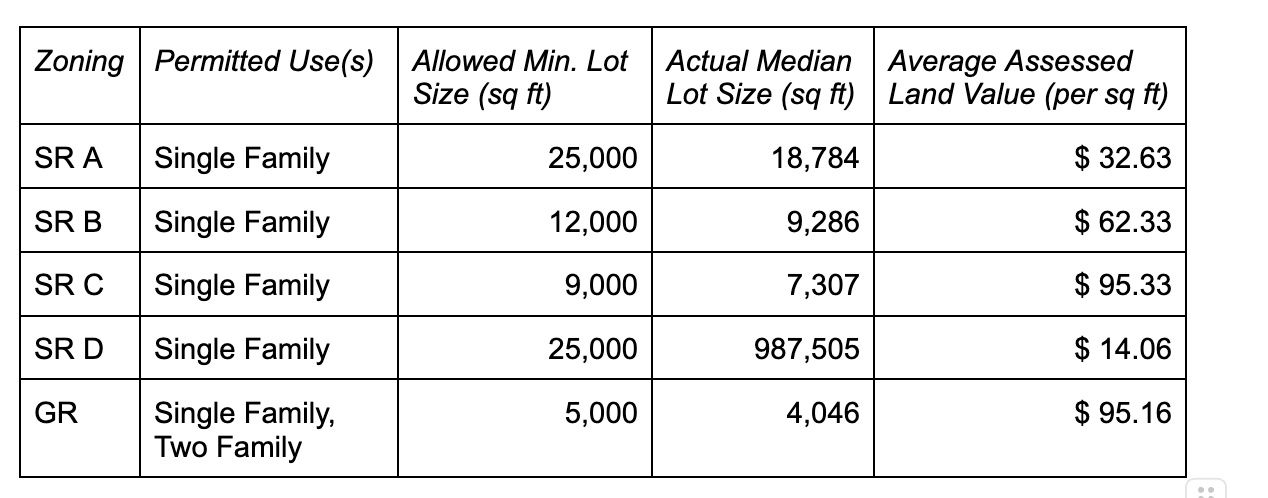
Average assessed land values, allowed minimum lot sizes, actual median lot sizes, and permitted uses for Belmont’s main residential zoning districts Source: Belmont Real Estate Database (belmont.jfryan.net)
Mapping the assessed land value per square foot shows that this trend carries across all of Belmont, with more areas zoned for denser development having much higher assessed land values (per square foot) than areas zoned for sparser development:
In particular, the land in the 3A Overlay District —most of which was previously zoned as General Residence (GR) or SR C—should increase in value now that it can be used for multifamily housing and mixed-use developments. This increase in land value won’t count as new growth and so won’t increase the total amount of property tax that Belmont collects, but it will shift more of the property tax burden onto the owners of these 3A parcels. If the historical economists Adam Smith, David Ricardo, James Mill, John Stuart Mill, and Henry George were right, these increases in land values and property taxes should incentivize development in the 3A Overlay District.
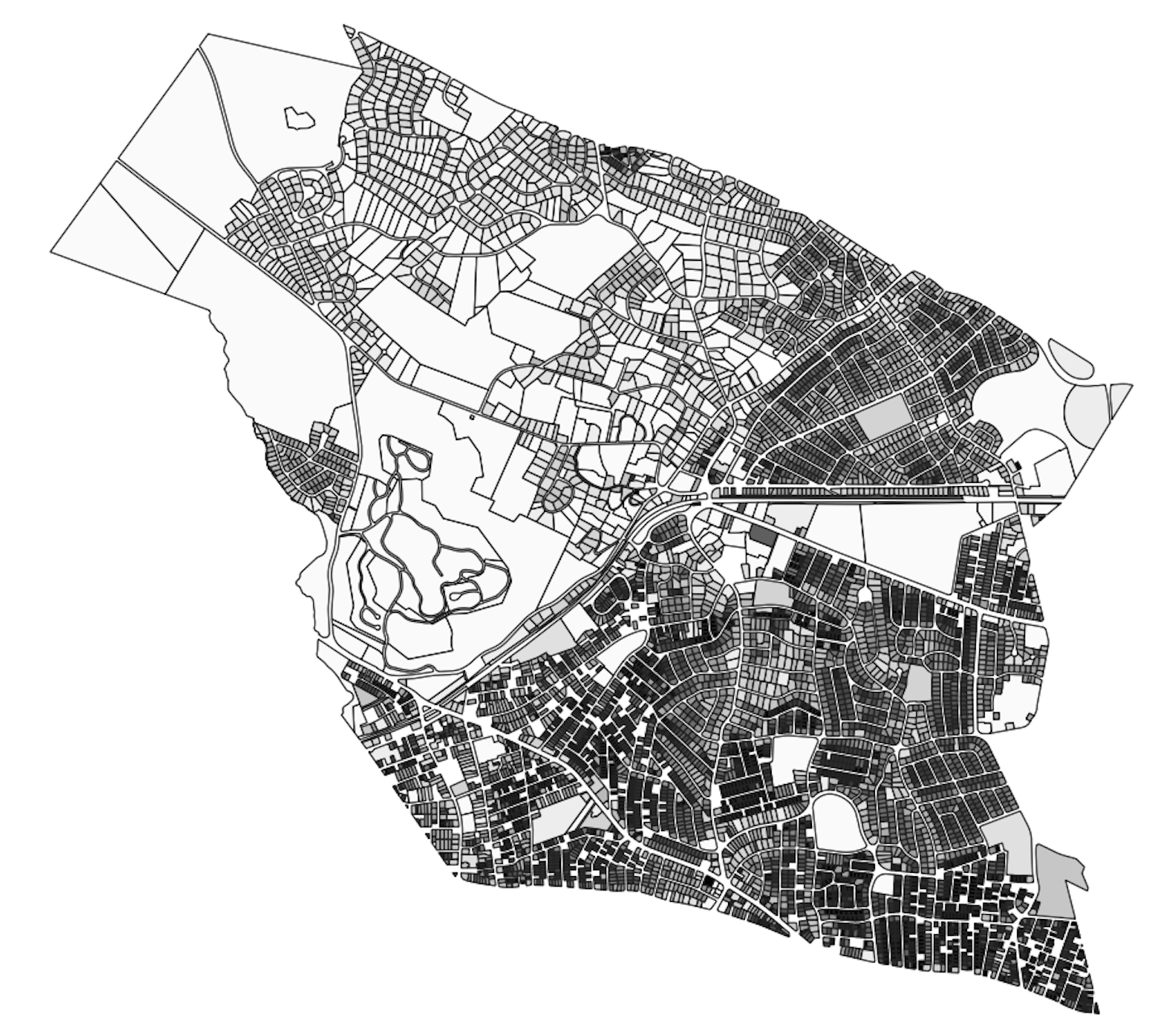
Assessed land value per square foot for each parcel in Belmont (darker shading indicates higher value). Source: Belmont Real Estate Database (belmont.jfryan.net/) and Mass GIS Data Hub (bit.ly/BCF-GIS).
This suggests that reducing the minimum lot size in the SR A, B, and D districts should incentivize even more development and justify increasing the assessed values of land in these districts. Changing the zoning and assessments in the SR A, B, and D districts would not increase Belmont’s total property tax revenue, but it would unlock potential small-scale development in a large swath of Belmont and shift a portion of the tax burden away from the SR C and GR districts. And because many lots in these districts are smaller than the minimum lot size, this change would also align the zoning and assessments with the actual use, reducing the administrative burden associated with renovation and construction for both homeowners and Belmont officials (See “Belmont’s Zoning Should Match Actual Use,” BCF Newsletter, January/February 2023).
Although shifting the zoning—and the assessed land values—would not increase total property tax revenue, it would shift the tax burden in a way that reflects actual use. In the SR A, B, C, and GR districts, the actual median lot sizes are all significantly smaller than the permitted minimum lot sizes. Reducing the minimum lot sizes, e.g., to the median lot sizes, should increase the land values in proportion to the corresponding increase in permitted housing density. Districts that experience higher increases in permitted housing density should experience correspondingly higher increases in land values. This would shift the tax burden away from property owners in the SR C and GR districts and towards property owners in the SR A, B, and D districts.
Max Colice is a Belmont resident.

Sorry, the comment form is closed at this time.