
By David Webster
When I lowered my bicycle on the grassy bank of the Sudbury River in Wayland and stared at the granite marker and historic broken Stone Bridge, time froze. The marker identified this place as being on the Knox Trail. I imagined steam rising from sweaty horses and oxen and then evaporating into the frigid winter air as the straining animals pulled their heavy loads of captured cannons across the bridge towards Boston.
This winter marks the 250th anniversary of an extraordinary Revolutionary War event that was pivotal in forcing the British evacuation of Boston in 1776. During the winter of 1775–1776, Henry Knox, a 25 year old Boston bookseller, led a grueling expedition to transport 59 artillery pieces and armaments captured at Fort Ticonderoga and Crown Point on Lake Champlain in upstate New York to General George Washington on the Cambridge Common on January 24, 1776. This “noble train of artillery,” as Knox described it to Washington in a December 1775 letter, was subsequently placed with fortifications on Dorchester Heights in a single night, surprising the British Army and compelling them to ship out of Boston on March 17, 1776.
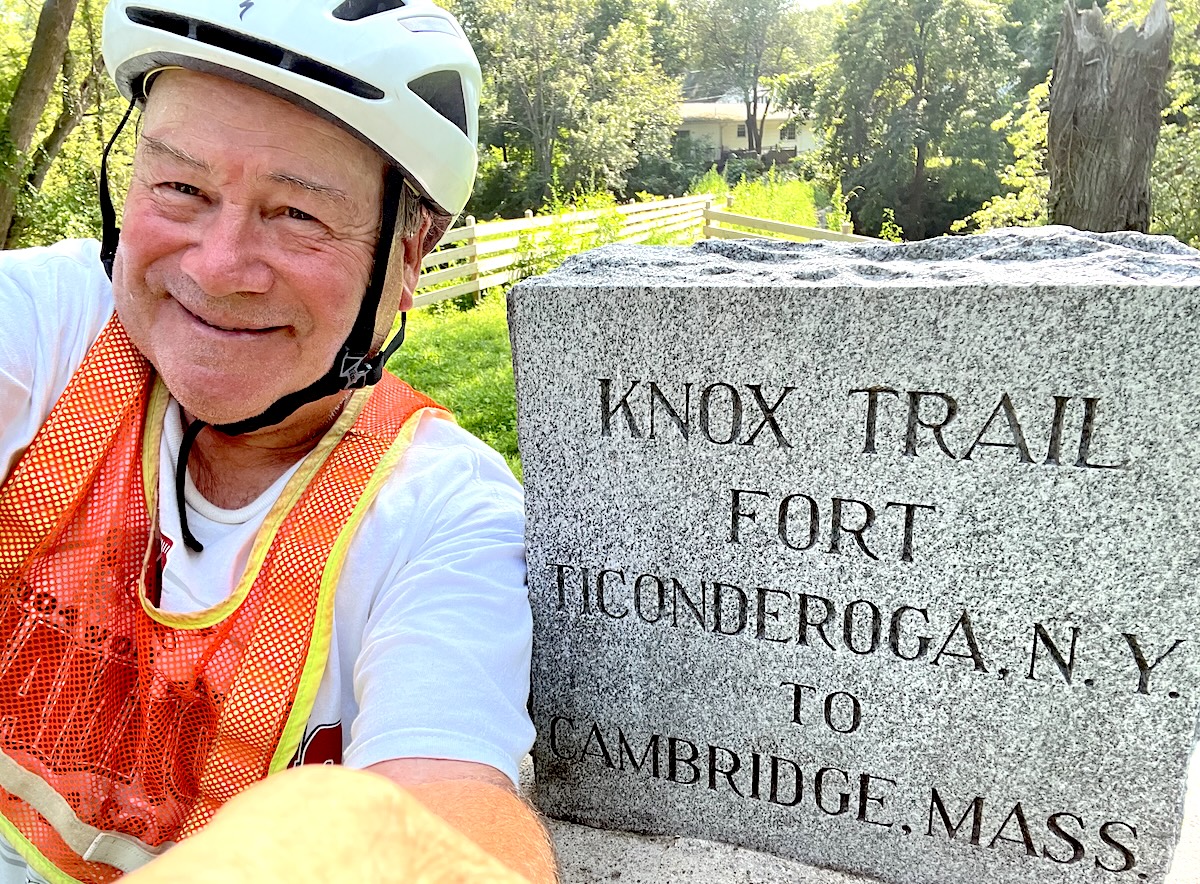
David Webster at the Sudbury River marker, August 2025. Photo: David Webster
One hundred and fifty years later, the state of New York and the Commonwealth of Massachusetts commemorated this courageous and harrowing journey with more than 58 stone markers that both memorialize the expedition and serve as landmarks along the route. Each marker includes a bronze tablet featuring a relief image depicting oxen pulling sleds loaded with cannon driven by a patriot teamster and under the watchful eye of Knox. Markers close to Belmont can be found along Mt. Auburn Street in Watertown, Main Street in Waltham, and on the Cambridge Common.
I became intrigued with the expedition and the markers spaced along the route from Fort Ticonderoga to Cambridge. I took it as a challenge to learn more of the trip’s history and topography by finding each marker on an expedition of my own, by bicycle. Clearly, there can be no repeat or reenactment of moving 60 tons of cannons down Lake George, along the frozen Hudson River, and across the snowy Berkshires and central Massachusetts.
I endeavored to find each marker, tracing the historical route of Henry Knox for six days during the summers of 2024 and 2025. I biked the New York section starting at Fort Ticonderoga during the summer of 2024 and the Massachusetts section in August 2025.
My quest was a rewarding combination of physical challenge, historic discovery, scavenger hunting to find each marker, and glimpses into the rural, urban, and forested roads and towns of upstate New York and across Massachusetts. I was aided by some helpful, if not essential, websites which describe the location of each marker. A good one is www.hudsonrivervalley.org/knox-trail.
The location of at least one marker south of Schuylerville, New York, remains a mystery. Other markers have been moved to new locations to make way for more recent development. However, each segment of the route that ended at a marker was an adventure with its own story, a sense of awe, and often a conversation with a local resident.
Unless you relish navigating with uncertainty and can put up with a variety of roads, drivers, and traffic conditions, I cannot necessarily recommend the Henry Knox Trail as a bike route. However, it also would be a gratifying and challenging trip by car. Either way, you can expect surprises.
For me, some memorable moments were seeing redcoat reenactors drilling at Fort Ticonderoga, chatting with the Lake George landowner who has a marker in his yard, and chancing upon a modern art metal sculpture depicting the expedition near the Saratoga Battlefield. I rode paralleling boat canals and the bike-friendly Empire State Trail near Albany, crossing the Hudson River. I encountered an antique car show and a bear in Great Barrington, came across a cricket match in Shrewsbury, and stood next to a unique marker at a broken stone bridge where Knox crossed the Sudbury River. Finally, I reached the Knox monument on Cambridge Common.
“We the people of the United States” certainly are indebted to the imagination, courage, and resourcefulness of General Knox and so many others who served and fought through the years for our freedom from monarchy and autocracy. Beginning this December, many celebrations are being planned along the route to commemorate the 250 year anniversary of the Henry Knox Expedition.
Riding a bicycle on paved roads on glorious summer days past farms, rivers, and towns bears no comparison to Knox’s 300-mile trek hauling heavy sleds of cannons in the dead of winter in a time of war. However, the 58 times I discovered and read the monument inscription, I was thankful for what these brave souls did and the legacy that they entrusted to us to preserve. The standard Massachusetts inscription reads:
THROUGH THIS PLACE PASSED GENERAL HENRY KNOX IN THE WINTER OF 1775–1776 TO DELIVER TO GENERAL GEORGE WASHINGTON AT CAMBRIDGE THE TRAIN OF ARTILLERY FROM FORT TICONDEROGA USED TO FORCE THE BRITISH ARMY TO EVACUATE BOSTON. ERECTED BY THE COMMONWEALTH OF MASSACHUSETTS 1927.
David Webster is a Belmont resident.

Sorry, the comment form is closed at this time.