
Belmont’s options for dealing with waste woes
By Jeffrey North
Dr. Jonathan S. Krones, associate professor of engineering at Brandeis University, gave a virtual presentation titled “Garbage 101: How the waste system actually works, and what we can do to achieve a more circular economy” sponsored by the Belmont Public Library last November.
The talk offered a rare behind-the-scenes look at how waste and recycling systems actually function in Massachusetts and around the country. It also delivered a clarifying message to communities like Belmont: our recycling system is struggling not because residents are necessarily doing it wrong, but because the system was never built to do what we now expect of it.
Krones organized the evening around seven core insights about the waste system in the United States. For Belmont residents, the most urgent issues were related to recycling: why recycling rates have not improved in more than 15 years; why “single-stream” systems create persistent contamination; and how local choices paired with upstream reforms can support the circular economy we say we want.
Recycling in Decline: What Went Wrong?
Recycling rates in the US rose swiftly from 1990 to 2010, climbing from less than 10% to roughly 35%. But since then: stagnation. For more than a decade, national recycling rates have hovered at 32% to 35%, even as public interest in sustainability has exploded.
Why aren’t we making progress? According to Krones, the culprit is a perfect storm created by two powerful forces.
- The shift to single-stream recycling, in which all materials, paper, glass, metal, and plastic, go into one bin
- Our inability to effectively regulate what gets produced—and thus disposed of
For years, China subsidized the world’s recycling habit. With low labor costs and minimal contamination rules, Chinese importers hand-sorted mountains of mixed recyclable material that US systems couldn’t cleanly process. In some cases, municipalities were actually paid for their recyclables.
But in 2017, China closed the door. In an abrupt crackdown on importing contaminated recyclables, known as Operation National Sword, shipments that once sailed across the Pacific were now rejected. Plastic exports to China collapsed from 581,000 metric tons in early 2017 to just 23,900 metric tons a year later.
US cities suddenly had nowhere for their mixed, contaminated recyclables to go. Processing costs spiked. Many materials were disposed of outright. The recycling industry’s business model, with billions invested in single-stream sorting facilities, no longer worked.
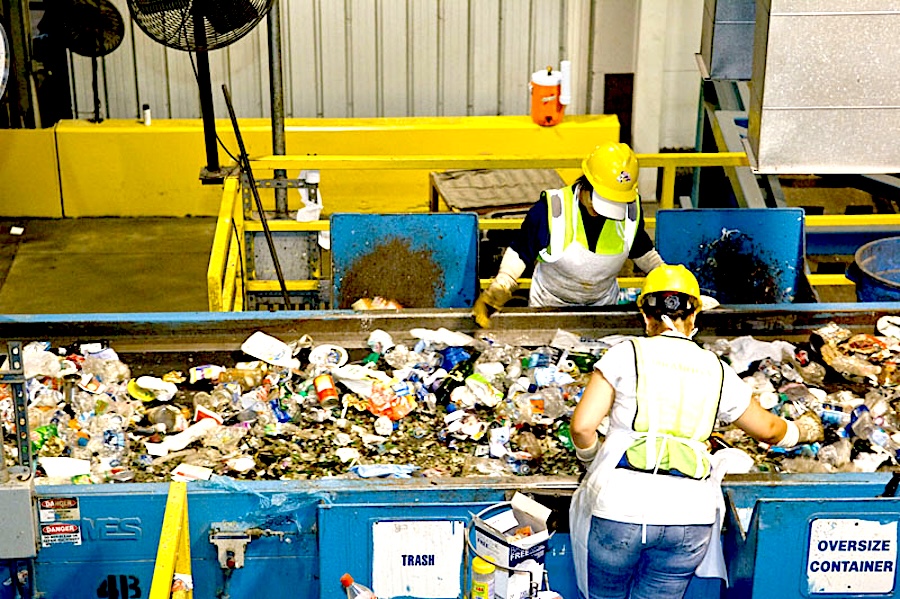
A municipal single-stream recycling plant in Montgomery, MD. Source: US EPA / Wikimedia Commons
Single-Stream: Convenience at a Cost
Single-stream recycling was intended to make recycling easier. And it did: participation rose sharply because all recyclables could go in one cart. But the convenience came with a hidden flaw: high contamination.
When all items are commingled, they crush, smash, tangle, and soil one another. At a materials recovery facility (MRF), workers and machines attempt to separate materials back out again, but often, the system simply can’t.
Recyclability: Shape and Material
A plastic tub may recycle well; a plastic bag likely will not. MRFs can only process certain forms: rigid containers, bottles, cans, and clean paper. Items that are too small, flexible, flimsy, or tangled cannot be separated out by sorting machinery, even if they are technically “recyclable” in a laboratory sense.
Krones warned against “wishcycling”—the well-intentioned habit of tossing questionable items into the recycling cart. It feels virtuous, but wishcycling increases contamination, raises costs, and often causes other, genuinely recyclable materials to be landfilled.
His distilled message: “Nothing is recycled until it becomes a new product.” Collection is just the first step.
The System Wasn’t Designed for Recycling
A major theme of Krones’s talk was historical. To understand today’s recycling crisis, he argued, we must understand the purpose of the waste system itself.
Sanitation Isn’t Recycling
The wase system’s core objectives, enshrined in the 1976 Resource Conservation and Recovery Act (RCRA), are to:
- Remove waste quickly from where people live
- Move it away efficiently and cheaply
- Isolate it from the environment
Recycling, by contrast, requires slowing the system down, sorting, cleaning, and preserving the material quality necessary to feed manufacturing markets. These goals conflict. As Krones put it, waste management’s job is, adapting a prayer from Fiddler on the Roof: “Bless the waste—and keep it far away from us.”
This explains why US recycling programs so closely resemble trash collection rather than being run as independent MRF enterprises. It also explains why recycling contaminates easily: the system was not built to maintain materials’ value.
Waste companies are investing in improved separation technologies, adopting new AI-powered robots to sort a dizzying array of different material types. Krones is not optimistic that doubling down on the current system will fix the problem. As long as producers do not have to shoulder the costs of responsible disposal, the mix of items on the shelves will always be one step ahead of the waste industry’s ability to sort and recycle them.
Beyond the Blue Bin: Industrial Waste
Most residents think of “waste” as what they put at the curb. But Krones’s research shows that there is a similarly large world of industrial waste with its own challenges and complexities.
Non-hazardous industrial waste is generated by a variety of activities, but it is largely invisible to the public. In fact, his best estimate puts the total mass of this waste at about a quarter of a billion tons per year in the US, about the amount of municipal solid waste we produce. Some recent results include the following.
- Phosphogypsum: 33 million metric tons in 2024; 1.73 billion tons accumulated since 1989
- Bauxite residuals (“red mud”): 600,000 dry tons (3 million wet tons) in 2024
These materials pose environmental hazards but also opportunities for beneficial reuse. For example, coal fly ash could replace Portland cement, or steel slag could serve as industrial insulation.
While fascinating, these findings also reinforce an essential point for local recycling discussions; municipal recycling is important, but it is only part of the nation’s overall materials problem.
Recycling’s Future: a Return to Separation?
In New England, many towns still operate municipal transfer stations where residents drop off source-separated recyclables: clean cardboard here, metal there, glass elsewhere.
Krones is actively researching whether these centers may hold the key to retaining material value in a post-China world. Early findings suggest:
- Source-separated materials maintain far higher quality than single-stream mixtures.
- These materials can feed local or regional recycling markets, reducing global transportation impacts.
- Transfer stations may serve as critical infrastructure for a localized circular economy.
Belmont is currently reliant on contracted curbside single-stream service. The town may wish to pay attention to these developments, particularly as the town revisits future hauling contracts and climate-related waste strategies.
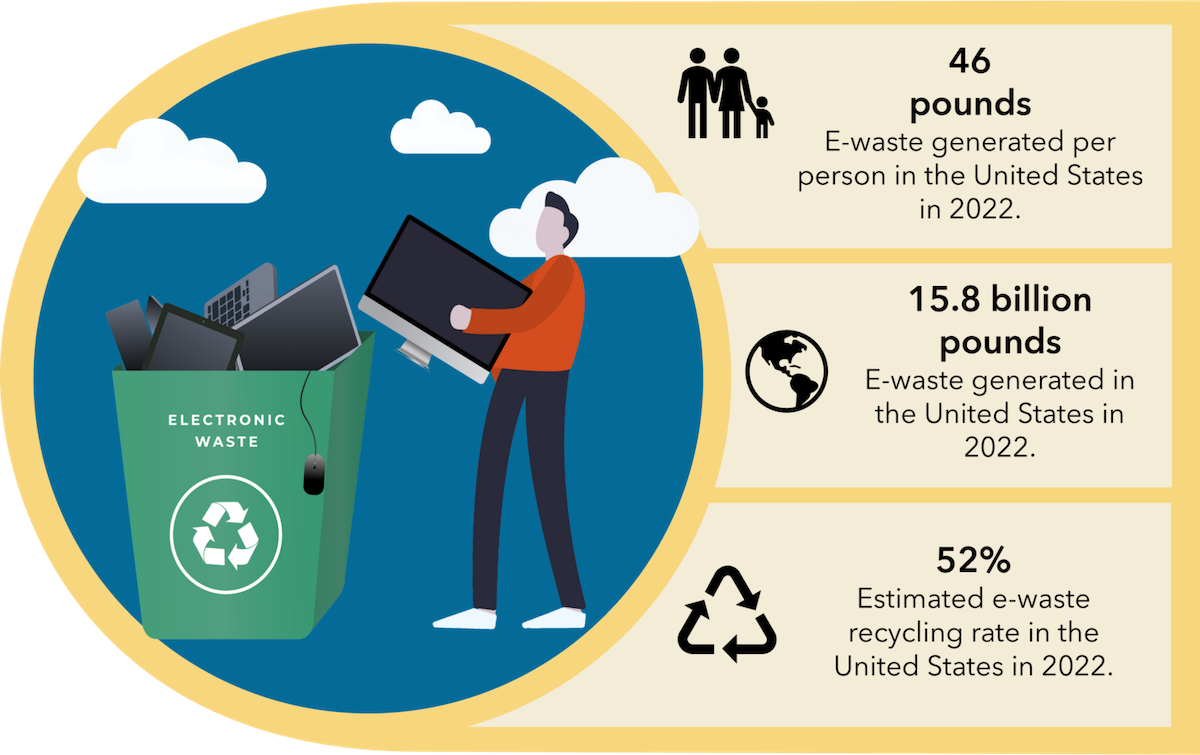
Illustration from 2024 Global E-Waste Monitor Report. Source: United Nations Institute for Training and Research (UNITAR).
E-Waste and Repairs
Though not the focus of the evening, Krones highlighted e-waste as the fastest-growing waste stream worldwide. Most electronics are difficult to repair by design, leading to unnecessary disposal of valuable materials.
He championed the Right to Repair movement, which protects consumer access to repair information, tools, and parts. He also praised community repair events, like Fixit Clinics and Repair Cafés, that help residents learn to repair household items rather than discard them. Massachusetts supports these events through its Recycling Dividend Points program.
Repair, Krones stressed, like waste reduction and reuse, is much preferred to recycling, as it allows us to keep using the things that have already been produced.
What Belmont Residents Can Do
Krones offered clear steps communities should take to improve recycling outcomes.
- Avoid wishcycling.
If you are not certain an item is recyclable in Belmont’s system, place it in the trash. This protects the value of truly recyclable items. - Support upstream policies.
We often think that recycling solves the waste problem. It doesn’t. Improvements must occur in product design and manufacturing:
• Extended Producer Responsibility (EPR) for packaging
• Design standards for recyclability and repair
• Restrictions on problematic materials (certain plastics, multilayer films) - Choose repairable goods
Buy items designed to last and learn basic repair skills. - Engage locally.
Belmont residents can advocate for:
• Clearer recycling guidelines
• Greater transparency in municipal recycling contracts
• Exploring supplemental programs for source-separated materials
• Local repair workshops
These small steps create feedback loops that influence both producers and policymakers.
Toward a Circular Belmont
Krones closed with a simple principle: “What comes out must first have gone in.” We cannot recycle our way out of a system designed to produce waste. Instead, achieving a circular economy requires changing what gets manufactured, purchased, and consumed, and then ensuring that what remains can actually flow back into productive use.
Recycling still matters. But the deeper solution lies further upstream.
For Belmont, this means that today’s recycling frustrations are not signs of failure; they are signals that our waste system is overdue for a redesign. And as Krones’s research makes clear, communities like ours have a meaningful role to play in pushing that transformation forward.
Dr. Jonathan S. Krones is associate professor of engineering at Brandeis University, where he researches waste systems and engineering education in liberal arts contexts.

Sorry, the comment form is closed at this time.