

By Dan Nolan
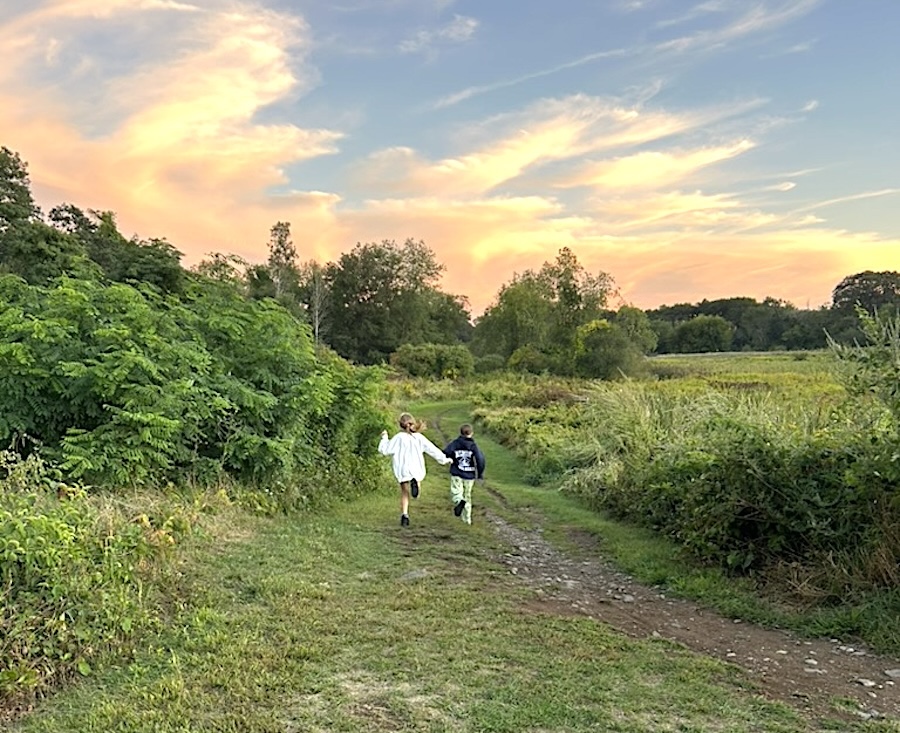
A pastoral gem in Belmont, Rock Meadow is in full splendor each fall as the leaves turn, providing a backdrop for Instagram posts, family holiday cards, and yearbook photos. It’s a treasure year-round for people, animals, pollinators, and the entire ecosystem it shares with the rest of the Western Greenway. What it doesn’t share is the same level of protection.
As the crow flies, the deer trots, and the water flows, the land is all connected. The Belmont Conservation Commission is seeking to strengthen that connection by providing Rock Meadow with the same level of enduring protection as the adjoining Lone Tree Hill and Beaver Brook Reservation lands: a conservation restriction.
The Swiss cheese model of protection
Federal and state laws form a critical framework for conservation, but local protections are essential to supplement and enhance that framework. Having layers of safeguards helps ensure that the holes in one layer are covered by another.
Where local government fails to provide protection, the federal government can step in to offer protection. Many critical environmental laws have the federal Interstate Commerce Clause of the US Constitution as their basis, including the Clean Air Act, Clean Water Act, and Endangered Species Act, to name a few.
Unfortunately, the federal government vacillates and has proven to be an unreliable steward of the environment. Federal protections can be weakened, as demonstrated in the recent Supreme Court decision (Sackett v. EPA, 2023), which limits the definition of wetlands under the Clean Water Act. While this decision will have a drastic ecological impact in several states, it will have a lesser effect on the wetlands and dependent ecosystems of Massachusetts due to our strong state Wetlands Protection Act, which is enforced locally by municipal conservation commissions. Strong local action ensures that protections endure when broader laws falter.
Protection on the state and local levels
Although Rock Meadow is already conservation land under Article 97 of the Massachusetts Constitution, its deed does not carry a conservation restriction as Lone Tree Hill and Beaver Brook Reservation in Waltham do. Why? Belmont bought the property from McLean Hospital in 1968. Massachusetts passed the Conservation Restriction Act in 1969. (So close . . . )
The conservation restrictions on Lone Tree Hill and Beaver Brook came decades later, when those properties were purchased (Lone Tree Hill) or designated conservation land (Beaver Brook). The BCC is now seeking to close that gap, ensuring that Rock Meadow remains protected in perpetuity like the adjacent lands of the Western Greenway.
Article 97 sets the bar for conservation of critical open space. But conservation restrictions are widely regarded as the gold standard for protecting conservation land. They prevent development or other uses that are inconsistent with conservation while allowing for passive recreation and the protection of habitats.
Establishing such a restriction for Rock Meadow would not alter the current use of the land; these allowable uses can be written into the deed. Rather, it would ensure that its character cannot be compromised by future pressures or shifting priorities. All of this is consistent with the protections covering the connected conservation and passive recreation lands.
Conservation restrictions address finances
Rock Meadow is a rare and valuable landscape. Open meadows in eastern Massachusetts are increasingly scarce, yet they provide essential habitat for ground-nesting birds, pollinators, and diverse plant communities.
Historically, the meadow was sustained by Indigenous burning practices and later by grazing livestock from McLean Hospital. Since Belmont acquired the land, the meadow has been maintained through mowing, a process that is costly and requires consistent funding. Absent maintenance in one way or another, the surrounding woodlands would swallow the meadow, radically changing the appearance of the land and the function of the ecosystem.
To address this, the Judith K. Record Endowment has offered Belmont a substantial matching fund to support Rock Meadow’s maintenance—on the condition that the town first establishes a conservation restriction. Last year, Town Meeting authorized funding to pursue this step. The Conservation Commission is now working with The Trustees of Reservations, experts in conservation restrictions, to draft the legal document and shepherd it through state approval. Final adoption will require votes from the Select Board and Town Meeting.
When complete, Rock Meadow will share the same protection as Lone Tree Hill and Beaver Brook Reservation, ensuring that this ecological treasure and community asset remains what it has been for centuries: meadowland for nature and for Belmont.
Keep Rock Meadow meadow.

Bumblebee in Rock Meadow. Photo: Mary Bradley
Dan Nolan is a member of the Belmont Conservation Commission.

Sorry, the comment form is closed at this time.