
By Jeffrey North and Joe Hibbard
For over a decade, Lone Tree Hill has been a focal point of community-led ecological restoration in Belmont. The Belmont Citizens Forum, the Judy Record Conservation Fund, and many dedicated volunteers, all under the aegis of the town’s Land Management Committee for Lone Tree Hill, have shared this effort. Since the restoration work began, this conservation land has transformed from a neglected patch of invasive thickets to a thriving habitat increasingly dominated by native species.
Last April 26, despite steady rain, more than 50 volunteers gathered at Lone Tree Hill’s Meadow Edge Trail for the 11th annual Lone Tree Hill Volunteer Day. The commitment of the volunteers shone through the drizzle as they planted 50 white pine saplings and 10 Eastern red cedar saplings.
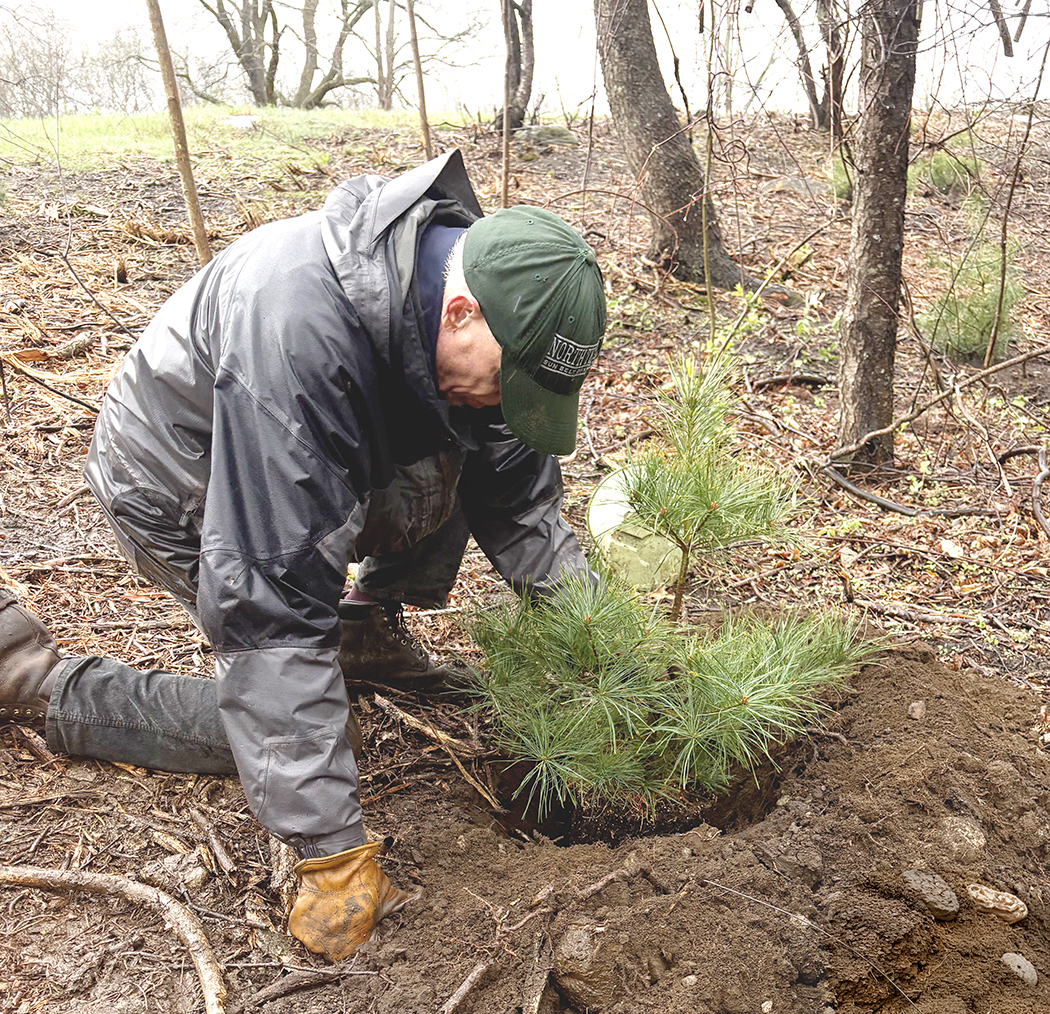
Joe Hibbard plants a white pine at the April 2025 Lone Tree Hill volunteer day. Photo: Jeffrey North
Volunteers also replaced five white pines that had not survived since last year’s planting and carefully transplanted seven saplings from the end of the Pine Allee to fill gaps where trees had died or gone missing.
This year’s saplings are flourishing thanks in part to their shaded location, which has protected them from the recent dry spells and intense heat waves. These young conifers should gradually outcompete invasive understory plants, helping restore the forest’s natural balance.
Visitors who are familiar with the history of this area may recall that, before these plantings, the Meadow Edge was an impenetrable thicket. Thanks to the forestry mowing done by Parterre Ecological Services, the site was prepared for new growth and opened up for effective invasive plant removal. Volunteer efforts are planned to continue focusing on this area, making it easier to manage invasive species.
New frontiers and ongoing maintenance
The restoration of Lone Tree Hill proceeds along two intertwined paths. New frontiers involve opening new areas of the conservation land to restoration, clearing invasive growth, and initiating native plantings. Meanwhile, ongoing efforts maintain and nurture previously treated zones, with decreasing intensity as native ecosystems become more resilient.
For example, patches of the invasive black swallowwort persist stubbornly in the Great Meadow, requiring vigilant attention. In contrast, the invasive purple loosestrife appears to be under control, likely benefiting from the ongoing Purple Loosestrife Biocontrol Project.
Elsewhere, bittersweet vine still clings to the emerging quaking aspen colony in in the southeast corner of the lower meadow.. That area was recently cleared during a hands-on training exercise for recruits of the horticultural services company responsible for much of the invasive species removal on LTH. This practical training both advances the restoration and builds skilled capacity for future efforts.
Native Plants Take Root in Upper Meadow
The upper meadow—also known as the North End or the upper section of Area A1—is showing remarkable signs of recovery. Native species such as wild bergamot (Monarda fistulosa), giant hyssop (Agastashe foeniculum), mountain mints (Pycnanthemum muticum and Pycnanthemum tenuifolium), and warm-season grasses such as Indian grass (Sorghastrum nutans) and little bluestem (Schizachyrium scoparium), planted in April 2023, have established healthy colonies. Many of these plants have strong natural defenses against deer and other browsers. They are thriving and helping to restore ecological function. Following the removal of invasive species, large areas have also been naturally reclaimed by native species. Chief among these are Pennsylvania sedge (Carex pennsylvanica) and several species of Goldenrod (Solidago spp.).
This area is also suitable for cost-effective long-term maintenance. Regular mowing can suppress invasive species such as buckthorn, black swallowwort, and garlic mustard without requiring expensive interventions.
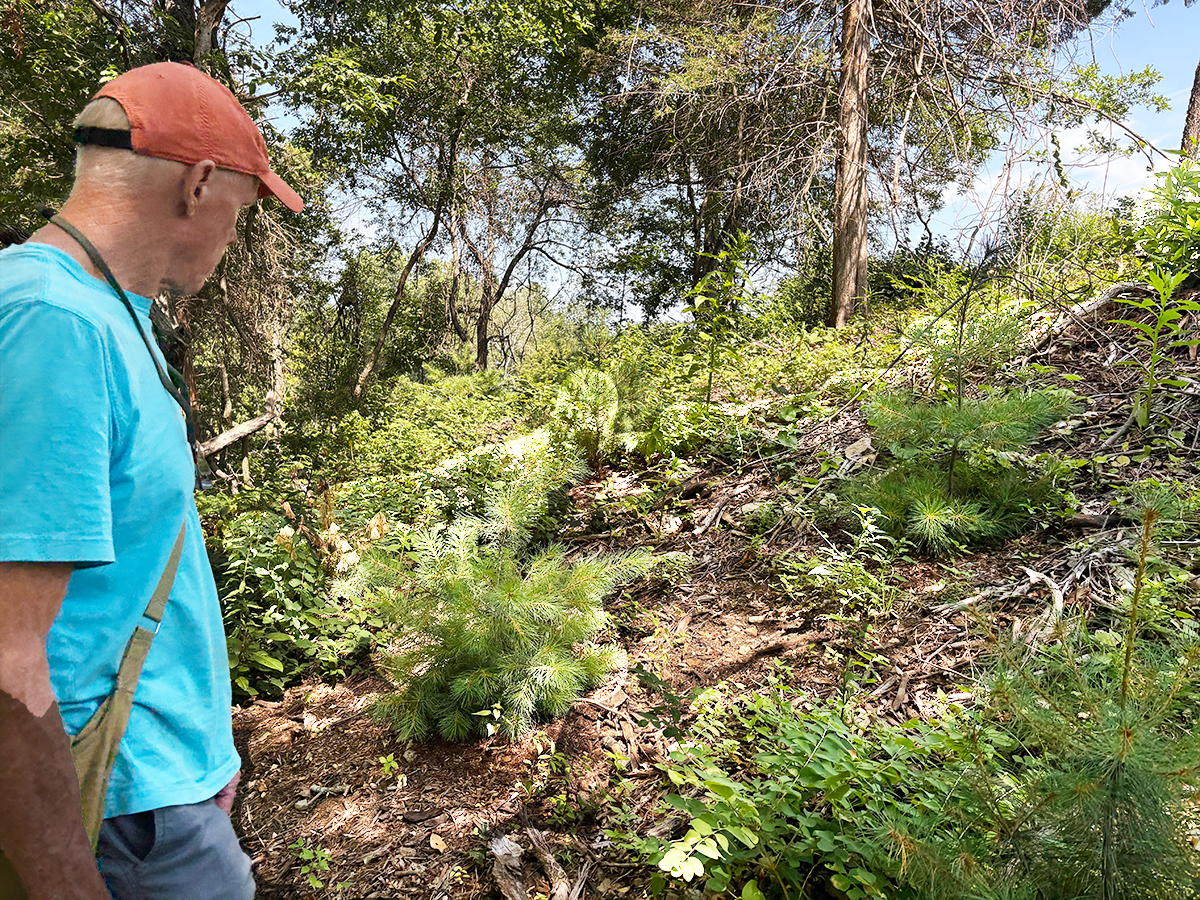
Joe Hibbard observes growth of seedlings planted in April. Photo: Jeffrey North
Looking Ahead
The restoration journey on Lone Tree Hill is far from over. Each year brings new challenges, new areas to reclaim, and new volunteers eager to leave a positive mark on Belmont’s landscape. Whether through planting native trees, clearing invasives, or supporting hands-on training, the community’s stewardship is gradually but steadily improving Lone Tree Hill’s natural beauty and ecological health.
If you’re interested in joining future volunteer days or learning more about the ongoing work, keep an eye on the Belmont Citizens Forum Newsletter, Belmont Conservation Volunteers, and the Judy Record Conservation Fund announcements. Together, we can ensure Lone Tree Hill remains a vital and vibrant for generations to come.
Jeffrey North is the managing editor for the Belmont Citizens Forum Newsletter. Joseph Hibbard is a landscape architect and Belmont resident.

Sorry, the comment form is closed at this time.