
by Fred Bouchard
Let’s open with, then qualify, two generalizations about Barred, Snowy, and Saw-Whet Owls. Females run a bit larger than males; one might (erroneously) surmise that their voices are somewhat deeper in pitch. Most owls are strictly nocturnal. That said, our first two are crepuscular and diurnal, respectively.
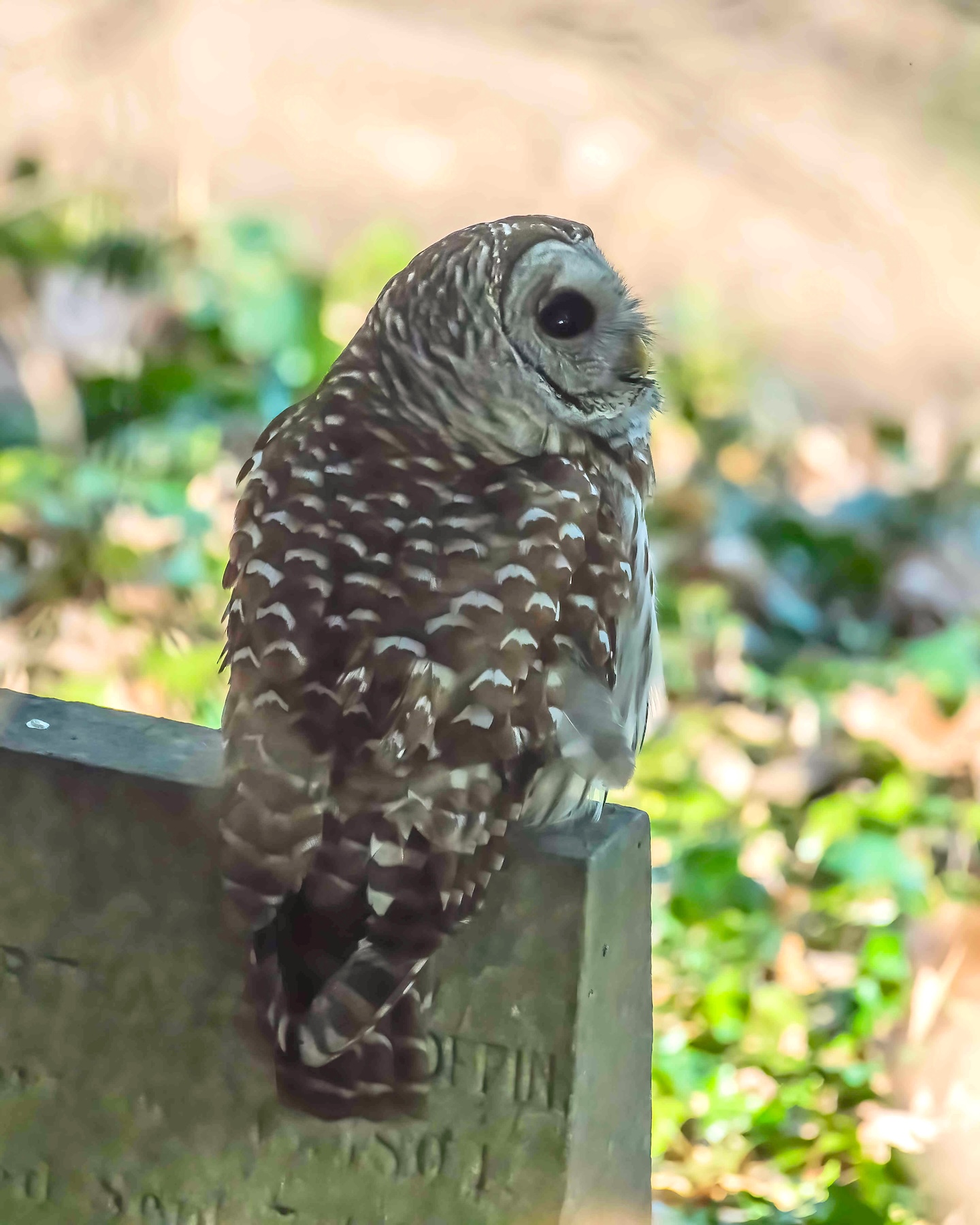
Barred Owl. Photo: Jeff Teitelbaum
Barred Owl (Strix varia)
Ubiquitous and crepuscular (active and vocal from dusk to dawn), Barred Owls rank among our easiest woodland owls to see. They tend to roost in outer branches, exposed. They don’t hug trunks for camouflage like Great Horned Owls or snuggle in holes like Screech Owls. Their unique brown eyes (other species’ eyes are yellow) seem to me somehow candid and inviting, with an inquisitive gaze and behavior. In April 2021, one swooped down into Habitat Belmont’s parking lot and perched calmly above the solar array, unperturbed by the summoned arrival of delightedly animated schoolchildren.
One or more Barred Owls have spent recent years among tall evergreens at Hall’s Pond Sanctuary, Brookline. Early one April morning in 2022 birders watched a large female perched above Isabella Gardner’s crypt by Auburn Lake at Mount Auburn Cemetery. They often roost near water and may skim ponds for fish and shellfish. Seek them—as with most owls—by scanning the trees for silhouettes, whitewash (feces), and pellets (regurgitated packets of prey fur and bones). Come May, in the white pine forest at Woburn’s Horn Pond, you’ll find birders with spotting scopes spying on Barred Owl hatchlings.
Listen for Barred Owls’ clear, signature eight-hoot—Who cooks for yoo / Who cooks for yoooo-all?—mainly between dusk and dawn. Last fall, however, at 10 AM at Pine Hill Grasslands in Leicester, a “Barry” eventually responded to my ragged imitation. Their varied vocals include upward slurring of a set of whoos, or duos engaging in bizarre maniacal cackles and howled hootenannies.
From my Winn Brook yard, here’s my elaborated eBird post of May 3, 2024: “We got out of the car at 8:40 pm (last dusk) just as a Barred Owl was calling lustily near the corner. It uttered a few drawn-out eight-hoots, then took off up Cross Street. Resisting a temptation to respond, I ran after it. It landed briefly atop a spruce, then flapped northward out of sight.”
Birder/musician Steve Geraci reported colorfully from Needham Forest on January 26: “During an afternoon walk, I again questioned my sanity as I navigated uneven trails, my neck craned to scan the crowns of towering hemlocks and evergreens. Many times I had walked away with little more than a stiff neck and fading hope. But not today. Thirty feet above me, motionless yet magnificent, perched the prize: a female Barred Owl. Though still, she exuded a quiet awareness, swiveling her head sharply at the faint approach of a dog walker before resuming her calm vigil, alternating between shut eyes and watchful squints. The next day, further down the trail, I found her again—40 feet high, soaking in the winter warmth. She remained still but ever observant, her graceful swivels capturing every movement below. I felt a profound sense of privilege, standing beneath ‘Brigitte Barred-O’ to witness her splendor.”
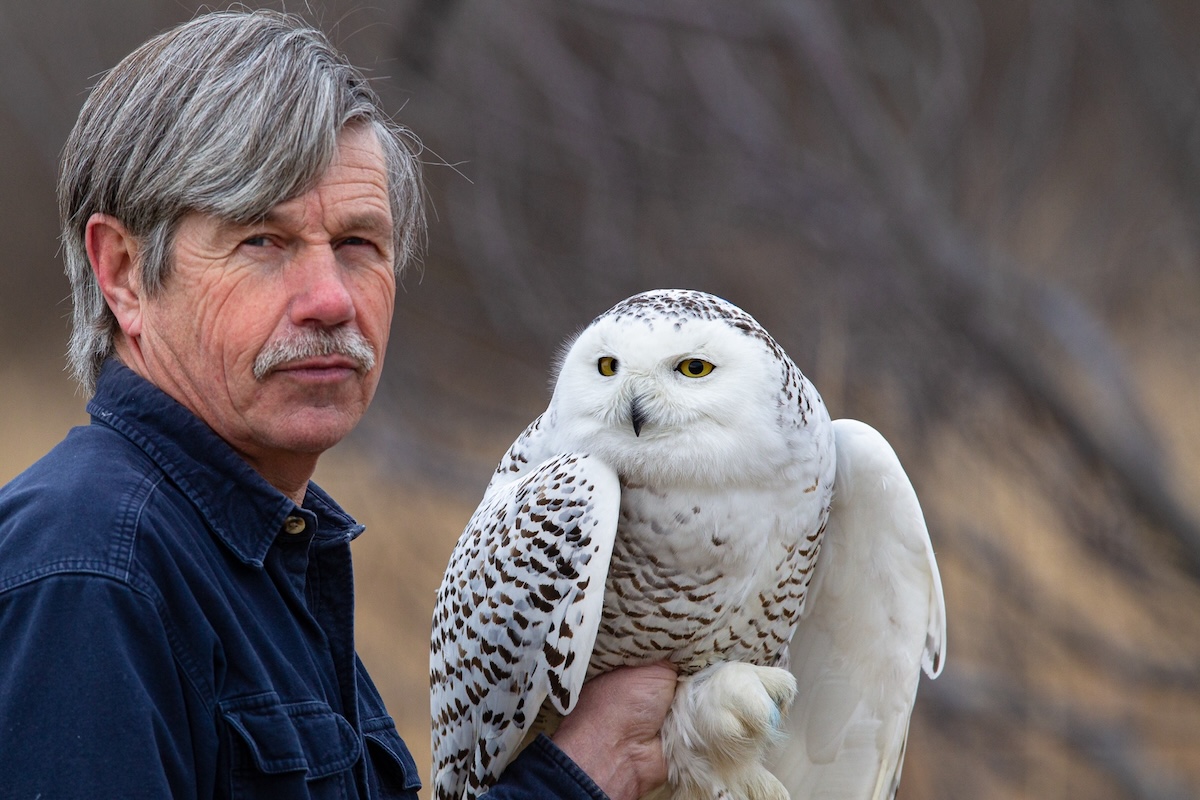
Norman Smith with a Snowy Owl. Photo: Shawn Carey
Snowy Owl (Bubo scandiacus)
North America’s largest owl (by body mass), this distinctive white owl breeds and summers in the Arctic tundra. Most frequently seen in the Bay State during years of irruptive (erratic, usually hunger-driven) migrations southward, “snowies” often winter at Plum Island, Newburyport, on Logan Airport’s windswept ‘tundra’, and along grassy dunes of Duxbury Beach. Mass Audubon’s Snowy Owl Project, directed by Norman Smith since 1981, nets and tags snowies with temporary tiny transmitters that track their travels around New England.
Here are edited comments from Norman Smith [2/25/25]:
“This winter has been an average winter for snowy owls at Logan Airport. I have captured and relocated 13 to date, 12 hatch-year birds and one adult. The previous two winters were very poor, with only four owls in 2022-23 and only two owls in 2023-24. My best winter was 2013-14 when I captured 179 snowy owls. An incredible lemming explosion in the arctic in the summer of 2013 produced lots of breeding and numerous owls to travel south as far as Florida, Texas, and Bermuda. I have relocated over 900 Snowy Owls from Logan Airport over 40+ years, for the safety of both owls and planes.
“Snowy Owls usually show up in early November after traveling up to 3,000 miles from the Aßrctic, and begin their journey back north in March or April. Some stay till May with the latest state record July 7. In 2013–14 however two snowy owls stayed between Logan Airport and the Boston Harbor Islands, throughout that whole year, a first, and left in the spring 2015.
“Snowy Owls are opportunistic and will hunt during the day, but they prefer to hunt after the sun goes down like most owl species. They prey upon an assortment of rodents, small mammals, passerines, waterfowl, herons, and fish. They will even take other raptors including American Kestrel, Northern Harrier, Saw-whet Owl, Short-eared Owl, Barn Owl, Long-eared Owl—or Peregrine Falcon.
“Most owls that show up here are in good shape, not starving to death as some speculate without capturing and examining live owls. Not all owls make it, as is true with all species, especially hatch-year birds. Some owls do not survive due to being hit by cars or jets, electrocuted, poisoned, starved, or diseased. In February 2022 bird flu showed up in Massachusetts for the first time and nine owls died from it. Again last January some owls died or tested positive for bird flu.”
A note: Gary Menin, Sr., reports that studies have found Snowy Owls to be profoundly vulnerable to rodenticides, and that one Project SNOWstorm study participant said that among Snowy Owl specimens examined worldwide, those in Massachusetts had the highest rates of poisoning.
Male snowies may attain that pure ivory; females and juveniles are variably sprinkled with black chevrons. If they don’t hop onto wooden staddles to extend their view over ice-bound Plum Island, they may prove nearly invisible to telescopers diligently scanning from the road. Few sights thrill New England birders more than watching a Snowy Owl skim gracefully over a vast expanse of frozen marsh on downy-soft, deeply flapping wings.
Sightings in Middlesex County are usually rare and brief: last winter en-route birds made eye-popping cameos on a harbor buoy in the Mystic River by Earhart Dam and atop Watertown Exploratory Labs.
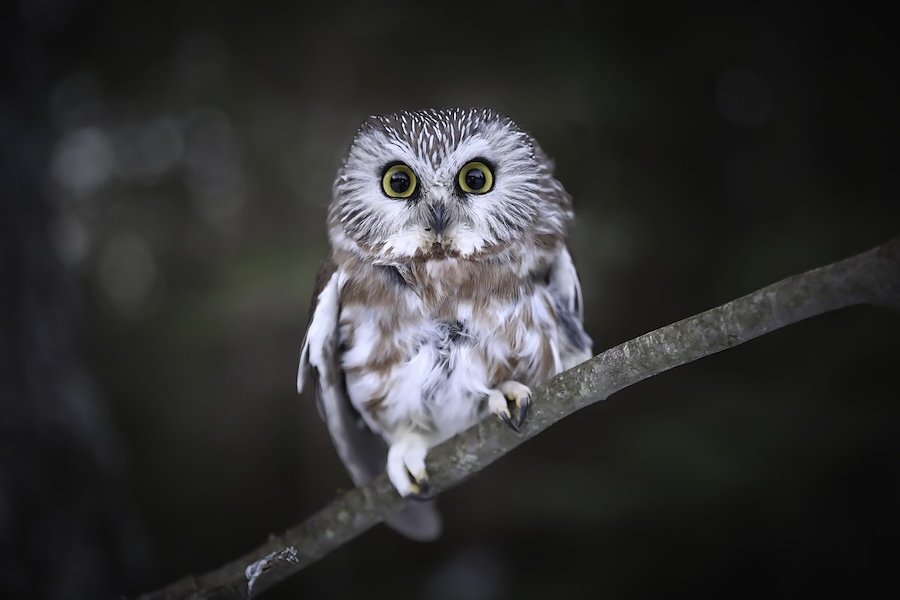
Northern Saw-whet Owl. Photo:Andy Witchger / Wikimedia Commons
Northern Saw-whet Owl (Aegolius acadicus)
Mass Audubon ornithologist Strickland Wheelock gives a telling thumbnail sketch about his bird-banding activities in Uxbridge. “Saw-whet Owls are uncommon, tiny, strictly nocturnal owls, slightly smaller than our Eastern Screech Owl. They can be found in most Bay State townships, primarily in the winter, roosting in dense evergreens (favoring cedar groves) or tree holes for protection from larger owls and other raptors. Their population is fairly stable. During the fall, through mid-November, they migrate from boreal forests on northeast winds. On clear nights when we’re banding, we play the male Saw-whet call loudly from a high elevation and what we capture are 90% females, both adults and immatures. On good nights we might net anywhere from 20 to 50 Saw-whets.
“They are calm and passive in the hand. As you are gripping their legs, they are not struggling to get away, not trying to bite you. When you open your hand to release, they just sit there looking around. Finally, you have to move your hand around to get them to fly away. If you venture at night around Saw-whet habitat, you might hear their monotonous repeated single-note whistle. When you whistle back the same notes, they often fly in quietly to check out who might be visiting their territory.”
The ‘saw-whet’ moniker relates to that simple toot, quaintly akin to honing a saw blade on a whetstone. I recall soft autumn evenings on Nantucket, perched on my porch across a dirt track from Miacomet Pond, thrilling to a Saw-whet chorus from the cedars – gently, if less shrilly, insistent as spring peepers — and calling back to them.
Owl’s well that ends, well . . . .
At 4:30 AM on August 15, during final edits for this issue, I was awakened by eight soft whinnies outside my open window, the welcome call of an Eastern Screech Owl. More like a warbling coo than a screech, it’s likely the 20th such visit over this decade. Despite losing three majestic deciduous trees within 50 yards of our house in as many years, our commonest little owl still sees fit to haunt our ‘hood. And I for one am grateful beyond measure.
Fred Bouchard is a member of the Belmont Citizens Forum Newsletter Committee.

Sorry, the comment form is closed at this time.