
By Dave Beavers
The answer to the question “Where does my electricity come from?” can be elusive. There can be many answers to what appears to be a straightforward question. These answers can be abstract by necessity, requiring physics concepts and a plethora of obscure acronyms for precision.
Instead of a textbook approach, the goal of this article is to offer an intuitive understanding of Belmont’s electricity. I will eschew dry facts, physics, and acronyms in favor of less abstract explanations and analogies. Along the way, I will explore key issues such as utility costs, rates, reliability, governance, and climate change.
Is electricity intuitive?
Electricity consumption is intuitive. You don’t need instructions to plug a phone charger into an outlet. But can we intuitively understand how electricity reaches the plug?
Consider tap water: hear the water running, feel the cool or warm sensation, and observe how it slides smoothly through your fingers, wet and refreshing. Imagine how it tastes. It’s easy to imagine water molecules stored in the Quabbin Reservoir flowing through outlet pipes, pumps, and filters managed by the Metropolitan Water Resources Authority (MWRA) to Belmont and distributed to homes through underground pipes managed by the town’s Water Division. It’s also easy to see the reservoir being filled by rainfall, streams, and rivers. Gravity, a force we intimately understand, does much of the work, and the hydrologic cycle is something we have direct experience with.
On the other hand, a personal experience with the AC electricity delivered by Belmont Light, whether it’s seen, heard, felt, tasted, or smelled, is not something to be celebrated. How do we accurately imagine electricity “flowing” to us? Electrons are not like water molecules. They don’t flow through electric lines like water molecules do through pipes. In fact, they barely move at all.
Perhaps even more confusing, when Belmont Light buys power from a generator, it does not necessarily mean the power from that generator will be physically consumed in Belmont itself.
Why does the question matter?
Consider the last apocalyptic movie you watched. What was the first thing to break and send our civilization on the road to ruin? There’s a good chance it was the electric grid. No clean water, lights, or heat in the convenient forms we are used to, dead batteries in cell phones and other electronics, empty supermarket shelves, and plenty of other unpleasantries. One study suggested that after only two weeks without power, civilization, as we know it, would collapse.
If you are concerned about climate change, you may want to consider sources of electricity that don’t contribute to the problem. You may ask if the energy you use is ‘green’ or ‘clean’ or ‘non-emitting’ or one of many other standards. Also, if you believe we should electrify transportation and heating, you may wonder where all the additional electricity will come from and whether our grid can accommodate it.
If you get a monthly bill from Belmont Light, congratulations. You are a Belmont Light customer and pay 30% less for electricity than friends in neighboring communities for nonprofit, award-winning service (scroll down to the Belmont Light Department page). As a voter electing commissioners to oversee Belmont Light, you are part of the governance process and have a say in the utility’s policies.

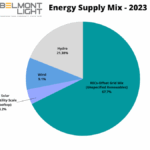
Belmont Light’s finalized energy supply by fuel type for 2023, the most recent information available. Source: Belmont Light.
Where does my electricity come from?
You get a bill from Belmont Light, so the electricity must come from them, right? Yes, that is true. So, what does the organization do? An analogy to a grocery store that does home delivery may help explain.
Grocery sourcing (energy purchases)
A grocery store sources vegetables, dairy products, meat, and other goods either directly from farms or through distributors and wholesale markets. Similarly, Belmont Light procures energy through either a direct contract with a specific generator, an energy company that aggregates multiple generators, or via the New England wholesale market. About 1.5% of the total is homegrown solar power that is pushed back on the grid when not consumed at a home or building.
Groceries brought to store (transmission)
Imagine trucks traveling down major highways carrying grocery products to a store. Analogously, transmission (e.g., the electrical lines supported by large towers that often run along major highways) carries energy to Belmont Light’s substation at Blair Pond. The grid operator, ISO-NE, ensures that energy is delivered smoothly. Traffic on the roads can delay deliveries, but there is generally no way to control it. Energy traffic on transmission lines, on the other hand, is continuously monitored and controlled, as any significant uncontrolled changes to the grid’s conditions (voltage, current, frequency) could cause damage to infrastructure and lead to blackouts.
The cost of transmission services is rapidly rising, putting upward pressure on electric rates.
Groceries delivered to homes (distribution)
The last leg of the groceries journey is delivery from the store to a home. This leg is equivalent, by analogy, to the distribution of electricity to our homes. The bulk of the work performed by Belmont Light is directed toward enhancing and maintaining our distribution system, which is the network of lines across Belmont that carry energy from the Blair Pond substation to homes and businesses. About half of the lines are underground, and the rest run on utility poles. Delivering around 130,000 MWh (megawatt-hours) of electricity per year, Belmont Light’s annual load is about nine times higher than the electricity consumed by Fenway Park annually.
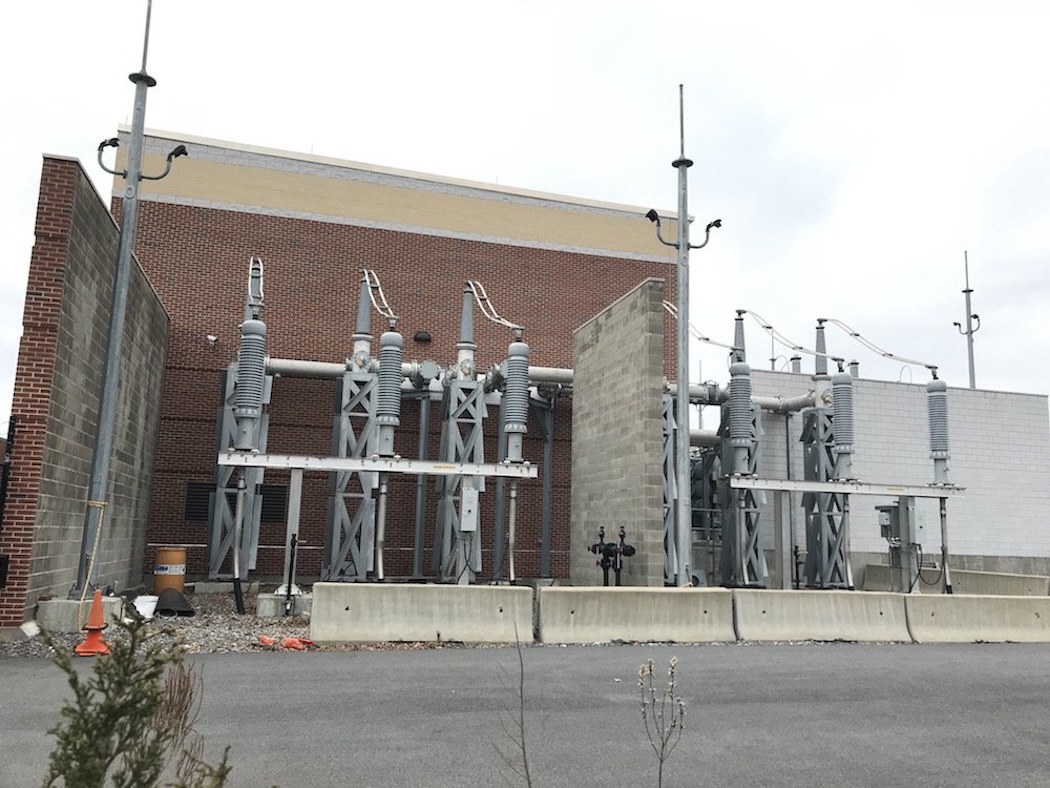
The Blair Pond electrical substation. Source: Wilcox and Barton
Belmont Light’s organization
With 31 employees and a close connection to the community, Belmont Light feels like a small nonprofit business—one that has been operating for 125 years. The yellow trucks out and about in Belmont are the most noticeable features of Belmont Light. Most of the work performed by the staff is dedicated to maintaining the reliability of the system.
Electric bill payments are the primary source of Belmont Light’s $30 million annual revenue. This value will increase as more customers adopt electric heating and transportation. For example, if our community had been fully electrified in 2024, revenues could have been as high as $75 million, assuming 2024 Belmont Light rates and a growth factor of 2.5 for electrification. For a load growth scenario, see the state’s Executive Office of Energy and Environmental Affairs webinar, “Improving Interconnection to the Electric Grid Driving Meaningful Progress in 2025.”
Supporting 100% electrification and its higher loads will require Belmont Light to upgrade our local grid. But electric rates do not necessarily have to increase to fund these upgrades. The much higher volume of sales under electrification, and resulting higher annual revenues, may be sufficient to pay for these upgrades.
Belmont Light’s governance
Massachusetts Municipal Light Plants (MLPs) are governed by state law under Massachusetts General Laws Chapter 164. Belmont has an elected five-person municipal light commission that hires the general manager and approves policies such as rates. The general manager oversees operations. Because the interests of commissioners and general managers are congruent with the interests of ratepayers, the state does not actively engage in establishing MLP policies. The state Department of Public Utilities (DPU) has a limited oversight role. As such, this governance model is light on bureaucracy, allowing MLPs to be nimble when enacting new policies.
In contrast, in the investor-owned utility (IOU) context, because the interests of investors seeking higher returns can be at odds with those of customers seeking lower rates, the state plays a significantly more prominent role through the DPU. In short, the DPU expends a considerable amount of effort balancing these interests, and decision-making can be lengthy and complex. For example, DPU major rate cases may exceed 1,000 pages of filings and testimony. These cases are heard about every three years for each of the four Massachusetts IOU territories.
While MLP governance is straightforward and nimble compared to IOU governance, what MLPs lack is scale. A lack of scale can limit progress toward goals, as an MLP typically has limited staff to tackle new projects. An IOU, on the other hand, may have whole departments dedicated to achieving specific goals.
Dave Beavers is an elected member and the vice chair of the Belmont Light Board and a Belmont resident.

Sorry, the comment form is closed at this time.