
By Jean Devine
Picture this: It’s 2028, and on the Belmont High School campus, a small forest of native trees and shrubs is shooting toward the sky. The trunks sway gently and the leaves shimmer softly in the summer breeze. As you walk toward this grove, birds flit in and out, you hear a hum of bees, while other pollinators, insects, and worms, mostly invisible to you, thrive in deeper sections of this new habitat. Before you stands Belmont’s first Miyawaki Forest (aka mini forest). Now, three years after planting, this forest is self-sufficient. And, it’s replicable! Maybe it has inspired other mini forest projects in Belmont.
The BHS mini forest, an educational and ecological solution for the community, will be planted on October 4, 2025, by students, families, and volunteers of all ages. A total of 1,400 native tree and shrub seedlings will fill 3,000 square feet, comparable to a public swimming pool. Short to start, the BHS mini forest will achieve significant heights in a third of the time of traditional forests.
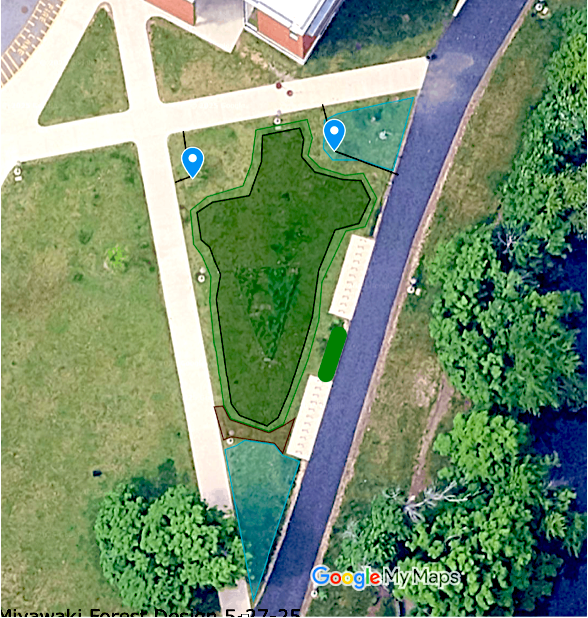
Future site of the BHS Miyawaki forest. Graphic: Dave Mussina
Why mini forests are important
Mini forests are small, densely planted, biodiverse forests that help restore local ecosystems and mitigate the impacts of climate change. Following a method named after the Japanese botanist, Akira Miyawaki, these forests range in size from 1,000 square feet to more than 400 acres and include diverse native trees and shrubs that are planted into carefully amended soil. The species are chosen based on soil analysis and assessment of tree and plant species that would have been here long before urban development. Such native plant communities support local food webs—from plant to pollinator to predator—because these indigenous plants and insects evolved together.
Mini forests grow faster than traditional forests, because the trees compete for sunlight and communicate through their roots sooner than trees set farther apart. In addition to fostering biodiverse habitat, mini forests increase stormwater absorption, sequester carbon, improve air quality, and reduce heat island temperatures.
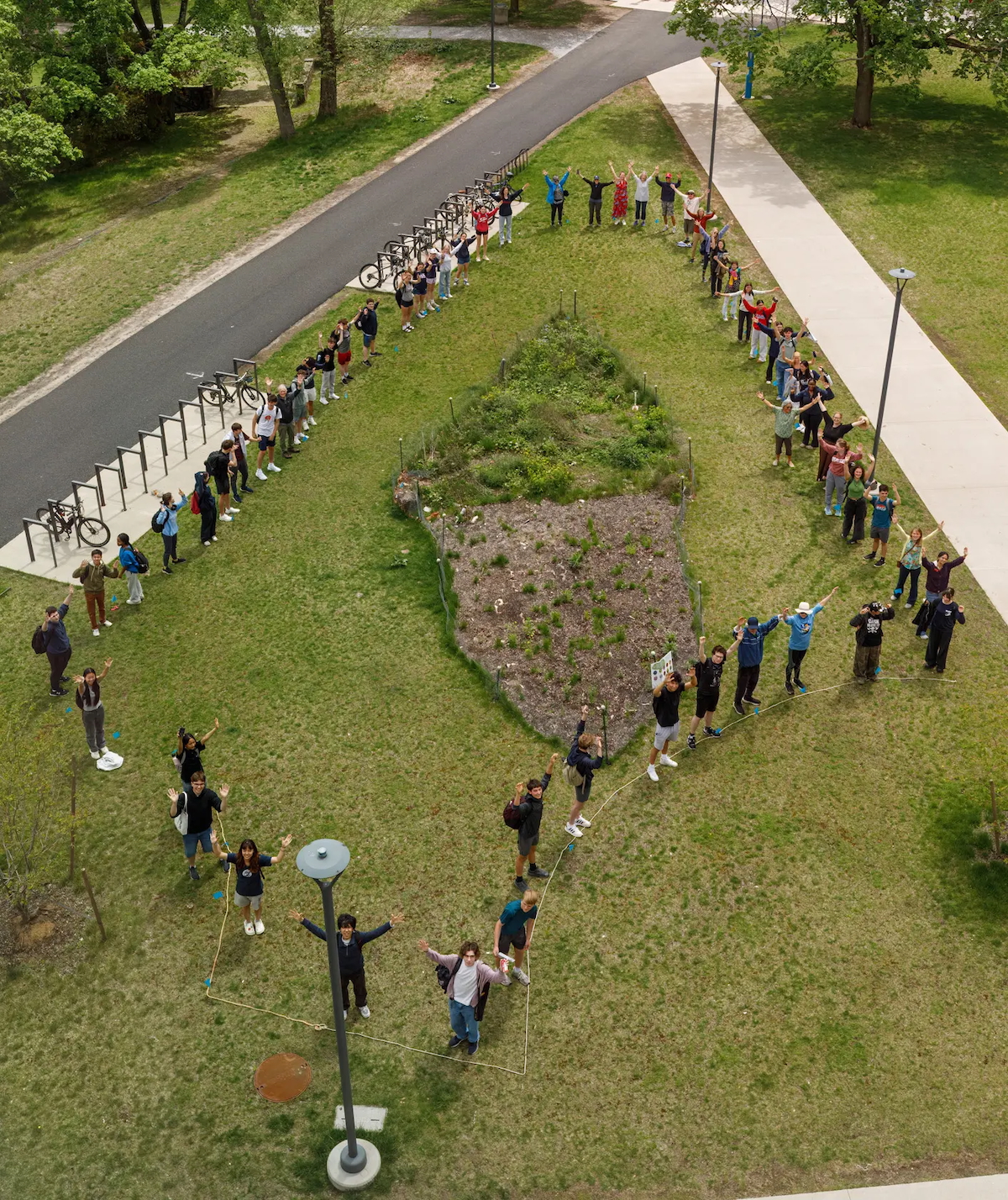
Students and adults form a human perimeter around the future forest. Photo courtesy of Jean Devine
BHS is a perfect place for a forest
When a group of residents gathered in June 2024 to form the Mini Forest Action Belmont team (MFAB), top of mind were the educational and community-building benefits this project could offer Belmont. The group considered several schools and quickly selected BHS for three reasons: 1) prominent location, 2) the forest’s ability to absorb/manage stormwater (one of the campus landscape designs included a rain garden), and 3) a student club had already committed to building biodiverse habitats on campus. The BHS Climate Action Club (CAC) installed their first native plant garden in May 2023 and doubled its size in October 2024. Holly Kong, garden leader for 2024-25, was intrigued by the ecological and climate benefits of a miniforest. She joined MFAB immediately, and over the past year has served as a chief advocate and liaison to Principal Isaac Taylor, science teachers, CAC peers, and student volunteers.
The BHS Mini Forest is designed as a living lab. A cutout and benches will provide space for instruction, appreciation, and reflection for all.
Forest project moved quickly
The MFAB team, composed of Sarah Wang, Kirsten Waersted, Michelle Oishi, Ranganath Nayak, Anne-Marie Lambert, Holly Kong, Ralph Jones, Jess Hausman, and Jean Devine, worked on site selection, fundraising, and community support simultaneously. Early on, two MFAB members pledged funds for two-thirds of the projected cost, while others presented the concept and plans to school officials, town departments, and local environmental groups.
Sarah Wang, MFAB chair, marveled, “This project found traction quickly and has not let up. We are on schedule to plant October 4, primarily due to the tremendous community support we have received. Everyone from the town and school administrations, including Superintendent Jill Geiser, Principal Taylor, the School and Shade Tree Committees, and the Department of Public Works, to environmental groups such as Mass Audubon Habitat and Belmont Citizens Forum, to the generous individuals donating to the project, have stepped up to help out. I find it so inspiring to see the community coming together like this.”
MFAB hired Biodiversity for a Livable Climate (bio4climate.org), to guide the team through the process. Bio4Climate is a Cambridge-based eco-restoration nonprofit that was instrumental in bringing the first Miyawaki Forest to the East Coast in 2021. Cambridge’s 4,000 square foot Danehy Park Miyawaki Forest has inspired the launch of over a dozen projects in eastern Massachusetts alone. Bio4climate’s forest-making experience ranges from mini forests in public parks to de-paved parking lots to schools, including Somerville and Natick high schools.
Species selection
Alexandra Ionescu, Bio4climate’s associate director of regenerative projects, and Walter Kittredge, ecology advisor, led the MFAB team through selecting trees. The process started with a soil test and exploring the history of the area as well as observing the nearby trees. Soil test results revealed that the site closely matches a “High Terrace Floodplain Forest” (HTFF) according to the Massachusetts Division of Fisheries and Wildlife classification for natural communities in the state.
In March, Ionescu, Kittredge, Wang, and Oishi travelled to Bolton Flats to view a relatively untouched example of an HTFF and identify tree and plant species. From there, they generated a list of roughly 40 species of trees and shrubs including: red, silver, and sugar maple; red, swamp, white, and pin oak; gray birch, shagbark hickory, American elm, American hornbeam, hackberry, silky and gray dogwood, black elderberry, black chokeberry, buttonbush, winterberry holly, and more.
Ionescu said, “I enjoy this part of the process—researching and experiencing the trees and shrubs that once flourished here. To each project that Bio4climate brings its expertise, we always find elements that are unique to that site.”
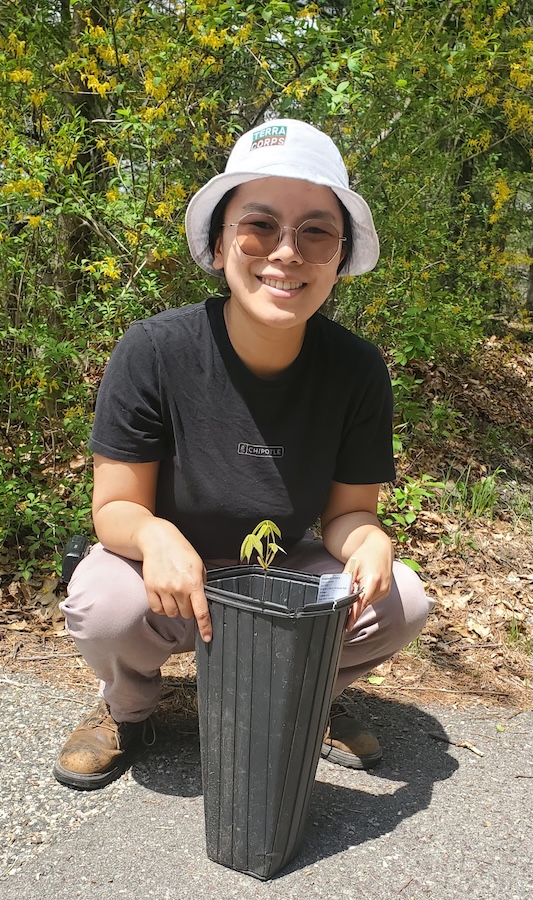
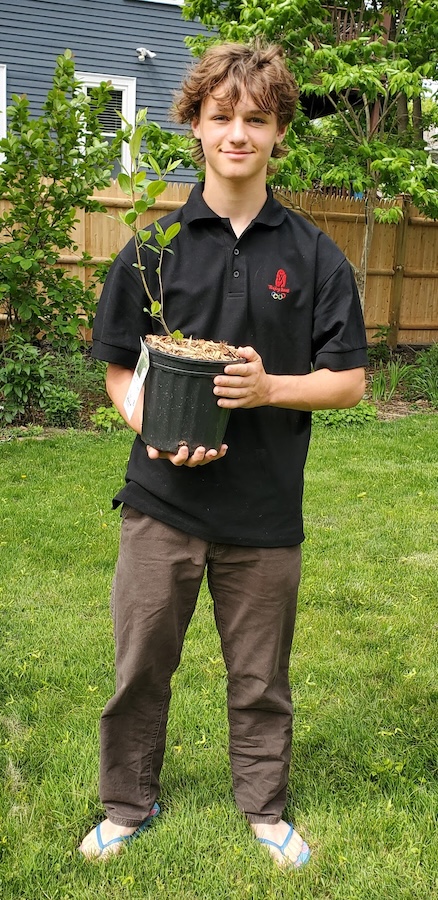
Kayleigh Yee, Terracorps fellow at Habitat, and Thatcher Simmons, a rising sophomore at BHS, are both fostering trees this summer for the BHS Miyawaki forest. Photos courtesy of Jean Devine.
Help turn BHS into a biodiversity hotspot!
With the planting date just three months away, the MFAB needs your help! Please volunteer for our Community Planting Day at tinyurl.com/BHSMiniforestvol. Join a team that will maintain and monitor the forest over the next three growing seasons.
This summer, you can also foster a tree, then help plant it in the fall. Find out more at bit.ly/BCF-Foster-Tree.
For more information, visit: bio4climate.org/miyawaki-forest-program/Belmont-high-school-microforest .
Jean Devine is a Belmont resident, cofounder of the Mystic Charles Pollinator Pathways Group, and is executive dIrector of the Biodiversity Builders youth environmental education program and Devine Native Plantings, LLC.

Sorry, the comment form is closed at this time.