

By Terri Goldberg
Lately, there has been a slew of dramatic stories about the failures of recycling. They could leave readers with the impression that recycling collection programs, like the one supported by Belmont, are a lie or a waste of time (for example, see “The Story You’ve Been Told About Recycling is a Lie” in the New York Times).
Often, when I talk to friends and family about my work with MassRecycle, the state recycling organization, they ask me whether recycling is a scam. No! The truth is that the recyclables in our recycling carts are being largely recycled, effectively reducing disposal tonnage and associated greenhouse gases.
The New York Times opinion piece and similar articles create the impression that our waste is being sent to large, open, poorly managed, and hazardous landfills in developing countries. They lack supporting documentation and leave readers with the impression that the materials we put in our recycling bins are not being recycled. While it is true that there are waste disposal sites in those countries that the author of the NY Times opinion piece has visited which pose local environmental and health risks, the materials contaminating those sites do not come from the recycling and trash bins of residents in Belmont or nearby communities in Massachusetts.
Belmont’s trash goes to a waste-to-energy facility in North Andover, operated by WIN/Wheelabrator. The materials handled through our residential recycling program move from the carts we place out on the curb to a materials recovery facility, or MRF (pronounced “murph”) in Billerica (recyclesmartma.org/where-does-it-go), which is managed by Waste Management, Belmont’s hauler.
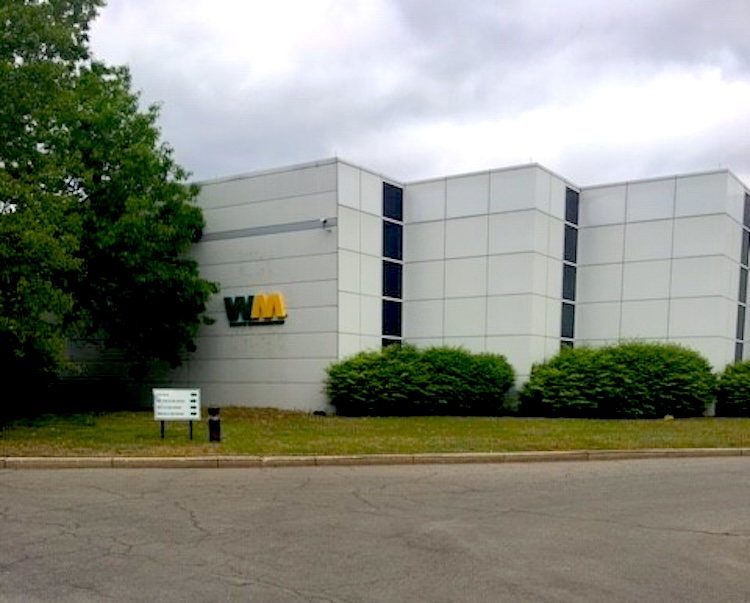
The Billerica materials recovery facility. Photo: Mass Recycling
From there, the materials are sent to a recycler, transforming them into new products. The MRFs sort the materials, eliminate contaminants (nonrecyclable items), and bale them for shipping to a recycler (view the process at www.mass.gov/recycling-reuse). For questions about which items should go in your recycling cart, refer to the State’s Smart Recycling Guide.
The Massachusetts Department of Environmental Protection (MassDEP) regulates activities at MRFs, and its enforcement staff conduct periodic inspections. MRFs must report annually to MassDEP the tons of material processed and, upon request, the destinations of the material sent for recycling. MassDEP states that the containers processed at one of the state’s nine MRFs, including the one that receives Belmont’s recyclables, are recycled at a rate of approximately 90% (recyclesmartma.org/2022/11/the-truth-about-plastics-recycling). However, the hauler serving Belmont and many other communities does not report to local officials about the destinations of recyclables.
When state environmental inspectors visit the MRFs, they look at the outbound commodities (i.e., paper, plastic, metal, glass) and inspect the “residue” to ensure that it consists only of things that are not recyclable.
Residue piles contain things like plastic bags, garden hoses, small appliances, t-shirts, shoes, diapers, and other non-recyclable plastic, and other items that people hope are recycleable, often called “wishcycling.” To ensure that textiles such as t-shirts are reused or recycled, place them and other textiles including shoes in the blue bins in convenient locations around town. Local grocery stores, including Star Market and the Watertown Stop and Shop collect stretchy plastic bags for recycling.
Massachusetts has waste bans that restrict the disposal of recyclables, because it is is illegal and expensive. These bans target recyclables including cardboard, textiles, mattresses, and certain hazardous products. State inspectors check to make sure that banned materials are not in the trash.
Massachusetts is running out of waste disposal capacity. The amount of in-state landfill space is rapidly shrinking, and the capacity of waste-to-energy facilities is stagnant. As a result, Massachusetts’s trash is increasingly shipped out-of-state to places as far away as Alabama and Michigan. Shipping trash long distances places a growing cost burden on municipalities and is not sustainable. Long-haul transport also produces greenhouse gas emissions.
Reduction, reuse, and prevention are key to addressing the problems with the growing amount of waste (check out “Think Twice About Single Use Plastics” by Lindsay Levine and Dean Hickman, BCF Newsletter, November/December 2021). But as long as we continue to generate so much waste, everything that can be recycled should be recycled. For example, we need to do better at recycling all of the rigid plastic food, beverage, and household product containers that we can. The plastics recycling industry not only wants these containers and can recycle them, but some experts say a shortage of recycled plastics prevents major consumer brands from meeting their sustainable packaging goals. Many perfectly recyclable plastic bottles, jars, jugs, and tubs are put in the trash, which means they are being sent for disposal.
At the same time, we need to support efforts to design packaging for reduction and recycling. There is still too much plastic packaging that is not reusable or recyclable. To help promote change, email the companies whose products you love and ask them to improve their packaging. Consumer brands listen to their customers’ demands for sustainable products and packaging.
Massachusetts is one of 10 states that has a bottle bill program. We were one of the first states to enact such a law, but the program has not been updated for over 40 years. The bottle bill incentivizes the collection of plastic, glass, and metal containers for carbonated drinks. These materials are separated at the redemption sites and are very clean. Recyclers want these materials because they have value. Several groups are advocating that the legislature modernize the bottle bill, which is long overdue.
In addition, various Massachusetts organizations are advocating for producer responsibility programs for packaging that seven other states have now enacted. These programs have been operating in Canada and Europe for many years. Extended producer responsibility (EPR) legislation includes, at a minimum, the requirement that a manufacturer’s responsibility for its product extends to its end-of-life (bit.ly/BCF-Recycle). EPR for packaging focuses on improving packaging design, increasing recycling, reducing consumption-based greenhouse gases, and reducing municipal costs. A bill (S.571) before the Massachusetts legislature would mandate EPR for packaging and paper products, and a separate bill (S.570) would mandate that the state conduct a needs assessment to develop the background information needed to effectively plan an EPR for packaging. Belmont and other towns would greatly benefit from the passage of this and other EPR legislation. It would reduce the expenses that Belmont taxpayers bear for waste services, increase access to recycling collection services, and provide clear and more consistent messaging about what is recyclable and what isn’t.
Belmontians are to be commended for doing a good job keeping contaminants out of our recycling bins, especially compared with other towns. It is equally important to keep all of the recyclables out of the trash and to put them in your recycling bin. Now that we have a town recycling coordinator, residents have someone to ask when they are confused about handling the complex and confusing array of stuff we all have in our homes.
Terri Goldberg is a Belmont resident, a member of the MassRecycle Board of Directors, and a former member of the Belmont Solid Waste and Recycling Committee.

Sorry, the comment form is closed at this time.