
By Meg Muckenhoupt
This issue contains an article by respected Belmont residents arguing that a proposed overlay district in Belmont Center will lead to a net loss to the town. Those calculations are at odds with the numbers produced by the Warrant Committee, which predict an annual net increase in town revenue between $127,000 and $857,00 (see bit.ly/BCF-Overlay-Fiscal). Which numbers you believe are more credible depends on your assumptions—chiefly assumptions about school enrollment.
Children cost towns money. They’re expensive to educate, they like to play in parks that are expensive to maintain, and they increase the need for traffic enforcement to make sure they aren’t imperiled by automobiles on their way to their expensive schools.
However, as many expectant couples learn, children’s arrivals are not entirely predictable. In 2018, the Belmont Middle & High School Building Committee predicted that by 2024, there would be 4,900 students in Belmont Public Schools. As of this school year, there are 4,433, according to the Massachusetts Department of Education. More than 450 anticipated children have have not appeared. A 2024 forecast predicted that Belmont’s school population will decrease by another 171 students by 2029.
Most towns could balance their budgets handily if they could forbid families from moving into the town, something which developers functionally accomplish when they build studio and one-bedroom apartments. But it isn’t legal to bar families outright, or to refuse to provide public schools. The citizens of the Commonwealth of Massachusetts decided long ago that it is necessary to educate all children for our society to survive.
Towns exist because people also decided long ago (in Belmont’s case, in 1859) that a town is a useful way to provide services, resolve disputes, and make decisions about land use. Belmont, like all other Massachusetts municipalities, gained the power “to limit the construction and use of buildings,” i.e. zoning, in 1920.
Since then, the state has attempted several times to intervene to stop towns from limiting housing construction via zoning, including 1946’s Emergency Housing Commission, Chapter 40B in 1969, and the 2021 MBTA Communities Act. The consistent problem the state is trying to solve is that individual communities in Massachusetts have no incentive to add to their housing stock, and often use zoning to prevent new construction.
New housing is troublesome for towns. The buildings block the view, beloved trees are uprooted, and the residents require more sewers, roads, and firefighters. Residents often decry a change in the town’s “character,” or a potential decline in property values.
Since 1920, residents in dozens of communities in greater Boston have zoned for short houses, or large lots, or single-family-only areas. These communities have managed to essentially halt building in much of the state since 1970. This kind of zoning might help explain why Belmont’s population is virtually the same as it was in 1950, while Massachusetts’s population has increased by 50%.
That’s unfortunate, because multiple studies show that building new market-rate housing slows the growth of local rents. Sometimes it reduces rents in the surrounding area. By throttling the housing supply, Greater Boston has made housing more expensive on purpose, one town at a time.
Unsurprisingly, Massachusett’s housing shortage has festered for decades. To house our state’s predicted population, we need to add 222,000 homes over the next 10 years; in 2024, only 14,338 housing units were permitted in the state.
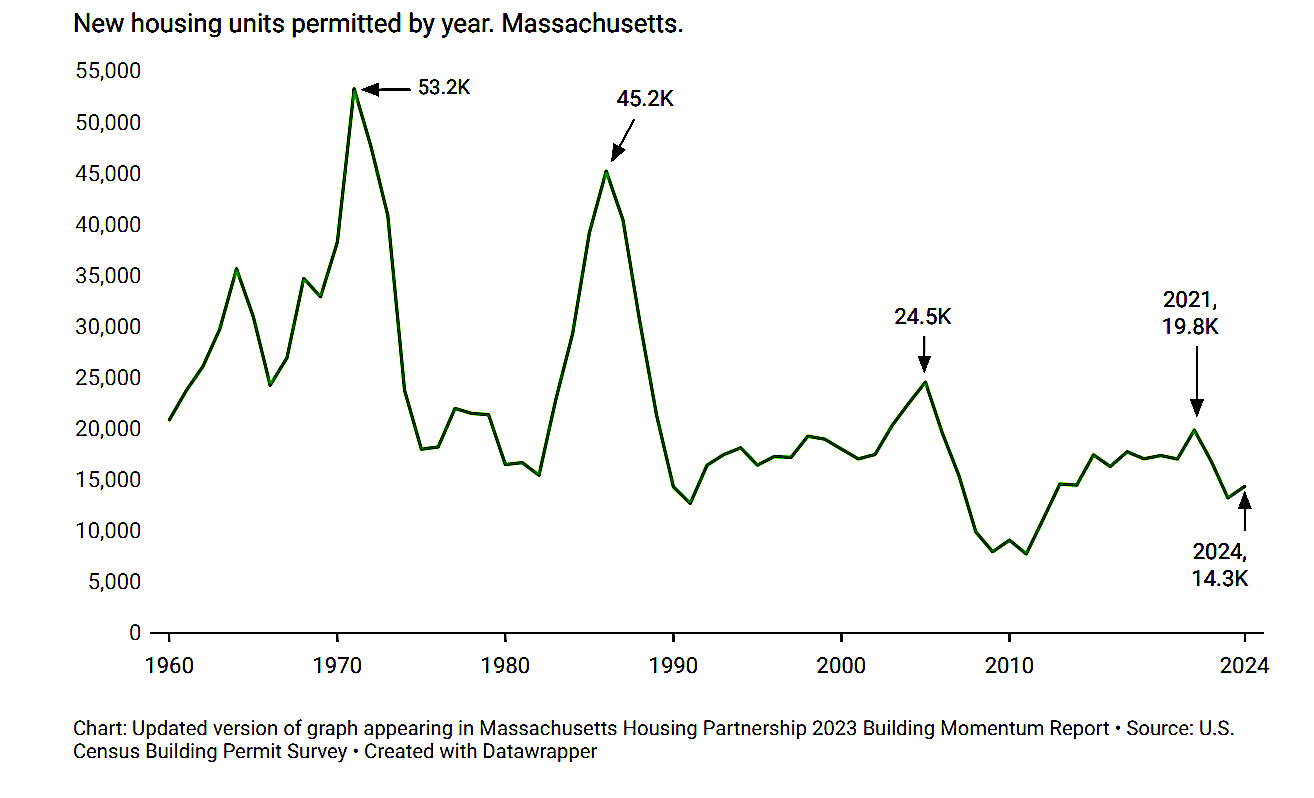
Source: Source: Greater Boston Housing Report Card 2025, The Boston Foundation.
The housing shortage and high housing prices are major reasons Massachusetts annually sees net out-migration of about 20,000 to 30,000 people ages 25–54 to other states. These are people of prime working age who pay taxes.
Of course, a lot of people ages 25–54 have children. Children are expensive.
The authors of the accompanying analysis suggest that the overlay district is a bad idea because it might require current Belmont residents to pay higher taxes to educate more children. In that scenario, the function of a town is to protect the current residents from potential demands from new residents. That is one theory of a town.
Yet there are other theories of town government. A town could also value future residents and their interests. These are people who could come to Belmont and pay taxes, spend money at local businesses, pick up trash at trail cleanups, perhaps even run for Town Meeting. They could become treasured members of the community, if they had a place to live.
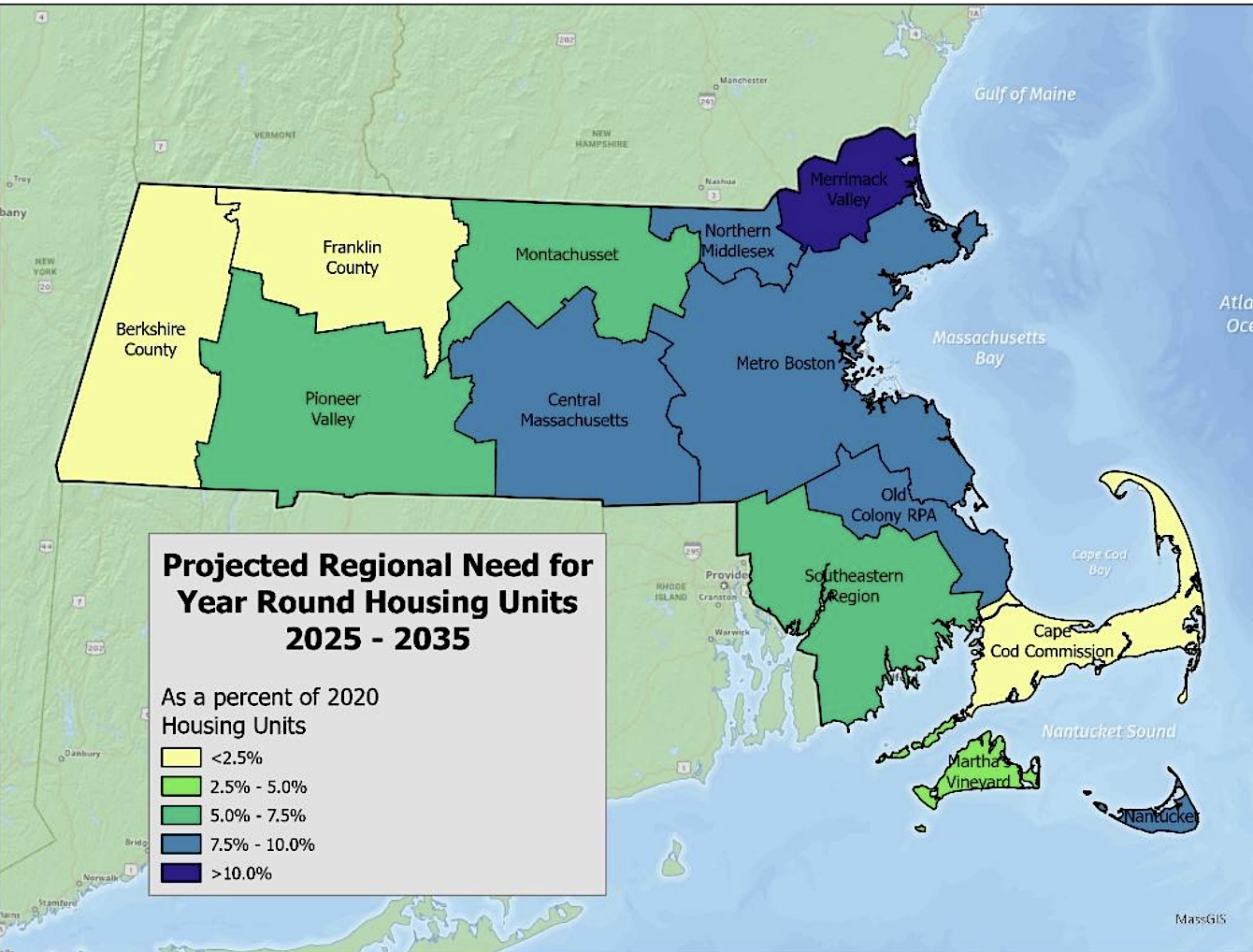
Source: Massachusetts’ Comprehensive Housing Plan, 2025-2029
As long as residents see towns as fortresses designed to exclude outsiders, and zoning as a tool to control taxes, Massachusetts’s housing crisis will continue, and young adults, their families, and their tax revenues will leave the state.
Soon, Town Meeting will vote on the Belmont Center overlay. I hope that Town Meeting members think clearly about Belmont’s past, and Massachusetts’ future, and what this town could and should be. And I hope they think of the children, who are expensive, and unpredictable, and necessary.
Meg Muckenhoupt is executive editor of the Belmont Citizens Forum Newsletter.

Sorry, the comment form is closed at this time.