
By Michael Widmer and Ira Morgenstern
The Select Board has repeatedly claimed that the Belmont Center Overlay proposal will help address the town’s high property taxes and provide additional funding for our schools. Unfortunately, the proposal may actually cost the town money.
A little history is instructive. Starting a year ago, the Planning Board, working with the Office of Planning and Development, developed a zoning proposal for Belmont Center, which included a hotel on Concord Avenue. They produced a number of financial scenarios with a full buildout achieving $3 million in annual net revenues for the town, with the hotel accounting for about three-fourths of the $3 million. Although the Select Board chair acknowledged that a full buildout was a “magical scenario” at a meeting, the Select Board members continued to promote the $3 million figure.
But at this point, the Select Board confronted a problem. The single overlay proposal would have required a two-thirds vote of Town Meeting, a high hurdle. So the Board decided to create a separate zoning proposal for the hotel, thereby asserting that the remaining center overlay proposal would require only a majority vote of Town Meeting.
However, by removing the hotel, the main revenue component disappeared. Town leaders are continuing to claim that the overlay will provide property tax relief and funding for the schools.
[Editor’s note: The Warrant Committee has released new projections which differ substantially from these estimates. Please see Belmont Center Zoning: More Information.]
The authors of this article, along with two others, all of whom are economic and financial analysts, have undertaken an extensive financial analysis of the center overlay proposal.
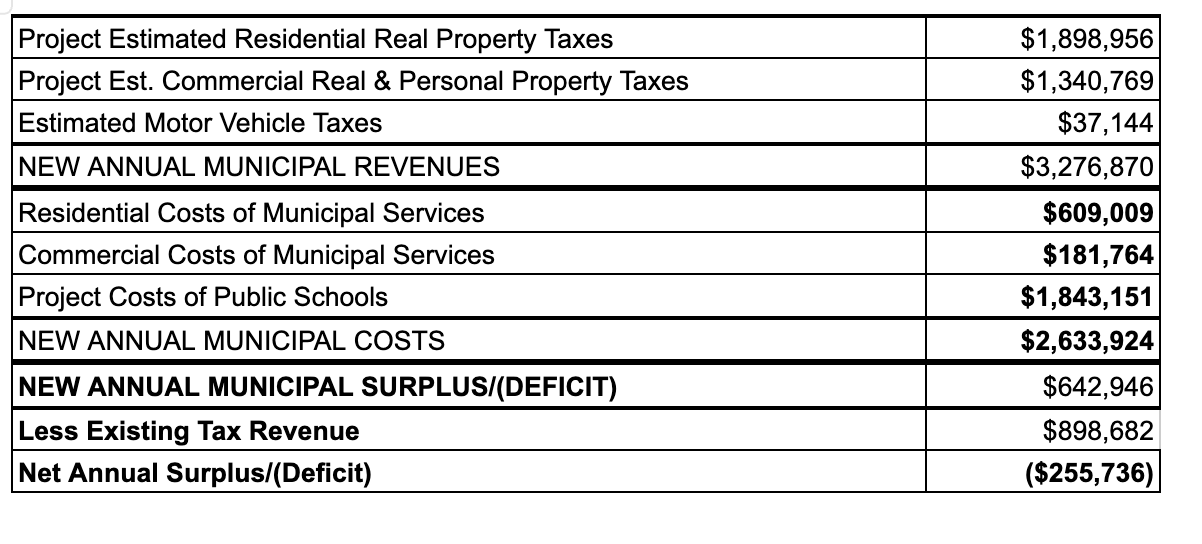
Our findings indicate the town would lose approximately $250,000 a year if the overlay were fully built out. This does not include a hotel, which is now part of a separate proposed bylaw.
In broad strokes, the new revenues derive from additional residential and commercial property taxes, which are offset by new municipal and school costs. The taxes that are currently being paid by businesses in the center must then be deducted to reach a final number.
In the table, new annual revenues from residential and commercial property taxes total $3.3 million. The revenues are offset by new annual costs of $2.6 million, principally the $1.8 million costs of additional school children. The resulting “surplus” of $642,946 is then adjusted for existing tax revenues of $898,682—producing a loss of $255,736. And this does not account for any municipal infrastructure upgrades that will likely be required by the new construction, though these have not been evaluated by the town.
Analysis provided by Michael Widmer.
In making these calculations, there are three key variables that drive the final estimates: the apartment mix, the number of school-aged children, and the cost per school child.
To calculate apartment mix, we collected data on 43 developments located in Belmont and other neighboring and comparable towns, all of which were either built within the last 20 years or are detailed in recent town reports as being in advanced planning stages. The other towns included Arlington, Braintree, Lexington, Melrose, Newton, Watertown, and Wellesley.
Applying those data to a full buildout in Belmont Center, we estimate 408 apartments could be produced under the overlay, of which 7% would be studios, 46% one bedroom, 40% two bedrooms, and 7% three bedrooms.
Also using data from several surrounding communities (Arlington, Lexington, Newton, Watertown, and Wellesley), we developed weighted averages of school-aged children by unit size, with separate estimates for market-rate and affordable units. That produced a combined figure of 118 new school-aged students, or 29% of the 408 units. That seems like a very conservative estimate, given the enormous appeal of Belmont schools and the proximity of schools for all grade levels to Belmont Center. Obviously, if more students moved into the center apartments, the costs would be greater than we have estimated. The 29% is virtually identical to the 30% average estimated by the RKG consultants in their November 2024 report.
As the final step in calculating school costs, we examined Belmont’s school budget and estimated a cost per student of $15,489 (using the fiscal 2026 budget). That number includes the costs of health care for school employees under the town’s shared services budget.
Analysis provided by Michael Widmer
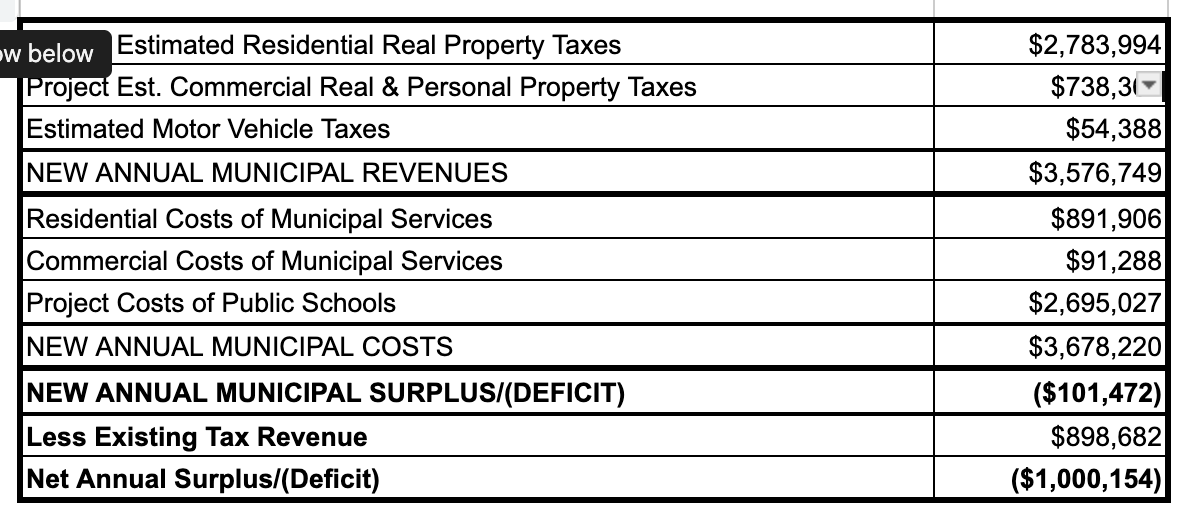
All these calculations are based on the current proposal, with the bottom two floors of commercial and all the higher stories (as many as three additional stories) residential. With a weak commercial market, if the town were to adjust to only the first-floor commercial and the rest residential, the net loss to the town would rise dramatically. Following the same process used in the calculations above, one floor of commercial and the remainder residential would result in an annual loss of $1 million in revenues to the town.
In conclusion, most likely, the overlay will actually worsen the town’s finances, forcing cuts in school and municipal services and/or larger property tax overrides.
Unfortunately, myths die hard, especially since the Select Board’s claims have an easy appeal in these challenging times. The trouble is, if approved by Town Meeting, it will take years and a lot of pain to show the inaccuracy of these claims, and sadly, we will have lost the small-town scale of our center.
For more information about the sources for these calculations, please contact BelmontBetterZoning@gmail.com.
Michael Widmer served as Town Moderator from 2008 to 2025. Ira Morgenstern is a Precinct 7 Town Meeting member. Doug Koplow, Precinct 6 Town Meeting member, and Robert Sarno, Precinct 3 Town Meeting member, contributed to the research and reviewed this article.

Sorry, the comment form is closed at this time.