
By Elissa Ely
Few of us recognize our path in this spinning world until long past childhood. It’s usually vague, convoluted, unclearly marked. If we’re lucky, we don’t wander down too many side streets leading nowhere (or worse, to unhappiness). For some, the wandering never ends.
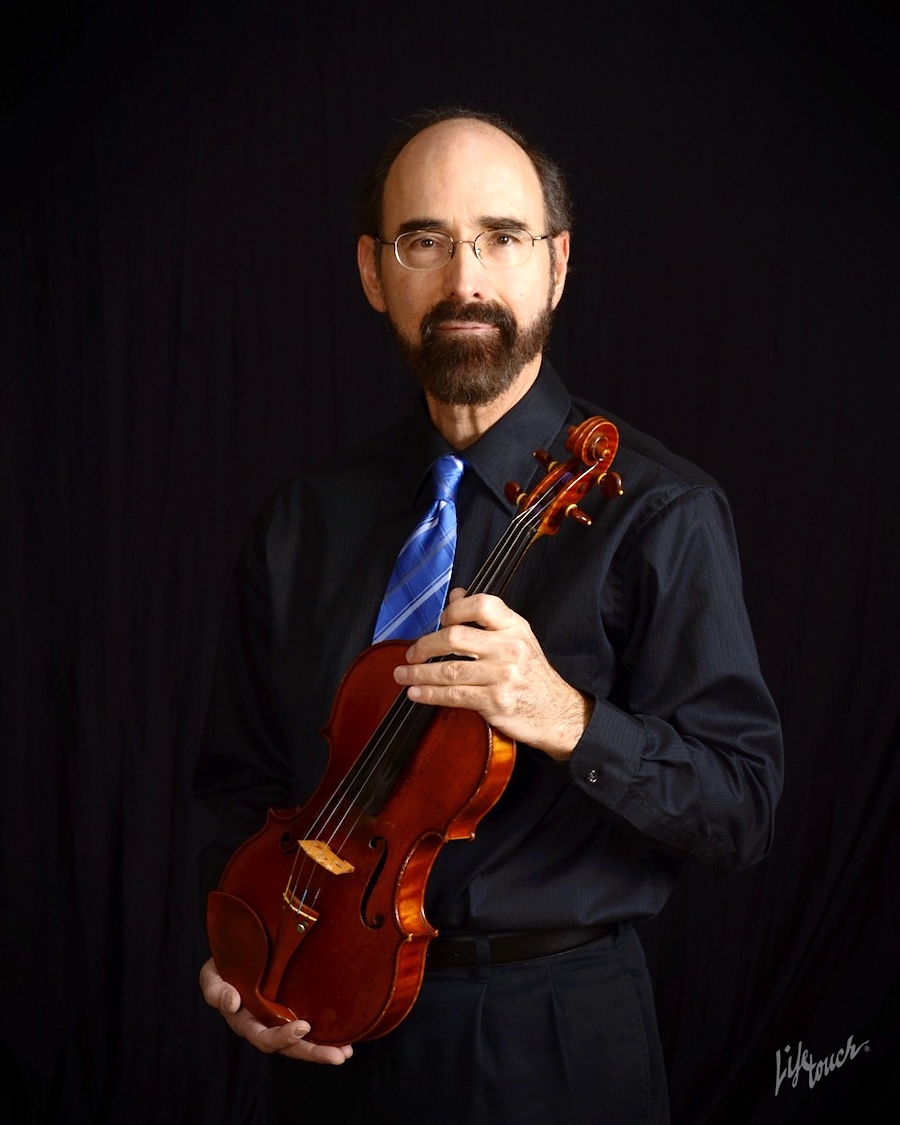
Ken Stalberg. Photo courtesy of Ken Stalberg
Ken Stalberg, former “Mailing Maestro” for the BCF Newsletter, principal violist with the Boston Lyric Opera Orchestra, the Boston Classical Orchestra, and the Boston Landmarks Orchestra, as well as a violinist with the Boston Ballet Orchestra, took a straight path from a young age. His mother was an amateur pianist (“and a very good one, though she had small hands”), and his father repaired woodwind and brass instruments in their basement. Once a week, after working a government day job, he would make the rounds of local music stores in Silver Spring, Maryland, collect his clients, and bring them home. Though he wasn’t formally trained, he played well enough to test and treat them all.
Ken’s father took him to his first violin lessons: Saturday mornings, the University of Maryland. He was 10 years old, in a class with 35 to 40 other students. It was led by a hard-working, well-meaning professor who, in the crush of young players, couldn’t attend fully to the individual. “I developed bad habits,” Ken said, “which had to be broken.” Many years later, he and the professor played in a chamber performance together. “Oddly enough,” he says wryly, “he didn’t remember me.”
To be clear, a straight path didn’t involve endless love for practicing (“I admit that I lied to my mother on more than one occasion”), but the music took hold. The road was certain though the instrument was not, and for a while Ken thought he might take up the flute. In the Stalberg home, classical music was a constant visitor, and one day he was listening to Mendelssohn’s Violin Concerto, lifting the record player needle over and over again to return to a particular segment. “I was captivated. It sent me into ecstasy,” he recalls.
Clarity arrived in the 11th grade and in the presence of a Beethoven String Quartet recording his mother had borrowed from the library. Music, he understood, would be his vocation. String music. He was called.
His mother, pianist and music lover, was not happy at first. She tried to talk him into something more self-sustaining, like medicine or engineering. But music was sustenance. He went on to Oberlin Conservatory, then to Tanglewood, then to Boston University. One formative mentor, concertmaster in the Boston Symphony Orchestra, had a photographic memory. Sometimes he taught a difficult piece without a score (“I used to think that ‘jaw dropping’ was just an invention”). He insisted that his students join nonmusical as well as musical communities—which was to say, find their ways to the rest of the world.
A second mentor, chamber music coach in Tanglewood, had such deep interpretive understanding that “the man just dripped music.” To make a passionate point, he once hurled his pocket score against a wall, pages exploding everywhere. “I used everything I learned from those two,” Ken says, “filtered through my own choices and experiences.”
Like most dewy young musicians, he didn’t understand at first that the reality of a life in music requires more than music. “We’re freelancers,” he explains. “If you’re not a member of a symphony—and I was lucky to get in early—it’s the art of accepting every bad job so you’ll be asked for the next bad job.”
There’s also the nagging issue of financial survival. Ken has been involved for years with writing collective bargaining agreements: 20 to 30 page contracts, often opposed by management, renegotiated every three to four years, and far from the purity of scales.
He and his wife were living in Watertown when, during the 1991 Nor’easter “Perfect Storm,” they moved to Belmont. Friends were nearby, the neighborhood around McLean was peaceful, the house had a studio, the studio had a bathroom. They raised two sons there; one sings in a chorale, the other became a piano teacher who lives around the corner.
Involvement with BCF began when McLean was planning to sell off property for development. Like many Belmont residents, Ken wanted to preserve open spaces and protect traffic manageability. Eventually the meetings he sat in on led to the newsletter mailings he helped out with. Every few months, there were mailing parties; friendly faces pasting address labels on about 2,000 issues around a dining room table with snacks. Those parties, which ended during the pandemic, led to volunteering as Mailing Maestro. (“I didn’t come up with the name, by the way.”)
The newsletter that appears so reliably in a mailbox winds its way through an obstacle course beforehand—it should be short of breath by the time it arrives. Heavy post office tubs, rubber bands, and labels are driven to a digital print and copy business in Cambridge that bundles and returns the publications for mailing.
There used to be an easy commute afterwards to the Belmont Post Office, but nothing easy is easy for long. Because of ever-evolving postal service rules, the drive to Belmont became a drive to the BMEU (Business Mail Entry Unit) in Waltham, where Ken and the postal clerk had long conversations about the state of the USPS. When the BMEU was shuttered, he had to find another office that accepted bulk mailings. Now the tubs and bundles—altogether weighing more than 200 pounds—travel to Central Square.
Musicians are nothing if not disciplined. His son Nathaniel often helped (“he’s wicked quick”), and over 20 years, Ken missed only one mailing. Sometime last summer, he stepped down, and became the Mailing Maestro emeritus. (Take notice, Belmont Citizens Forum administrators, and make time for a well-earned plaque.)
For musicians, there’s no obligatory retirement age with a farewell luncheon and the dismissal of a gold watch. “So far, my memory is good,” Ken says. “I’ll know it’s time to quit when I can’t remember if I went back to a repeat.”
There’s also the pleasure he takes in teaching; mostly children in younger grades, but some up to high school. His method is as much personal philosophy and lessons from his own mentors as it is scales and scores. “I believe in humor as a big part of teaching, and also, humor as a big part of approaching life,” he says. At the same time, his students must learn habits they won’t have to break. “I don’t allow them to skate. There are constant reminders of rhythm, and how to hold the bow. I won’t compromise on these points. The world doesn’t need another player playing out of tune.” Getting it right is especially important when making music with others. “That’s what I feel is the real point, in a deep, wordless way.”
This profile should come with a sound track, for the joy of listening to a boy called early in life to his path, a principal violist and violinist in multiple orchestras, a teacher, and a former Mailing Maestro (take notice, Belmont Citizens Forum administrators, and make time for that oral project, too).
In the end, though, here’s what everyone should know most clearly: “Music,” Ken says, “gives me hope. Especially when I’m playing.”
Elissa Ely is a community psychiatrist.

Sorry, the comment form is closed at this time.