
By Edmund McDevitt
In 1831, in the section of Watertown that later became the south part of Belmont, Peter Chardon Brooks was born. The child was to become one of the most important historic figures in the development of the skyscraper.
Little is known about his family’s residence in Watertown. Peter Brooks’s grandfather, the original Peter Chardon Brooks (1767–1849), was, at the time of his death, quite possibly the wealthiest man in Boston. His wealth came from a marine insurance business, some of which insured ships involved in the Atlantic slave trade—no surprise, given that the family were slaveholders prior to and after the American Revolution.
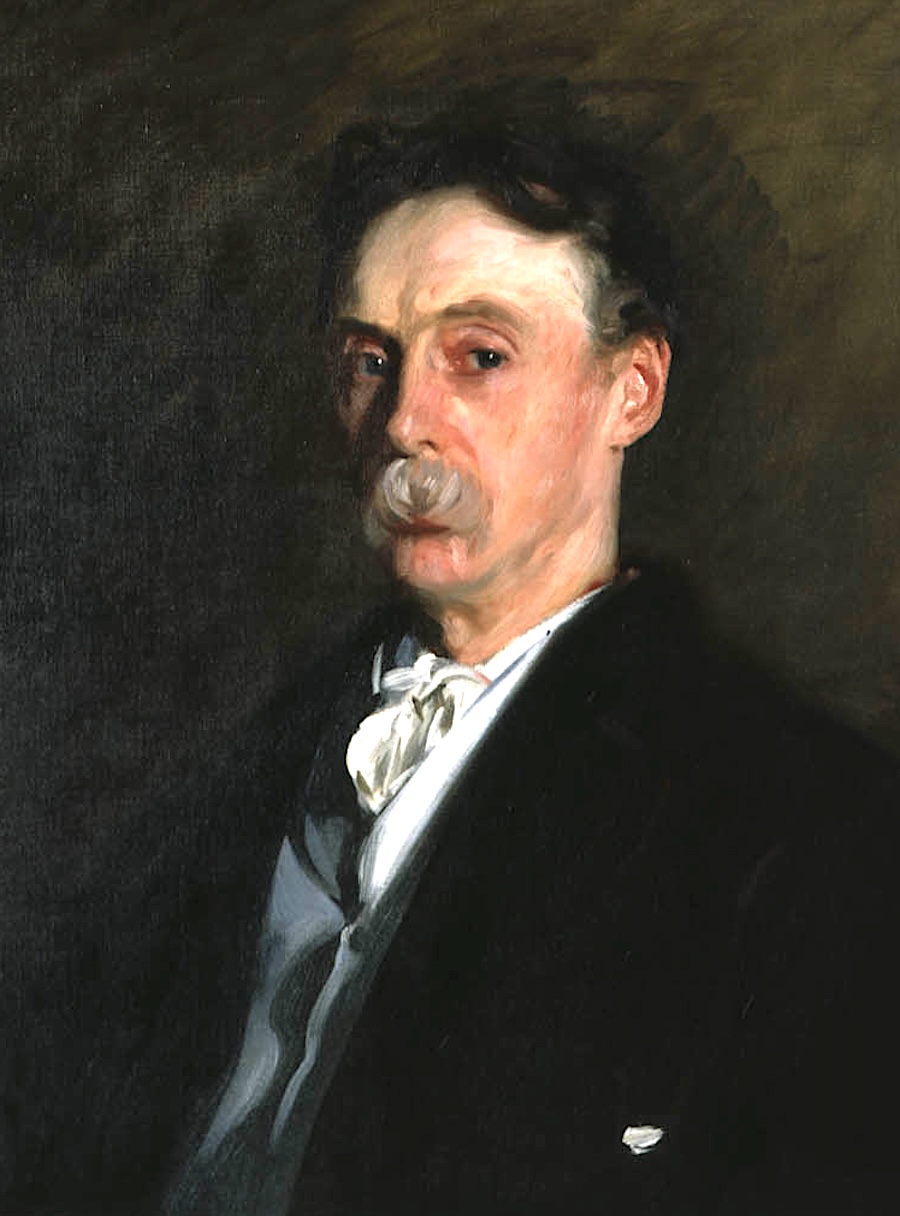
Peter Chardon Brooks III portrait, oil on canvas by John
Singer Sargent, 1890. Source: Massachusetts Historical Society
The elder Brooks was also the grandfather of the historian Henry Adams and the great-great grandfather of Massachusetts governor and senator Leverett Saltonstall (1892–1979). Leverett Saltonstall’s mother was Eleanor Brooks, Peter Chardon Brooks’s daughter, providing a bit of interesting insight into the insularity of Boston society. Leverett Saltonstall was also a descendant of Sir Richard Saltonstall of the Massachusetts Bay Colony, who founded Watertown.
Investment in Chicago Begins
Peter Chardon Brooks III and his brother Shepherd invested heavily in Chicago real estate at the beginning of the rise of the skyscraper. They built Chicago’s 1883 Montauk Block (demolished 1902), a very early tall building, 10-stories high, and the first building to be deemed a “skyscraper.” Historically, another Chicago building, the Home Insurance Building, completed in 1885, is considered the first true skyscraper, employing what became the standard method of construction, a fireproof structural steel frame that fully supported the building. The Montauk relied both on its steel structure and on its walls for support, whereas later skyscrapers were supported entirely by their interior steel lattice.
The Brooks brothers (no relation to the men’s suit company) spent most of their lives in Medford on what is now the Brooks Estate. Their friends and associates in Massachusetts knew little of their extensive investments in Chicago. Their reputations were those of “gentlemen farmers.”
The brothers, mostly Peter, worked extensively with Owen Aldis, a Chicago developer, and with the architecture firms Burnham and Root and Holabird and Roche, two of the most important 19th-century tall-building design firms. Peter was very involved in the details of his buildings and depended upon Aldis both to innovate with him and to manage the process. They together adhered to several development principles:
- The office building with the most light is the best investment.
- Second-class space costs as much to operate as first-class space; therefore, build no second-class space.
- Common areas should make a lasting impression.
- Operating expenses must always be kept in mind.
- Upkeep is important; it should be management progressive.
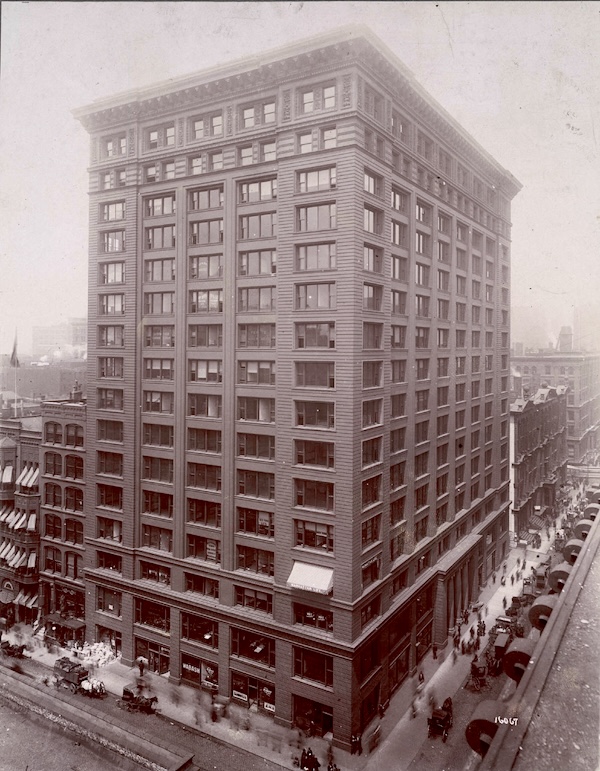
1895 photograph of the Marquette Building. Source: A. D. White Architectural Photographs, Cornell University Library/ Wikimedia Commons
The Landmark Marquette Building
In 1895, they completed construction of the Marquette Building, a Chicago landmark and current home of the John D. and Catherine T. MacArthur Foundation. In keeping with having common areas “make a lasting impression,” the revolving doors and lobby are adorned with relief sculptures. The lobby ceiling contains a spectacular encircling mosaic that depicts the 1674–1675 expedition of Quebec explorers Father Jacques Marquette and Louis Joliet to the swampland that later became Chicago. The shimmering mosaic, designed by Louis Comfort Tiffany and his art director, Jacob Adolph Holzer, is one of several large Tiffany works in the city but is the first such high-class decoration in an office building in the city. Peter Brooks is known to have understood early on that the top floors of buildings should be marketed as the most prestigious to occupy.
Peter was very detail-oriented (his brother Shepherd was not). According to Joyce Goldenstern in her “Monadnock on the Prairie,” for Peter (whose visits to Chicago were brief and infrequent):
“Nothing was too minute for his scrutiny: paint color, faucets, urinals, plumbing, and elevators invited his long-distance comments and commands. He is said to have in his study a grid-map of downtown Chicago, dotted with colored pins on which he studied the patterns of speculative office space. Like a chess master, he anticipated his competitors’ moves and plotted his own. He knew each block, each corner lot and its potential by heart.”
Elevators were a means to an end: they carried people to those prestigious floors at the tops of buildings. The Marquette Building (remember, this is 1895) has 11 of them! Also keep in mind that not too long before the Marquette opened, people did not trust elevators; they would gladly put supplies and equipment on them, but not themselves. Elevators were, for Peter Brooks, a key element in his ideas about classy buildings.
Owen Aldis apparently cajoled Peter Brooks to add multiple amenities to the Marquette Building. Brooks was well known for his disdain for building art and decorative flourishes. He famously directed that the first half of the 1891 Monadnock Building be thoroughly unadorned. Architect John Wellborn Root, an artist at heart, had, a few years earlier, gotten away with all sorts of whimsical decoration on another Brooks project, The Rookery. It’s not clear what Peter Brooks thought of those fillips, but he was very careful to instruct Root on what to include in and on the Monadnock Building, a very speculative office structure at the time. So Aldis’s Marquette design ideas are all the more remarkable. The Marquette was, and remains, a unique and classy office building.
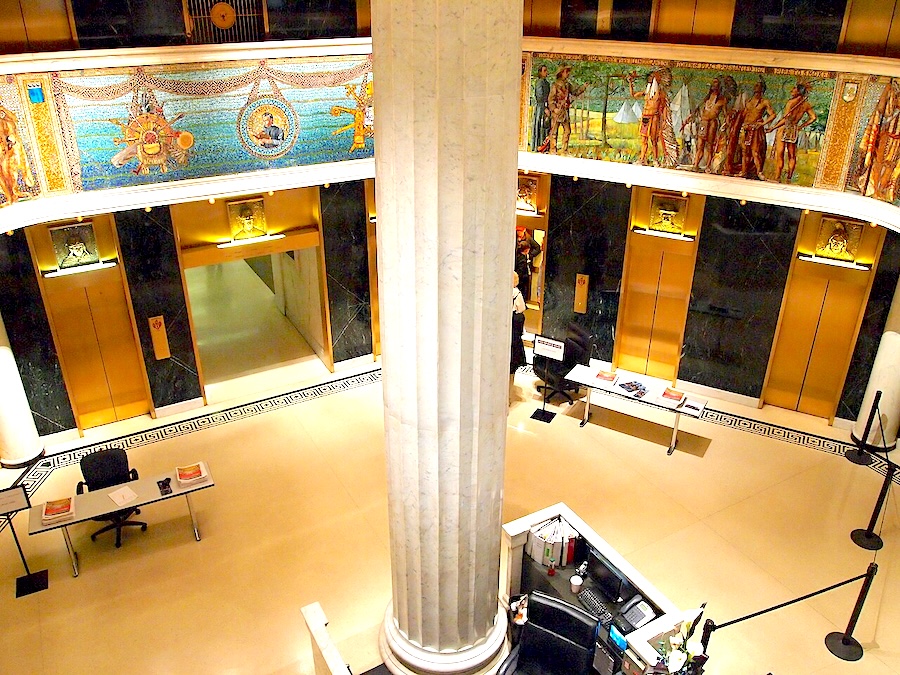
Lobby of the Marquette building. Source: Wikimedia Commons
The “Gentlemen Farmers”
Surprisingly, to this day, the deception of the Brooks brothers, the quiet fiction that they were just your ordinary well-to-do farmers, persists in Massachusetts. According to Joyce Goldenstern:
“Before he died, Peter, the grandson, told the historian of his Harvard class that he had never worked, that he had no profession. Poor health, he noted, had prevented him from pursuing a career. Whether motivated by modesty or mockery, Peter’s words did not coordinate perfectly with the facts of his life. He, along with Shepherd, had, indeed, worked. They lived the quotidian life of New England farmers, tending to crops and cows, mending stone walls and walkways. In addition, both men, from afar, invested in the development of the burgeoning frontier city of Chicago. They bought land, planned and paid for office buildings, and collected rent.”
Peter’s vision and foresight with respect to Chicago’s tall buildings of the time not only made him a lot of money, they also put him in rare company: the true innovators and mavens of our contemporary world. But his story remains buried and mostly unremarked upon in his own home state. And he was born in Belmont.
Edmund McDevitt was born and brought up in Belmont (in the part of Belmont excised from Watertown) and is a 1957 graduate of Belmont High School. He is, among other things, an active architecture docent, leading walking tours for the Chicago Architecture Center.

Sorry, the comment form is closed at this time.