
By John Beaty
The William Flagg Homer House is a Belmont story with two mysteries. The first mystery is who was the architect who designed and built the Homer House. The second mystery is who William Flagg Homer was and how he provided the resources to acquire the land, hire an architect, and build this magnificent home.
The Homer House is listed in the National Register of Historic Places (1979) and has been a focal point in Belmont’s Pleasant Street Historic District. It is especially interesting because the artist Winslow Homer was Flagg Homer’s nephew and often visited during the summers. Some of Winslow’s most famous paintings are set on Belmont Hill.
The Homer Family
Flagg Homer’s grandfather, Eleazer Homer, was a wharfinger; he ran Hobs Wharf from Lyn(n) Street, at the foot of State Street in Boston. Eleazer provided men and machines for loading and unloading cargo, and Boston merchants for buying and selling goods to ships docked at his Hobs Wharf. The family lived in Arlington.
Being a wharfinger was a rough-and-tumble business. It was competitive, yet lucrative and highly sought after. Eleazer operated Hobs Wharf for more than 40 years.
His son, also named Eleazer Homer, became a Boston merchant. He learned from his father that the real money to be made was in the buying and selling of ship cargo that came to the wharves of Boston. He bought cargo from ships landing in Boston and sold it to other merchants or Boston businesses. Due to his connections with wharfingers and, increasingly, Boston merchants, his business thrived.
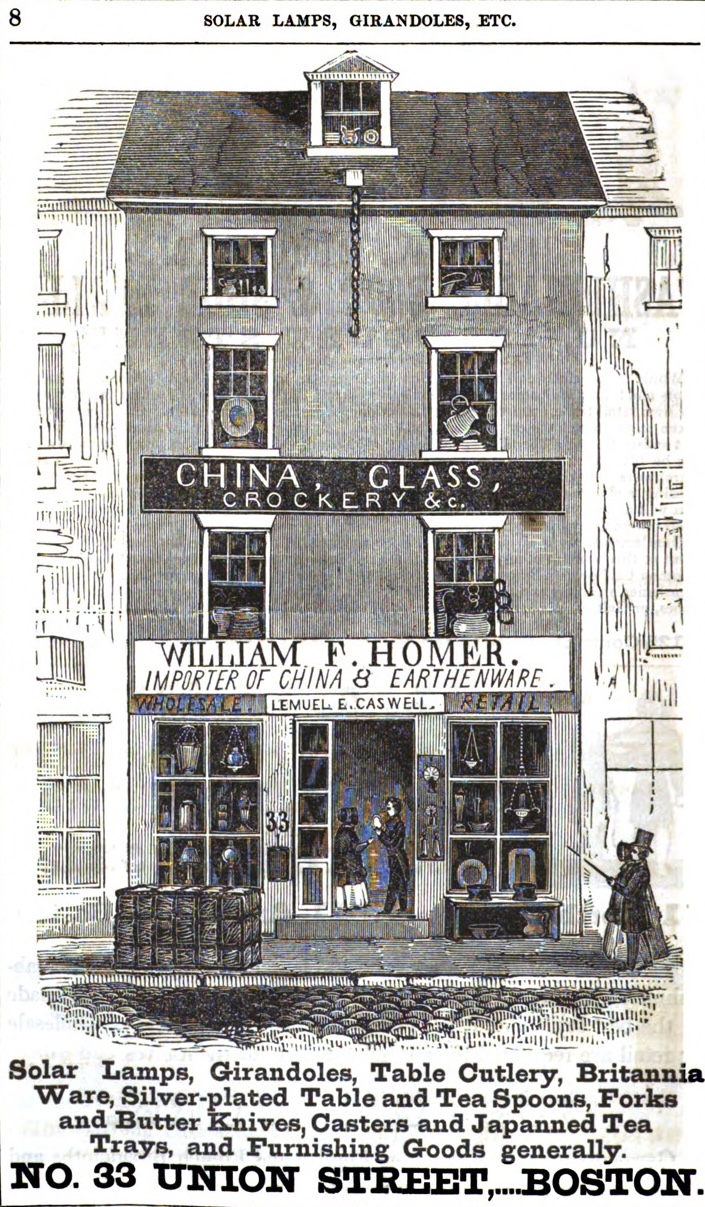
1848 advertisement for William Flagg Homer’s crockery business. Source: Arlington Historical Society
The Homer family prospered. The next generation grew up and continued the business as merchants. William Flagg Homer, Eleazer’s second grandson, specialized in the crockery and wallpaper business, purchasing crockery and related sundries from ships. In 1850, he established the first white porcelain pottery manufacturing factory in New England.
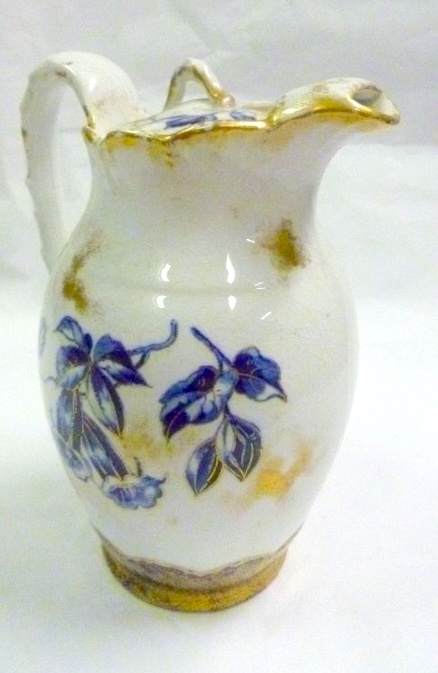
1892 Pitcher manufactured in Homer’s factory. Source: Arlington Historical Society
William Flagg Homer’s crockery business flourished, as did his porcelain factory, and he built his fortune. He married Adaline Matilda Wellington on September 1, 1831, in Arlington.
The Mead Family
Samuel Orlando Mead was a registered broker in Boston and practiced his trade for over 30 years, selling and buying stocks, properties, and buildings in the city. On June 27, 1822, Mead married Mary Maria Dix Wellington. He brokered a sale of land from the Underwood Estate to himself and, in 1836, built a Federal Style (Greek Revival) house on Wellington Hill, where the Homer House now stands, on Concord Avenue. By 1829, Mead owned the 14 acres that are now known as the Underwood Estate.
The Homer House Property
William Flagg Homer purchased land for the Homer House from the Underwood Estate through his brother-in-law, Samuel Mead, in 1850, and built the house in 1853.
Who designed and built the Homer House?
Architects are usually proud of their work: creating a beautiful structure requires talent, education, and expertise in science, engineering, and the arts. If they are fortunate enough to secure a commission and complete the project, they take pride in and value their effort.
In the Homer House case, no one knows who the architect was, and no one has claimed to have contributed to the architectural or building effort. For 150 years, the mystery has endured.
Architecture, Design, Builder, and Building
In 1850, there were no college programs in architecture in the United States and only a few architects in the Boston area. T. William Robert Ware (1832–1915) designed and led the first college program in architectural education in the country. He was appointed to the newly founded Massachusetts Institute of Technology in 1865 and taught the first architecture classes there.
Builders built homes in Belmont in 1850. The Homer house was built in 1853. Architects did not design homes in Belmont until the 1880s and 1890s, according to the book Belmont: The Town of Homes. Before that, owners and designers used “The Practical House Carpenter” and other books, and manuals to design homes, and builders and craftsmen to build homes.
In the case of the Homer House, Simon Hatch, who built the Blake house next door and had a workshop in the carriage house nearby, was reputed to be a very sophisticated builder and carpenter of some renown, working on buildings in the greater Boston area. Homer, Mead, and Hatch most likely sat down at Homer’s kitchen table and went through the design books. They designed the house, room by room, then discussed the embellishments of each room and what should be done. They also talked about the craftsmen needed and what Homer was willing to pay.
Who was the architect of the Homer House?
William Flagg Homer, Samual O. Mead, and their builder probably designed the Homer House. Their unconventional process did not drive their fame or fortune. No architect could claim, publish, or advertise the Homer House as theirs, so its history, fame, and fortune went muted and unrecorded.
That does not make it less than the magnificent house that it is. Just look at the majestic, spiral staircase.
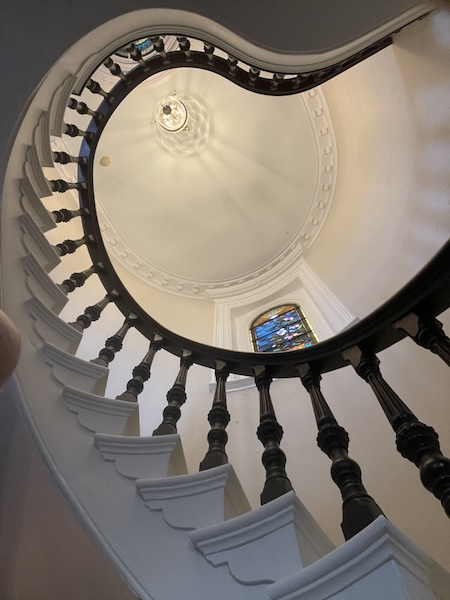
Staircase at the William Flagg Homer House. Photo: John Beaty
Go examine the oval dining room. The walls, wooden door, and frames are curved. Four doors each in a different place along the oval. Then look at the entertaining/living room with its grand fireplace and beamed ceiling with inset embellishments. Go to the top of the staircase and look at the light-providing octagonal cupola, with a widow’s walk, and it illuminates the entire center of the building with sunlight in a time without electricity!
The women of the Belmont Woman’s Club recognized it for what it was and is. They preserved it and upgraded its exterior and interior in the context of its original design and placement.
Bonus material
West Cambridge/Arlington to Belmont
At the beginning of the 19th century, Belmont did not exist. The area was known as either Arlington or West Cambridge. It was surrounded by Watertown to the south, Arlington to the north, Cambridge to the east, and Waltham to the west. Much of the hill land was owned by the Wellington family. It was a rural community, sparsely populated in 1850, with a population of about 1,000. Most of the population consisted of farm families, who supplied leafy vegetables, fruits, and other produce to Cambridge and Boston. West Cambridge and Arlington farmers, tradesmen, and businessmen traveled east to Boston on their daily commute by road, railroad, and coach.
West Cambridge/Arlington sat at the foot of Wellington Hill to the west and Meetinghouse Hill, King’s Common, and Strawberry Hill to the south in Watertown, making the natural boundaries of the town. It was predominantly flat, rich farmland, surrounded by Spy Pond, Little Pond, Clay Pit Pond, Fresh Pond, and fed by many artesian streams flowing out of Wellington Hill. Five streams still run most of the year: Beaver Brook, Junction Brook, Wellington Brook, and Winn’s Brook, from what we now call Prospect Hill, Lone Tree Hill, and Belmont Hill to the west. Then, as now, fresh water was fundamental for crops and human consumption. It was a beautiful natural setting to the west of Boston, and people came to visit and enjoy it. The Fitchburg railroad initially ran from Boston through West Cambridge and Arlington, with stations in Belmont, Waverley Square, and on to Fitchburg.
On May 5, 1803, Colonel Jeduthun Wellington obtained a chartered toll road from Harvard Square in Cambridge to Concord, passing through the West Cambridge/Arlington valley. This created a shorter, more direct route to Boston than the older roads, known as the new “Concord Road.” However, the turnpike had to go over Wellington Hill, a steep climb, and Jeduthun always kept his oxen ready to assist loaded teams up the hill. It took about an hour and a half to travel from Cambridge to Concord via the new toll road.
Town Incorporation
Beginning in 1850, Belmont struggled with its neighboring towns and the Massachusetts legislature to become \ incorporated. Samuel Orlando Mead was among those who worked diligently to ensure the town’s incorporation, serving on a three-member committee charged with organizing the town’s incorporation.
Along with David Mack and Samuel P. Hammat, Mead organized the parish committee of the Belmont Congregational Society. John Perkins Cushing was also a strong proponent for the town’s creation, providing significant financial support, and his estate, “Bellmont,” provided the name for the new town.
Belmont was incorporated on March 18, 1859, after an arduous struggle with its neighboring towns. Of the total area of 5 square miles, 2.26 square miles were taken from Watertown, 0.67 from Waltham, and 2.82 from West Cambridge. The population by then was 1,175, of whom 170 were registered voters and 325 were school children.
The Wellington family
“…Roger Wellington, the founder of his family in America, was born in England about 1609. He came to this country in 1630, and in 1636 bought fourteen acres of land on the border of Watertown and Cambridge, now called Belmont…” – A few Facts Concerning Roger Wellington and Some of his Descendants, A.W. Grisworld, 1892 – Ex Libris Rosetta
Colonel Jeduthan Wellington, for whom Wellington Hill was named, was an important figure linked to Belmont Hill. The Wellington family owned a homestead and tavern that were popular stops for travelers between Boston and Concord. A stone marker in the Belmont Town Hall complex marks where they once stood. The Wellington railroad station, built in 1840, helped develop Belmont Center. Some members of the Wellington family, and those related through marriage (such as the Mead and Underwood families), lived in homes tied to the family’s historic land holdings, including land originally bought by Roger Wellington in 1636. Jeduthan’s daughters married Samuel Orlando Mead and William Flagg Homer. As a result, Samuel and William became brothers-in-law through the Wellington family. His daughter, Esther, married William Underwood, the son of the founder of the Underwood Canning Company, whose estate is on Common Street.
References
- Samuel O. Mead, 1st generation, built a private school,” which became the Belmont Train Station and now sits on the Belmont Town Green.
https://www.belmonthistoricalsociety.org/wp-content/uploads/BHS-CPA-Funding-Final-Application.pdf
- Samuel O. Mead, married Maria Wellington and built a Federal Style house in 1826 on Wellington Hill, on the land at 661 Pleasant.
Samuel O. Mead c. 1826
- The Samuel O. Mead c. 1836 House, a Greek Revival Home, sits on the Underwood Estate overlooking Wellington Brook on a 5-acre wood lot, now 346 Concord Avenue. A marvelous Greek Revival structure was designed and built ten years before Greek Revival structures flourished in the Boston-Cambridge area.
Samuel O. Mead c. 1836
- 70 Common Street, built as a barn for 50 Common Street, is significant for its association with the Underwood family and as a surviving example of one of the many 19th-century estates built as Belmont developed as a quiet rural retreat from the city.
The house and barn may have been built by Samuel O. Mead, who owned most of the property now known as the Underwood Estate and is known to have built the gatehouse for the property c. 1850. His descendants still live in the main house, and the barn was recently converted to a residence by his great-granddaughter, Carolyn Baker.
Samuel O. Mead House c. 1850
- William Mead, 2nd generation, may have built the Italianate villa (before 1853) on the Underwood Estate at 50 Common Street, which was later occupied by Lyman Underwood, a talented scientist who made essential contributions in food canning and bacteriology. At 100 Common Street, his brother, H. O. Underwood, president of the family canning company, commissioned Hartwell and Richardson to design a Shingle Style residence for him in 1885. However, other sources state the house was a former Italianate carriage house built by the Underwood family.
- Another source describes the house as being built in 1898 and in the same family for over 150 years.
William W. Mead House c. 1850?
- The house is also referred to as the “Lyman Underwood House, 1853,” and is associated with the Underwood family. Lyman Underwood lived there from 1887 to 1929.
- A new high school was built south of the Town Hall in 1897 on the site of the historic Wellington Tavern. It was designed by an MIT-educated architect, Eleazer Homer 3rd generation, who had formerly worked as a draftsman for the firm of Hartwell & Richardson. Homer was also the grandson of Joseph Wellington, one of Belmont’s founders. The building served as a high school for twenty years and was used briefly as an elementary school. The Homer Building, as it is now known, has served as the Town Hall Annex since 1937.
Appendix 1:
I went through the list of architects, looked at their bodies of work on the web in Wikipedia, and Buildings of New England (no authorship). I tried to compare what was available on the web to the Homer House. I also tried to understand if it was likely that any of the architects or builders would have designed a private home.
The following comments result from my brief study of the internet and some of my associated thoughts.
Alexander Jackson Davis (~1850) is an unlikely choice. Comments: Italianate, Gothic style, huge, named mansions.
- Andrew Jackson Downing (~1845) worked with Davis as a landscape architect predominantly.
- John Notman (~1840) is not a likely choice: Comments: worked in the mid-Atlantic states as a landscape architect in the Italianate style.
- Samuel Sloan (~1850) is a candidate: Comment: he worked in the mid-Atlantic and Southern states. Many of his buildings were institutional, but some were private residences. The following link is “Winter Place”, residence of Col. Joseph Samuel Winter, Montgomery, AL – 1855
- Alfred Mullett (~1860-1890) is a very unlikely candidate. Comment: Many of his buildings were for the U.S. Government from the West Coast to the East Coast.
- Thomas Ustick Walter (~1840-1870) is a very unlikely candidate. Comment: Many of his buildings were institutional, government, religious, and corporate.
- Isaiah Rogers (~1830-1860) is an unlikely candidate. Comment: Many of his buildings were institutional, government, religious, and corporate, but there are exceptions. The following link, https://en.wikipedia.org/wiki/Hillforest, is the Thomas Gaff house in Aurora, Indiana.
- Detlef Liehau (~1830-1880) is a candidate. Comment: his buildings were designed for religious, academic, business, institutional, and private use. The following link, https://en.wikipedia.org/wiki/Nuits_(Ardsley-on-Hudson,_New_York) is” Nuits,” a private residence.
- Gridley J.F. Bryant (~1820-1885) is an unlikely candidate. Comment: Many of his buildings were for local and state governments. The predominant styles were Neo-Classical and Colonial Revival. Many of his buildings are historic: the Bryant Commission (many buildings), the Massachusetts State House, Hathorn Hall at Bates College, Boston’s old City Hall, and Independence Hall in Philadelphia. There are one or two private residences. The Robert Treat Paine estate, for example: https://en.wikipedia.org/wiki/Robert_Treat_Paine_Estate
- George M. Dexter (~1820-1870) is a likely candidate. Comment: many of his buildings were local private residences in the greater Boston area. The following link with mansard roofs It is to the David G. Fales House, a Second Empire house: https://buildingsofnewengland.com/2025/03/30/david-g-fales-house-c-1858/.
- Clifton A. Hall (1860 -1900) is a likely candidate. Comment: Many of his buildings were local private residences in the greater Boston area, as well as churches: https://en.wikipedia.org/wiki/Benjamin_F._Greene_House.
The following example is located in Central Falls, Rhode Island: https://buildingsofnewengland.com/2025/03/31/benjamin-f-greene-house-1868/.
- Arthur Gilman (1840- 1880) is an unlikely candidate. Comment: Many of his buildings were for local, state governments, and churches. He worked closely with Gridley J.F. Bryant, note above.
- Nathaniel J. Bradlee (1850-1888) was not an architect; he was the Master Builder of Boston, and he might be a candidate. Comment: Bradlee designed many South End structures, including several elegant blocks of townhouses, numerous Back Bay structures, including over twenty residences, several churches, and commercial buildings:https://buildingsofnewengland.com/2025/02/15/boston-young-mens-christian-union-building-1875/
- William G. Preston (1865-1900)
The initial conclusion is that it is unusual for the architect or builder of a building of Homer’s stature not to be known or claimed by the architect or builder who designed it. It is also unusual for the Belmont Historic District Commission, with the Boston University Preservation Studies Program, to have not identified the architect or builder of the Homer house in their “comprehensive architectural and historic survey of the town of Belmont.”
The architect or builder is unknown because they were either unknown, a little different, or maybe hidden on purpose.
Appendix 2:
Highgate Manor c. 1870
Henry Baxter (1821-1897), a doctor and owner of a local mill and multiple area farms, built one of the most remarkable Second Empire style houses in New England, and it can be found in the small town of Highgate, Vermont! Dr. Baxter was said to have acquired an earlier Federal period house on the site in the 1860s and began planning a high-style Mansard estate here for his family. The earlier Federal house was incorporated as a rear ell and the new Second Empire mansion was built in front. Architecturally, the house stands out for its bellcast mansard slate roof topped by a square belvedere with arched windows and heavy scrolled brackets.
John Beaty is a Belmont resident and lives in the Pleasant Street Historic District. He is an alternate member of the Belmont Historic District Commission, and is retired from Northeastern University.

Sorry, the comment form is closed at this time.