

By Jeffrey North with assistance from Roger Wrubel
In his latest book, Here Comes the Sun, environmental writer and activist Bill McKibben offers a compelling case for why solar energy may be the most hopeful—and practical—path forward in the fight against climate change. McKibben, who has long been a voice for climate action and grassroots mobilization, weaves together history, science, and policy to argue that solar power is not only technologically viable but also socially transformative.
McKibben begins by tracing the origins of the modern solar movement, reminding readers that the technology is hardly new. What has changed, he notes, is cost and scale. Once prohibitively expensive, solar panels are now cheaper than coal or natural gas in much of the world. He documents how communities from rural India to suburban America are embracing distributed solar, installing panels on rooftops, farms, schools, and community centers.
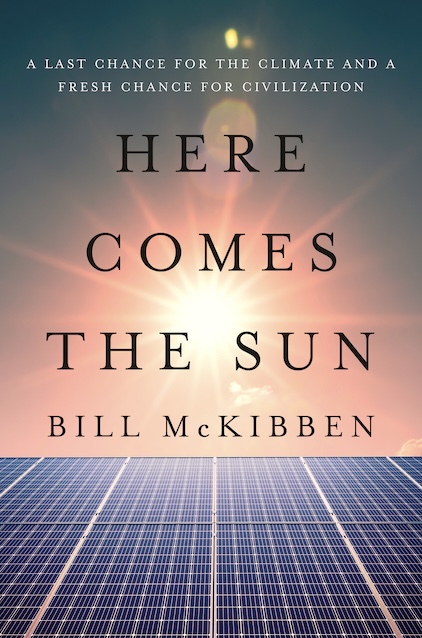
The heart of the book, however, lies in McKibben’s argument that solar is not just an energy source: it is a democratizing force. Unlike fossil fuels, which require centralized extraction, infrastructure, and political power, solar lends itself to local control. Neighborhoods, towns, and even households can become energy producers, reducing dependence on large utilities and foreign oil. In this sense, solar promises not only environmental benefits but also political and economic ones, empowering citizens and communities.
McKibben does not shy away from solar’s challenges. He acknowledges the intermittency of solar power, the need for advances in storage technology, and the political resistance from entrenched fossil fuel interests. He is also candid about the scale of transformation required: a rapid buildout of renewable infrastructure, coupled with decisive public policy and international cooperation.
Yet McKibben’s tone is more optimistic than in his earlier works, such as The End of Nature. He argues that for the first time in modern history, the tools to avert climate catastrophe are within reach—and that solar stands at the center of that opportunity.
For readers in Belmont and across Massachusetts, Here Comes the Sun is timely. Our state and our town are investing in the hope, efficiency, and cleaner power described so optimistically by McKibben.
The state has just opened the third generation of its SMART program: SMART 3.0, which has incentives for rooftop and community solar as well as battery storage. SMART stands for Solar Massachusetts Renewable Target. Working toward grid modernization, the state required Eversource, National Grid, and Unitil to create Electric Sector Modernization Plans, which are five-year roadmaps to upgrade their electric grids for reliability, resilience, and decarbonization. These were filed with the Department of Public Utilities in 2024.
In Belmont, the town demonstrated municipal leadership by completing a solar array on the Chenery Middle School gym roof at the end of 2021, the first municipal building in Belmont to go solar. Recent town-sponsored or town-facilitated steps toward expanding solar energy include funding and support for installing solar panels on the new Belmont Sports Complex, home of the Skip Viglirolo Skating Rink, with a $250,000 commitment from Belmont Light, and donations from future anchor tenants, Belmont Hill School, and Belmont Day School.
The town achieved its goal of 100% non-carbon-emitting electric supply in 2022 via a mix of renewable sources plus Renewable Energy Credits, according to Belmont Light, while keeping our rates stable and our service safe and reliable. Belmont Light’s energy goals align with those set forth in the town’s Climate Action Plan and the Belmont Roadmap for Strategic Decarbonization.
For residential and commercial solar projects, Belmont has enacted streamlined permitting for solar and EV installations under Massachusetts SB 379, enabling instantaneous plan review through a Symbium portal. The town has adopted a solar energy bylaw (Section 4.3.8) in its zoning regulations to encourage siting accessory and ground-mounted solar systems, along with design and setback standards.
Belmont residents who have already installed solar panels on their homes will find in McKibben’s book both validation and a broader context for their efforts. Those who have not may come away convinced that joining the solar movement is both a civic and environmental responsibility.
In the end, McKibben’s book is less about technology than about hope. Here Comes the Sun invites us to imagine a future in which energy is clean, affordable, and local—and to take part in building that future now.
Jeffrey North is the managing editor of the Belmont Citizens Forum Newsletter. Roger Wrubel is a member of the Belmont Energy Committee.

Sorry, the comment form is closed at this time.