
By Dave Beavers
To further explore the question, “Where does my electricity come from?” (See “Follow Belmont Electricity From Source to Socket“, BCF Newsletter, July/August 2025), this article considers what happens upstream of the Belmont Light substation at Blair Pond.
Beyond Blair Pond
Our Blair Pond substation is supplied by a transmission line from Alewife which connects Belmont to the New England grid. The Independent System Operator of New England (ISO-NE) operates the grid and administers the wholesale electricity market in New England. It is one of seven regional grid operators in the United States. Belmont Light is a stakeholder and has had a voice (albeit limited due to its small size) in supporting policies that enable the easier integration of new renewable resources.
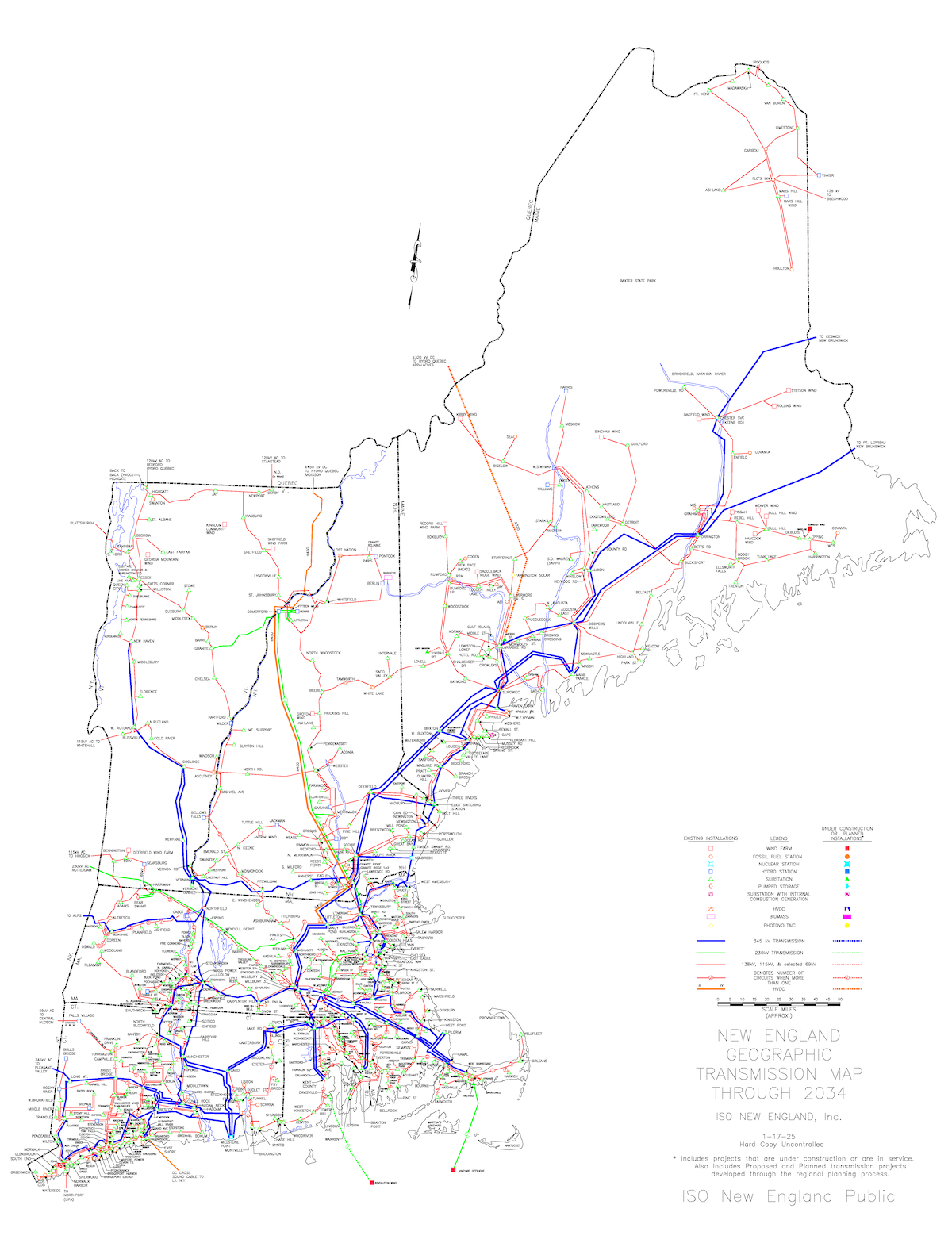
The ISO-NE Transmission map. Source: ISO-NE
The New England market
Imagine a setup where consumers draw water from a reservoir as needed and replenish the water they’ve used through contracts with wells and other sources that pump water into that reservoir. On balance, the water level stays even. Contracts may be with independent sources for 20 years or more, or with a water company that combines many sources. Some water may be purchased on a real-time market, and at the end of the month, any differences in water consumed versus water contracted for are settled.
Like this fictional water market, Belmont Light must contract for electricity or buy it on the real-time market and balance consumption against purchases over a month. Unlike larger utilities such as Eversource, Belmont Light has a wide latitude in when and how to buy electricity. To avoid price shocks to customers, Belmont Light employs a hedging policy that calls for diversified energy sources and limits real-time purchases to about 20% of the total electricity purchased. This policy has blunted the rapid rate increases that customers at other utilities have experienced.
Voluntarily, Belmont Light has been procuring Renewable Energy Certificates (RECs) to help meet the 100% fossil-free electricity goal prescribed in Belmont’s Climate Action Roadmap. Electricity generated or imported into New England’s grid is tagged with emission attributes (e.g., the amount of carbon released during electricity production). Electricity derived from qualified renewable energy resources is designated as an REC. Procuring and retiring RECs (either bundled with electricity or as a separate product) allows an organization to claim that its share of the power pool is renewable and fossil-free.
How we manage the transmission system in a physical, not market, sense is difficult to describe in a simple analogy and won’t be attempted here. The question, “Where does my electricity come from in a physical sense,” is not easy to answer.
2025 vs. 2024 Power Supply Policy Comparison |
|||
|
|
|
2024 Policy |
2025 Policy |
|
MA RPS Class 1 Renewable Portfolio Standard (RPS) Class 1 |
Mostly solar, wind, and some small hydro |
28% of the load |
27% of the load increases each year, reaching 60% in 2050 |
|
New England —Other Class 1 & 2 (Various NE state RPS laws and regulations) |
Varying definitions by state (CT, ME, NH, VT) |
In 2024, Belmont Light purchased ME Class 2 RECs (hydro) to help meet a 100% non-emitting goal |
Belmont Light may purchase RECs to achieve 100% non-emitting status (similar to 2024) or utilize the funding for other priorities, such as incentives for energy storage, heat pumps, and other initiatives |
|
Non-Emitting (GGES) Greenhouse Gas Standard |
Includes MA Class 1 RECs, other NE RECS, large hydro, nuclear, biomass, and some limited types of natural gas-based generators |
Belmont Light is required by state law to cover 50% of the load with qualified resources starting in 2030 |
|
Issues facing Belmont Light
Lack of renewable resources
Belmont Light, when possible, contracts with new renewable energy resources. These contracts are typically for 10 to 20 years and come bundled with RECs, which Belmont Light retires. Unfortunately, due to the lengthy interconnection study process, the number of new renewable energy resources available is currently not meeting the demand in New England, and this issue is unlikely to be resolved anytime soon.
For a sense of scale, the region is currently served by 28 MW of resources—largely natural-gas fueled generators—while 20 GW of offshore wind projects are in the ISO-NE interconnection queue, pending interconnection studies and authorization. Recent changes in federal policy, such as attacks on offshore wind or eliminating tax credits for solar projects, make solving this challenge even more difficult.
Rising transmission cost
Transmission is the fastest-growing cost for Belmont Light, with an expected increase of 31% in 2026 over 2024. Federal trade tariffs on copper, aluminum, and steel, implemented on July 31, 2025, could accelerate the rise in costs as these are the primary materials used in conductors, transformers, pylons, and other transmission equipment.
Charges are assessed based on Belmont Light’s load during the Greater Boston area’s peak hour each month. These peak hours largely fall between 4 and 8 PM, except during the summer months, when they may start as early as 2 PM. Moving energy use to off-peak hours can save money for Belmont Light and its customers. Advanced rate policies such as Time-Of-Use (TOU) rates and the Connected Homes Program are two efforts Belmont Light is pursuing to shift load to off-peak hours.
Generators
All but a small portion of Belmont’s electricity comes from generators tied to the New England grid. Approximately one-third is generated from a mix of hydroelectric, wind, and solar plants. The rest is a mix of the grid, primarily fueled by natural gas. From 2022 to 2024, Belmont Light’s Power Supply Policy, which follows Belmont’s Climate Action Roadmap, called for 100% coverage of Belmont’s load with New England-derived RECs. Thus, a 100% “non-emitting” power supply was achieved.
However, questions have been raised regarding the environmental benefits of this policy and whether funds could be used to reduce carbon emissions in the region more efficiently. With input from the town’s Energy Committee, Belmont Light has revised the policy to reflect this evolved thinking.
Reasons behind the changes
The idea behind the new 2025 Power Supply Policy is to provide Belmont Light flexibility in moving toward two long-term strategic goals: electrifying heating and transportation, and supplying renewable energy.
Do our share
According to some people, municipal utilities are not doing enough to utilize renewable energy. To fulfill our obligations, Belmont Light is voluntarily complying with the Massachusetts Renewable Portfolio Standard (RPS) Class 1 requirements, which are mandatory for Eversource and other large utilities. In 2025, Belmont Light will source electricity from qualified renewable sources or purchase Class 1 RECs to cover 27% of its load. The percentage increases to 40% in 2030, then to 60% in 2050. The Massachusetts Climate Action Network promotes this as a best practice for municipal utilities.
Invest strategically
Does it make sense to acquire and retire Maine Class 2 hydro RECs to reach a 100% goal? Are there more effective ways to invest funds in reducing carbon emissions and promoting electrification? These questions will be answered by Belmont Light and its commissioners this fall. Each year, opportunities may arise to make progress, and having the flexibility to direct funding toward these opportunities should ultimately benefit Belmont Light in the long term.
The Greenhouse Gas Emission standard
Under state law, Belmont will be required to cover 50% of its load with resources identified in the Greenhouse Gas Emission Standard (GGES). As the GGES has a broad definition of what qualifies as a resource, Belmont Light expects to meet and exceed this requirement easily.
Dave Beavers is an elected member and the vice chair of the Belmont Light Board and a Belmont resident.

Sorry, the comment form is closed at this time.